Duke University Press Journals


  The Collected Letters of Thomas and Jane Welsh Carlyle

Duke University Press launches the Carlyle Letters Online on HighWire Press, available at no charge to institutions

Duke University Press announces the launch at carlyleletters.org of the Carlyle Letters Online: A Victorian Cultural Reference, the electronic edition of The Collected Letters of Thomas and Jane Welsh Carlyle. In part because of grants from the National Endowment for the Humanities and the Delmas Foundation, the Carlyle Letters Online is currently available at no charge to institutions and individuals.

Leveraging HighWire’s award-winning online hosting platform and suite of features, the collection offers users an unprecedented level of functionality and personalization.

For more information, please visit carlyleletters.org or download the full press release.


The Collected Letters of Thomas and Jane Welsh Carlyle
offer a window onto the lives of two of the Victorian world’s most accomplished, perceptive, and unusual inhabitants. Scottish writer and historian Thomas Carlyle and his wife, Jane Welsh Carlyle, attracted to them a circle of foreign exiles, radicals, feminists, revolutionaries, and major and minor writers from across Europe and the United States. The collection is regarded as one of the finest and most comprehensive literary archives of the nineteenth century.

Correspondents include

Lord Ashburton
Robert Browning
Charles Butler
Julia Margaret Cameron
Erasmus Darwin
Charles Dickens
George Eliot
Ralph Waldo Emerson
John Forster
Elizabeth Gaskell
Anne and Alexander Gilchrist
Johann Wolfgang von Goethe
Geraldine Jewsbury
John Stuart Mill
John Ruskin
Alfred Tennyson
William M. Thackeray
Ivan Turgenev

Recent and Forthcoming Issues

Volume 34 of The Collected Letters of Thomas and Jane Welsh Carlyle covers the second half of 1858. Not unusually, the Carlyles were apart, writing to, and obsessively demanding letters from, each other. In July, Thomas was on holiday at his brother-in-law’s farm the Gill, in Scotland, while Jane remained in Chelsea, training the new house-servant, Charlotte Southam. Jane soon trusted her implicitly and, given a new sense of freedom from the domestic responsibilities of Cheyne Row, began to make rather frequent day trips to Brighton, Portsmouth, and Alverstoke. On 21 August, Thomas set sail from Edinburgh for Germany to visit battlegrounds and other sites associated with the career of Frederick the Great, eager to finish the third volume of the biography. With Thomas on the continent, Jane visited Scotland and made the rounds of kith and kin until the end of September. This volume is a comedy of nervous travel adventure: a lost and found passport, a lost and found ring, the “greasy tepid cooking” and “praeternatural beds” of Germany, and the usual Carlyle physical and mental maladies. From a newly found cache of letters to the Wall Street broker Charles Butler, we find that Thomas, never one to miss an opportunity to lambaste the Americans and “Yankeedom,” in fact held significant investments in American railroads.

At the opening of volume 33, which covers letters written between August 1857 and June 1858, Jane Welsh Carlyle is in Scotland visiting relatives and Thomas Carlyle is at home in Chelsea, working daily under an awning in the backyard and struggling with the proofs of the first two volumes of History of Frederick the Great as well as with research for future volumes. Thomas was disturbed both by the Panic of 1857 and by news of the Indian Mutiny and the behavior of British troops in that part of the empire. He was fiercely critical of the politicians and civil servants who trumpeted the merits of “progress,” “democracy,” and “civilization” while governing India with often brutal and repressive policies. Meanwhile, Jane was reading an early work by a new writer named George Eliot, to whom she wrote a fan letter that began “Dear Sir,” unaware that Eliot was in fact Mary Ann Evans, whom they had entertained in their home. In May, Thomas observed a gang of navvies, or day laborers, with picks and shovels, digging a foundation and uncovering ancient, gigantic bones. At the suggestion of paleontologist Richard Owen, the bones of the extinct Pliocene mammals-including a whale-were sold to a dealer to be ground into powder. During the same month, the separation of Charles Dickens and his wife, the former Catherine Hogarth, was the subject of many a conversation.

Volume 32 covers the period from October 1856 to July 1857. During this time, Jane is beset with a succession of illnesses, while Thomas prepares the first two books of his massive History of Frederick the Great for publication and labors on his publisher’s proposed new “cheap” edition of his works. The “Indian mutiny,” the bombardment of Canton, and a dissolution of the British Parliament also feature in this volume. In addition to its 168 richly annotated letters, many published here for the first time, volume 32 includes two appendixes: (1) advertisements in the Athenaeum for the “cheap edition” from December 1856 to December 1858 and (2) a transcription of Thomas Carlyle’s marginal comments on a borrowed copy of Elizabeth Barrett Browning’s Aurora Leigh.

In volume 31, which covers the year 1856, the Carlyles continue a rigorous correspondence, depicting and examining Victorian London as well as its inhabitants. They also return to their native Scotland and offer details of their travels in the Scottish Lowlands and Highlands.

Volume 30 illuminates Jane’s inner life with the help of two previously unpublished documents: her complete journals from the years 1845-1852 and 1855-1856 and an interview conducted by her friend Ellen Twiselton that chronicles a painful period in the Carlyle marriage. Also included here is Jane’s story, "The Simple Story of My Own First Love," and discussions of her complicated relations with feminists, whom she admired yet distrusted. Meanwhile, Thomas is mired in his remarkable study of Frederick the Great, a figure he reveres as an exemplar of “veracity” in a shallow age--an image of Carlyle himself.

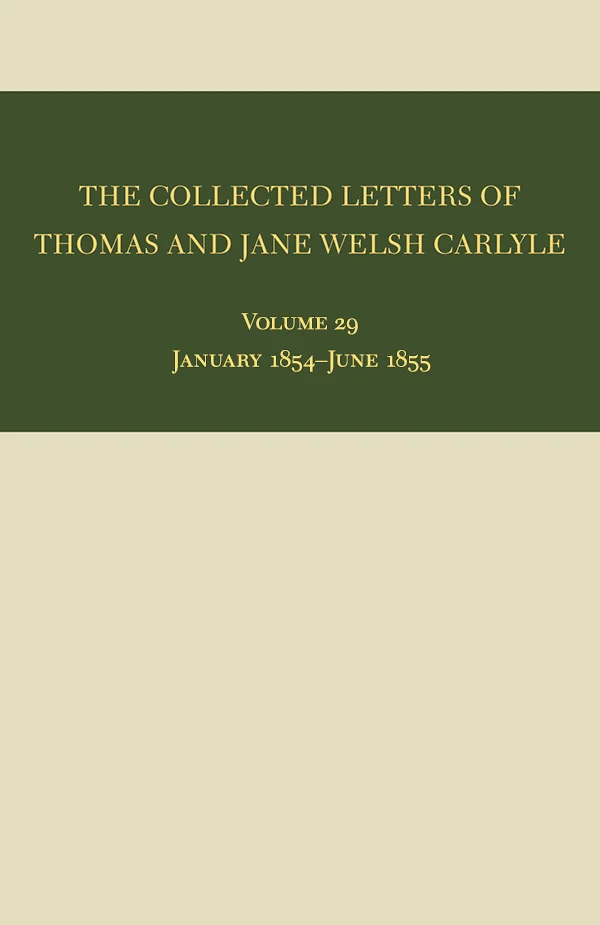
Volume 29 resumes themes begun in earlier letters: Thomas's flirtatious exchanges with Lady Ashburton, the recent death of his mother, the improvement of his soundproof room, and his struggle to pursue his research for Frederick the Great. Other notable items include Dickens's dedication of Hard Times to Thomas and Thomas's support of G. H. Lewes during the scandal over Lewes's affair with George Eliot. The highlight of the volume is a passionate and humorous letter by Jane, subtitled "Budget of a Femme Incomprise," in which she defends the rising cost of running their house.


Indexed/abstracted in the following: Intute.

Related links:


Frequency: Annual

    Editors
Submission guidelines
Request exam copy
Advertising rates
Journals in bookstores

Subscribe:
$60  institutions (print only)
$30  individuals
$0  
$0  
$0  
$0  
$0  
$0  
$0  

Quantity:
*A photocopy of student ID must be faxed to +1 919-688-2615 to secure the student subscription rate (if student rate is available)
.


    © 2007 Duke University Press        
             
Duke University Press homepage Journals About us View items in your shopping bag Search for journals and books Sign up to receive e-mail updates! Home How to order/subscribe Contact us Announcements and news For booksellers and media Special features Books