
Home / Books / A Year at the Supreme Court

A Year at the Supreme Court
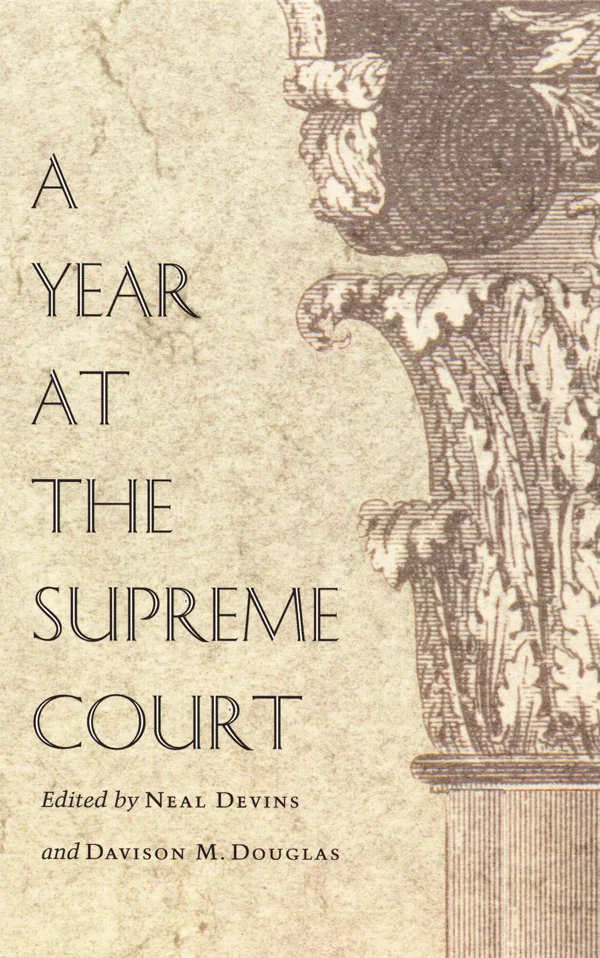
A Year at the Supreme Court cover image

Constitutional Conflicts

More about this series

Book

Pages: 256

Published: October 2004

The United States Supreme Court’s 2002–03 term confounded Court watchers. The same Rehnquist Court that many had seen as solidly conservative and unduly activist—the Court that helped decide the 2000 presidential election and struck down thirty-one federal statutes since 1995—issued a set of surprising, watershed rulings. In a term filled with important and unpredictable decisions, it upheld affirmative action, invalidated a same-sex sodomy statute, and reversed a death sentence due to ineffective assistance of counsel. With essays focused on individual Justices, Court practices, and some of last year’s most important rulings, this volume explores the meaning and significance of the Court’s 2002–03 term. Seasoned Supreme Court advocates and journalists from The New Republic, The Los Angeles Times, Newsweek, National Journal, Slate, and Legal Times grapple with questions about the Rehnquist Court’s identity and the Supreme Court’s role in the political life of the country.

Some essays consider the role of “swing” Justices Sandra Day O’Connor and Anthony Kennedy within a Court that divides 5–4 more than any other group of Justices in the nation’s history. Others examine the political reaction to and legal context of the Court’s Lawrence v. Texas decision declaring a Texas law criminalizing homosexual sodomy unconstitutional. Contributors analyze the Court’s rulings on affirmative action and reassess its commitment to states’ rights. Considering the Court’s practices, one advocate explores the use and utility of amicus curiae, or “friend of the court” briefs, while another reflects on indications of an increased openness by the Court to public scrutiny. Two advocates who argued cases before the Court—one related to hate speech and the other to a “three strikes and you’re out” criminal statute—offer vivid accounts of their experiences. Intended for general readers, A Year at the Supreme Court is for all those who want to understand the Rehnquist Court and its momentous 2002–03 term.

Contributors
Erwin Chemerinsky
Neal Devins
Davison M. Douglas
David J. Garrow
Dahlia Lithwick
Tony Mauro
Carter Phillips
Ramesh Ponnuru
Jeffrey Rosen
David G. Savage
Rodney A. Smolla
Stuart Taylor Jr.

Praise

"A Year at the Supreme Court raises some thought-provoking questions about some of the court's decisions during the 2002-03 term. . . ." - Aitan Goelman , The Weekly Standard

"[T]he book does this job well. It makes a valuable contribution to the public's understanding of the Supreme Court."
- Andrew J. Morris , Legal Times

"The editors, who provide useful introductions to each chapter, should be applauded for adding this splendid volume to Duke's 'Constitutional Conflicts' series. Highly recommended." - P. Watkins , Choice

“‘The quiet of a storm center,’ Justice Oliver Wendell Holmes Jr. said of the Supreme Court. The storm—the drama—has never been more intense than in the 2002–03 term. Here the decisions of that term are brilliantly, provocatively described and analyzed.” - Anthony Lewis, author of Gideon’s Trumpet and Make No Law

“A close and revealing look by journalists and advocates on the operations of the Supreme Court. This book captures the powerful political pressures that constantly play against the Justices and help determine their decisions.” - Louis Fisher, author of American Constitutional Law

Buy

Availability: Loading...

Price: Loading...

Request a desk or exam copy

Information

Author/Editor Bios

Back to Top

Neal Devins is Goodrich Professor of Law and Director of the Institute of Bill of Rights Law at the William and Mary School of Law. He is also Professor of Government at the College of William and Mary. His most recent books include The Democratic Constitution and Political Dynamics of Constitutional Law (4th edition), both coauthored with Louis Fisher.

Davison M. Douglas is the Arthur B. Hanson Professor of Law at the William and Mary School of Law, where he is former Director of the Institute of Bill of Rights Law. He is the author of Reading, Writing, and Race: The Desegregation of the Charlotte Schools.

Table Of Contents

Back to Top
Acknowledgments  vii
The Justices of the Supreme Court of the United States, 2002-03  ix
Introduction / Neil Devins and Davison M. Douglas  1
1. A High Court of One: The Role of the “Swing Voter” in the 2002 Term / Dahlia Lithwick  11
2. Anthony M. Kennedy and the Road Not Taken / David D. Savage  33
3. A Revolutionary Year: Judicial Assertiveness and Gay Rights / David J. Garrow  55
4. The Next Culture War / Jeffery Rosen  71
5. The Affirmative Action Decisions / Stuart Taylor, Jr.  87
6. Was Affirmative Action Saved by Its Friends? / Carter G. Phillips  113
7. The Court’s Faux Federalism / Ramesh Ponnuru  131
8. Cross Burning: Virginia v. Black / Rod Smolla  151
9. Cruel and Unusual: Lockyer v. Andrade / Erwin Chemerinskiy  175
10. Glasnost at the Supreme Court / Tony Mauro  191
Notes  209
Table of Cases  229
Index  233
Notes on the Contributors  241

Rights

Back to Top

Sales/Territorial Rights: World

Rights and licensing

Additional Information

Back to Top
Paper ISBN: 978-0-8223-3448-4 / Hardcover ISBN: 978-0-8223-3437-8 / eISBN: 978-0-8223-8595-0 / DOI: https://doi.org/10.1215/9780822385950

Publicity material