
Home / Books / Acoustic Colonialism

Acoustic Colonialism

Acts of Mapuche Interference
Book

Pages: 288

Illustrations: 11 illustrations

Published: October 2025

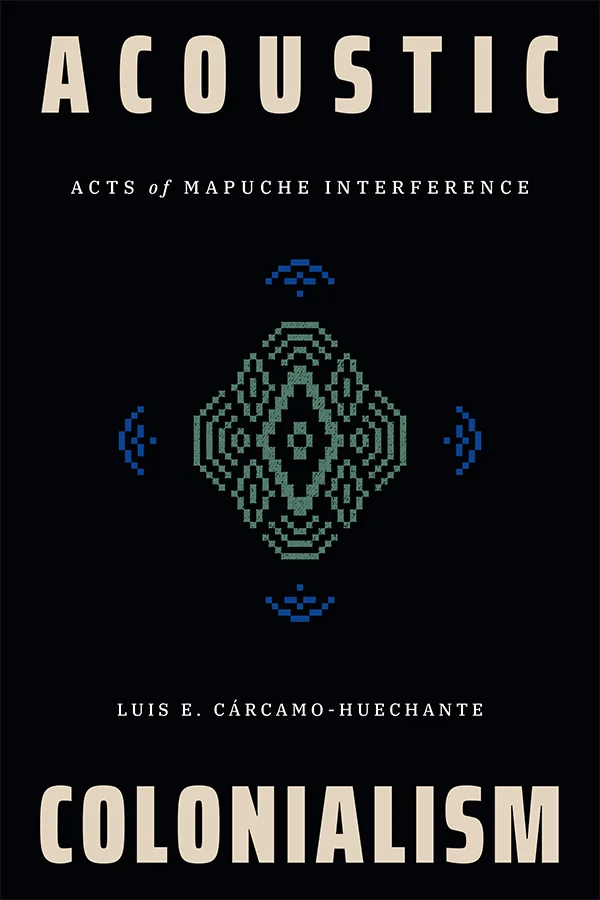
In Acoustic Colonialism, Luis E. Cárcamo-Huechante examines the role of sound in Chilean and Mapuche cultural production over the last two centuries. Cárcamo-Huechante theorizes sound as a territory of racial, patriarchal, and colonial hegemony as well as of Mapuche struggle, agency, and response to what he calls "acoustic colonialism." From the mid-nineteenth century to the present, Chilean literature, radio, and other media have exerted a historic role in disseminating distorted visual and sonic representations of the Mapuche. The enduring effects of what Cárcamo-Huechante defines as the colonial ear—the entry point for these misrepresentations—reflect the logic of the Chilean settler nation-state. In response to these aural and sonorous figurations, contemporary Mapuche writers, artists, and activists have produced their own literary, radiophonic, vocal, and musical expressions. The voices, sounds, and discourses of these Mapuche productions contest and disrupt the acoustic colonialism that has dominated the soundscape of the territory designated in present-day cartography as central and southern Chile. 

Praise

“Luis E. Cárcamo-Huechante provides a radical critique of how to study indigeneity and sound, and their relation to literary and media history. With an approach that draws on Native American and Indigenous scholars from the North and South, he demonstrates the need to consider Indigenous scholarship as central to the interpretation of sound and voices in a settler colonial context while offering transformational readings of the Mapuche literary and media cultures Acoustic Colonialism is a crucial book.” - Ana María Ochoa Gautier, author of Aurality: Listening and Knowledge in Nineteenth-Century Colombia

“In this stunning book Cárcamo-Huechante makes audible the complex waves of centuries-long colonialisms affecting Mapuche Peoples and places and the consequent rise of Indigenous movements for autonomy across the sounded territories of poetry, radio, and music. By centering the rich particularities of Mapuche Peoples and the concept of allkütun (to listen attentively), Acoustic Colonialism offers capacious accounts of sonic forms of resurgence that resonate with Indigenous Peoples elsewhere working towards liberation.”

- Jessica Bissett Perea, author of Sound Relations: Native Ways of Doing Music History in Alaska

Buy

Availability: Loading...

Price: Loading...

Request a desk or exam copy

Information

Author/Editor Bios

Back to Top
Luis E. Cárcamo-Huechante belongs to the Mapuche People. He is a founding member of the Comunidad de Historia Mapuche and Associate Professor of Spanish at the University of Texas at Austin.

Table Of Contents

Back to Top
Author’s Note  ix
Mañumtun/Acknowledgments  xiii
Introduction  1
1. Disfiguring and Silencing of the Mapuche in the 1860s  34
2. Indio Pije: A “Mapuche” in the Mediascape  67
3. Listening Poetically: A Land That Resounds and Sings  94
4. Wixage Anai: Mapuche Voices on the Air  130
5. Enduring Listening and Sounds: The Contemporary Musics of Ngulu Mapu  168
Coda  211
Notes  219
References 245
Index  261

Rights

Back to Top

Sales/Territorial Rights: World

Rights and licensing

Additional Information

Back to Top
Paper ISBN: 978-1-4780-3263-2 / Hardcover ISBN: 978-1-4780-2929-8 / eISBN: 978-1-4780-6153-3 / DOI: https://doi.org/10.1215/9781478061533