
Home / Books / Architecture of Migration

Architecture of Migration

The Dadaab Refugee Camps and Humanitarian Settlement
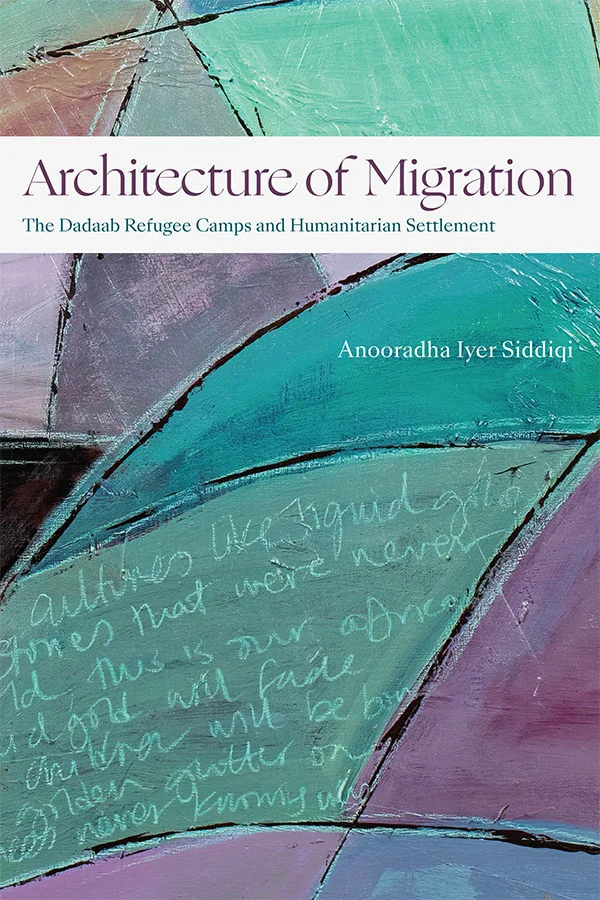
Book

Pages: 432

Illustrations: 107 color illustrations

Published: December 2023

Environments associated with migration are often seen as provisional, lacking both history and architecture. As Anooradha Iyer Siddiqi demonstrates in Architecture of Migration, a refugee camp’s aesthetic and material landscapes—even if born out of emergency—reveal histories, futures, politics, and rhetorics. She identifies forces of colonial and humanitarian settlement, tracing spatial and racial politics in the Dadaab refugee camps established in 1991 on the Kenya-Somalia border—at once a dense setting that manifests decades of architectural, planning, and design initiatives and a much older constructed environment that reflects its own ways of knowing. She moves beyond ahistorical representations of camps and their inhabitants by constructing a material and visual archive of Dadaab, finding long migratory traditions in the architecture, spatial practices, landscapes, and iconography of refugees and humanitarians. Countering conceptualizations of refugee camps as sites of border transgression, criminality, and placelessness, Siddiqi instead theorizes them as complex settlements, ecologies, and material archives created through histories of partition, sedentarization, domesticity, and migration.

Praise

“This beautifully written and brilliantly original work elucidates a seemingly irresolvable tension, central to the condition of migrants, between the transience of the refugee category and how refugees’ lives are anchored in hard infrastructures and histories. By tracing the entanglement of aesthetics and politics in the Dadaab refugee camp, Anooradha Iyer Siddiqi ties migration to encampment in a visceral and material way.” - Miriam Ticktin, author of Casualties of Care: Immigration and the Politics of Humanitarianism in France

Architecture of Migration deftly deconstructs humanitarian discourses in architecture, planning, and global crisis management. Its compelling ethnographic research with camp residents and aid workers shares lived experiences within these built-to-be-temporary camps of tents and tarps that have become permanent sprawling urban settlements. Anooradha Iyer Siddiqi’s insightful histories share spatial narratives of lives caught in the wake of colonialism and political, economic, and environmental upheaval. Siddiqi produces an unparalleled study of how neoliberal policies strategically and violently underdevelop spaces for the world’s most vulnerable people.” - Mabel O. Wilson, Professor of Architecture and Professor of Black Studies, Columbia University

"[A]s this rich, multilayered and slow study makes clear, there is much more than decolonial theory to draw on as we think and rethink camps at this most unsettling moment. The book’s great and original contribution is to make many openings into these carceral spaces that have been kept outside of the boundaries of architectural history." - Hannah le Roux, Architectural Theory Review

"[T]his book is recommended for those interested in or studying migration from the spatial point of view." - Maria Gabriella Trovato, International Migration

"Attentive to the incommensurabilities and structural differences between herself and refugees, Siddiqi engages in a feminist—and queer, I would add—praxis that is collaborative, affirmative, and, perhaps, reparative. . . . In Siddiqi’s words, 'it is a call for peace' (42), a work of scholarship that has the strength to transform the imaginations of spatial practitioners so that they can move from reforming humanitarian encampments to fighting for a land that, in the end, cannot be riven." - Theodossis Issaias, Journal of the Society of Architectural Historians

"Architecture of Migration adds something radically new and deeply humanizing to [the] literature. Siddiqi brings a stunning range of theory to bear on Dadaab’s history, helping us think capaciously about spatial divisions, migratory lives, and the domestic arts that knit together the places where such practices meet." - Emily Brownell, Technology and Culture

"With its insightful analysis and thought-provoking inquiries, [Architecture of Migration] will undoubtedly leave a lasting impression on anyone seeking to broaden their understanding of humanitarian environments and the agency of displaced communities. It’s a captivating and enlightening read that offers a fresh perspective on the intersection of architecture, history, and humanitarianism." - Nerea Amoros Elorduy, Anthropos

"[T]he book teems with creative energy and represents an utterly original intervention indispensable for anyone with an interest in camp studies."

- Hanno Brankamp, Journal of Modern African Studies

Buy

Availability: Loading...

Price: Loading...

Buy the e-book:

Open Access

Request a desk or exam copy

Information

Author/Editor Bios

Back to Top
Anooradha Iyer Siddiqi is Assistant Professor of Architecture at Barnard College, Columbia University, and coeditor of Feminist Architectural Histories of Migration and Spatial Violence.

Table Of Contents

Back to Top
Abbreviations  xiii
Author’s Note  xv
Introduction. Architecture and History in a Refugee Camp  1
1. From Partitions  51
2. Land, Emergency, and Sedentarization in East Africa  99
3. Shelter and Domesticity  141
4. An Archive of Humanitarian Settlement  181
5. Design as Infrastructure  249
Afterword. “Poetry Is a Weapon That We Use in Both War and Peace”  305
Acknowledgments  321
Notes  329
Primary Sources  363
References  371
Index  397

Rights

Back to Top

Sales/Territorial Rights: World

Rights and licensing

Awards

Back to Top

Honorable Mention, 2025 African Studies Association Best Book Prize

Winner of the 2026 Alice Davis Hitchcock Award, presented by the Society of Architectural Historians

Additional Information

Back to Top
Paper ISBN: 978-1-4780-2524-5 / Hardcover ISBN: 978-1-4780-2038-7 / eISBN: 978-1-4780-2737-9 / DOI: https://doi.org/10.1215/9781478027379