
Home / Books / At Penpoint

At Penpoint

African Literatures, Postcolonial Studies, and the Cold War
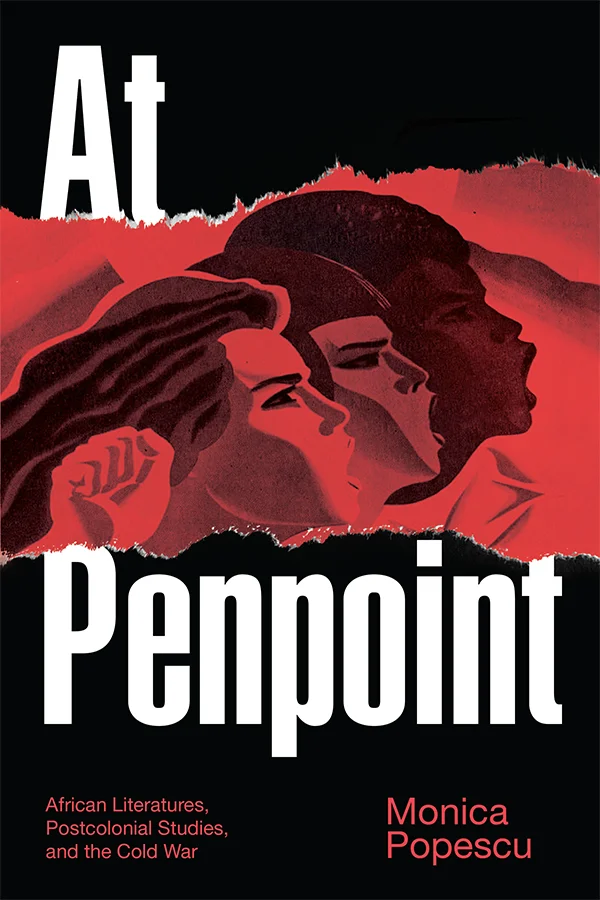
Book

Pages: 272

Illustrations: 12 illustrations

Published: September 2020

Author: Monica Popescu

In At Penpoint Monica Popescu traces the development of African literature during the second half of the twentieth century to address the intertwined effects of the Cold War and decolonization on literary history. Popescu draws on archival materials from the Soviet-sponsored Afro-Asian Writers Association and the CIA-funded Congress for Cultural Freedom alongside considerations of canonical literary works by Ayi Kwei Armah, Ngugi wa Thiong'o, Ousmane Sembène, Pepetela, Nadine Gordimer, and others. She outlines how the tensions between the United States and the Soviet Union played out in the aesthetic and political debates among African writers and intellectuals. These writers decolonized aesthetic canons even as superpowers attempted to shape African cultural production in ways that would advance their ideological and geopolitical goals. Placing African literature at the crossroads of postcolonial theory and studies of the Cold War, Popescu provides a new reassessment of African literature, aesthetics, and knowledge production.

Praise

“African nations regained their independence from Western colonialism against the background of the Cold War. Monica Popescu's book is a comprehensive study of the impact of the war on the culture, literature, and intellectual production of the postcolonial world. It is a great addition to the body of scholarship on African literature and postcolonial studies.” - Ngugi wa Thiong’o, Distinguished Professor of English and Comparative Literature, University of California, Irvine

“This ingenious account offers sharp new insight to the history of African Literary Studies and decolonization by framing them in light of the Cold War, not just in terms of subjection by the West, as stressed by postcolonial perspectives, but also by the colonial outreach of the USSR. As Monica Popescu makes stunningly clear, African and Afro-Caribbean writers of the period—Aimé Césaire, Youssef El-Sebai, and Ezekiel Mphahlele—brought to our understanding of twentieth-century imperialism a comprehensiveness unrivaled before or since.” - Jean Comaroff, Alfred North Whitehead Professor of African and African American studies and of Anthropology, Harvard University

“Popescu’s book is a steadfast engagement with the cultural Cold War’s impact on African literary studies.... At Penpoint...shows how a range of cross-disciplinary and hybrid methodologies are required if we are to build and establish this scholarship.” - Bhakti Shringarpure, Johannesburg Review of Books

"At Penpoint speaks to a variety of disciplines and historiographies. . . . Popescu writes in accessible language that will make graduates and undergrads appreciate and trace the transnational networks involving African writers, diasporic African intellectuals, and various Cold War actors and the impact they had on Africa, especially in the area of African literature." - Emmanuella Amoh, E3W Review of Books

"Through supple readings and reflections on disciplinary developments, the book underscores the centrality of a dual lens methodology not only for African but also for wider Global South contexts. Doing so, it makes a strong case for attending to and widening the circle of scholarship which takes this approach." - Kerry Bystrom & Carolyn Ownbey, Global South Studies

"Popescu’s work provides a way to theorize minority resistance in Niger Delta poetry. In her claim for the agency of African writers in the context of the Cold War, Popescu provides the foundation to think of Niger Delta poetry using a Cold War lens." - Mathias Iroro Orhero, Global South Studies

"At Penpoint brilliantly diagnoses the fragmentation of postcolonial studies and Cold War studies, showing how the former has often only attended to neocolonial relations of the Third World to the West ,and ignored 'the competition between Western and Eastern Bloc forms of imperialism.'" - Jini Kim Watson, Global South Studies

". . . At Penpoint is an engrossing and provocative book that illuminates an important archive and challenges humanities scholars of all midcentury regions to reconfigure their fields." - Laura Chrisman, Modern Language Quarterly

"Popescu’s biggest contribution here is historiographical: not only does she historicize African literary production during the Cold War, she also reveals the lasting effects of the Cold War on today’s intellectual concepts and commitments. . . . By rehabilitating the idea of the writer as engaged, even committed, At Penpoint reveals a scholar undertaking not only study of the era of decolonization, but also the slow process of decolonizing literary study itself by wresting the Cold War away from the superpowers who waged it." - Emily Hyde, Contemporary Literature

"At Penpoint accomplishes what the best scholarship does by illuminating what has been right before our eyes but obscured by our own blinders, ideological or otherwise. Her account resituates Africa at the center of postcolonial studies and reveals the Cold War to be, among other things, a struggle of competing imperialisms." - Cedric Tolliver, The Journal of African History

Buy

Availability: Loading...

Price: Loading...

Request a desk or exam copy

Information

Author/Editor Bios

Back to Top
Monica Popescu is Associate Professor and William Dawson Scholar of African Literatures in the Department of English at McGill University. She is the author of South African Literature beyond the Cold War and The Politics of Violence in Post-communist Films.

Table Of Contents

Back to Top
Acknowledgments
Introduction. Genres of Cold War Theory: Postcolonial Studies and African Literary Criticism
Part I. African Literary History and the Cold War
1. Pens and Guns: Literary Autonomy, Artistic Commitment, and Secret Sponsorships
2. Aesthetic World-Systems: Mythologies of Modernism and Realism
Part II. Reading through a Cold War Lens
3. Creating Futures, Producing Theory: Strike, Revolution, and the Morning After
4. The Hot Cold War: Rethinking the Global Conflict through Southern Africa
Conclusion. From Postcolonial to World Literature Studies: The Continued Relevance of the Cold War
Notes
Bibliography
Index

Rights

Back to Top

Sales/Territorial Rights: World

Rights and licensing

Awards

Back to Top

A 2021 CHOICE Magazine Outstanding Academic Title

Honorable Mention, 2021 Scaglione Prize for Comparative Literary Studies, presented by the Modern Language Association

Co-Winner, 2022 African Literature Association Book of the Year

Additional Information

Back to Top
Related Links Paper ISBN: 978-1-4780-0940-5 / Hardcover ISBN: 978-1-4780-0851-4 / eISBN: 978-1-4780-1215-3 / DOI: https://doi.org/10.1215/9781478012153