
Home / Books / Black Girl Autopoetics

Black Girl Autopoetics

Agency in Everyday Digital Practice
Book

Pages: 176

Illustrations: 16 page color insert

Published: February 2024

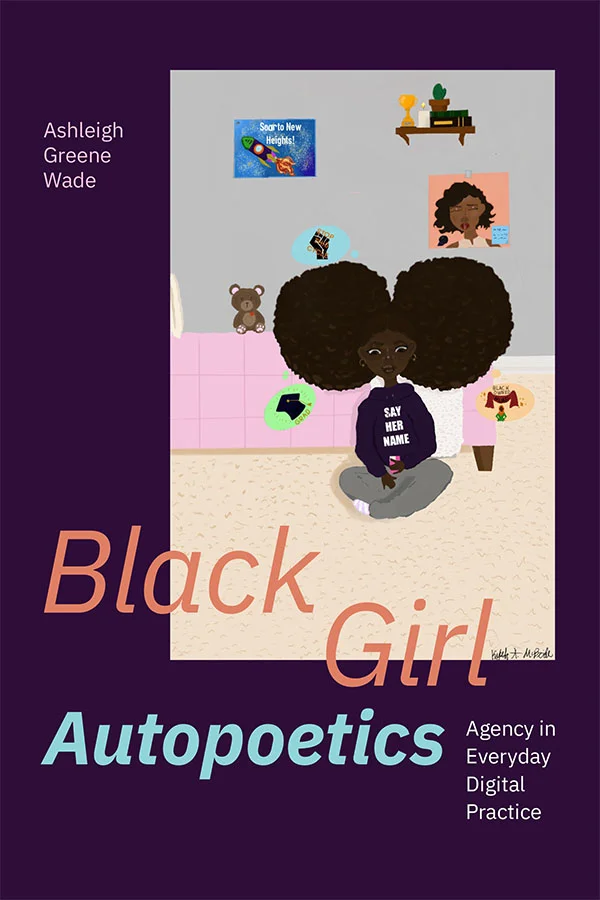
In Black Girl Autopoetics Ashleigh Greene Wade explores how Black girls create representations of themselves in digital culture with the speed and flexibility enabled by smartphones. She analyzes the double bind Black girls face when creating content online: on one hand, their online activity makes them hypervisible, putting them at risk for cyberbullying, harassment, and other forms of violence; on the other hand, Black girls are rarely given credit for their digital inventiveness, rendering them invisible. Wade maps Black girls’ everyday digital practices, showing what their digital content reveals about their everyday experiences and how their digital production contributes to a broader archive of Black life. She coins the term Black girl autopoetics to describe how Black girls’ self-making creatively reinvents cultural products, spaces, and discourse in digital space. Using ethnographic research into the digital cultural production of adolescent Black girls throughout the United States, Wade draws a complex picture of how Black girls navigate contemporary reality, urging us to listen to Black girls’ experience and learn from their techniques of survival.

Praise

“With Black Girl Autopoetics Ashleigh Greene Wade gives us a mechanism to witness the creativity embedded in Black girls’ survival strategies and digital social lives. She brilliantly readjusts our framework to focus on Black girlhood as a site of digital exploration, innovation, and creativity. Black girls teach us how to play with the digital through an interrogation of visibility, spatiality, activism, and self-presentation. This is a must-read for anyone invested in reimagining our digital future.” - Catherine Knight Steele, author of Digital Black Feminism

Black Girl Autopoetics is incredibly important for Black girlhood studies; it will be the go-to book on Black girls’ digital expression. As Ashleigh Greene Wade points out, the dominant paradigm of Black girls’ use of digital media is too often enveloped in panic and mania. Here, she helps us understand how Black girls use media to navigate structures of oppression as they engage their imaginations. Black Girl Autopoetics will help create more life-affirming possibilities for Black girls to be in and move through the world with full access to their creative energies.” - Ruth Nicole Brown, author of Hear Our Truths: The Creative Potential of Black Girlhood

"Ashleigh Greene Wade . . . writes a fascinating book examining the intersection of Black girlhood and digital arts. She argues that Black girls who express themselves creatively in the digital sphere are exposed to the trauma of cyberbullying and harassment as they become hyper-visible, yet at the same time, seldom receive credit for their digital intellectual property and are rendered invisible." - Jordannah Elizabeth, New York Amsterdam News

Buy

Availability: Loading...

Price: Loading...

Request a desk or exam copy

Information

Author/Editor Bios

Back to Top
Ashleigh Greene Wade is Assistant Professor of Media Studies and African American Studies at the University of Virginia.

Table Of Contents

Back to Top
Acknowledgments  ix
Introduction: Defining Black Girl Autopoetics  1
Interlude: On Developing Digital Ethics for/with Black Girls  19
1. Places to Be: Black Girls Mapping, Navigating, and Creating Spaces through Digital Practice  29
2. “You Gotta Show Your Life”: Reading the Digital Archives of Everyday Black Girlhood  61
3. “I Love Posting Pictures of Myself”: Hypervisibility as a Politics of Refusal  84
4. Making Time: Black Girls’ Digital Activism as Temporal Reclamation  105
Conclusion: What Does Black Girl Autopoetics Make Possible?  127
Notes  133
Bibliography  147
Index  157

Rights

Back to Top

Sales/Territorial Rights: World

Rights and licensing

Awards

Back to Top

DUP First Book Fund Recipient

Additional Information

Back to Top
Related Links Paper ISBN: 978-1-4780-2560-3 / Hardcover ISBN: 978-1-4780-2085-1 / eISBN: 978-1-4780-2773-7 / DOI: https://doi.org/10.1215/9781478027737