
Home / Books / Cachita′s Streets

Cachita′s Streets

The Virgin of Charity, Race, and Revolution in Cuba
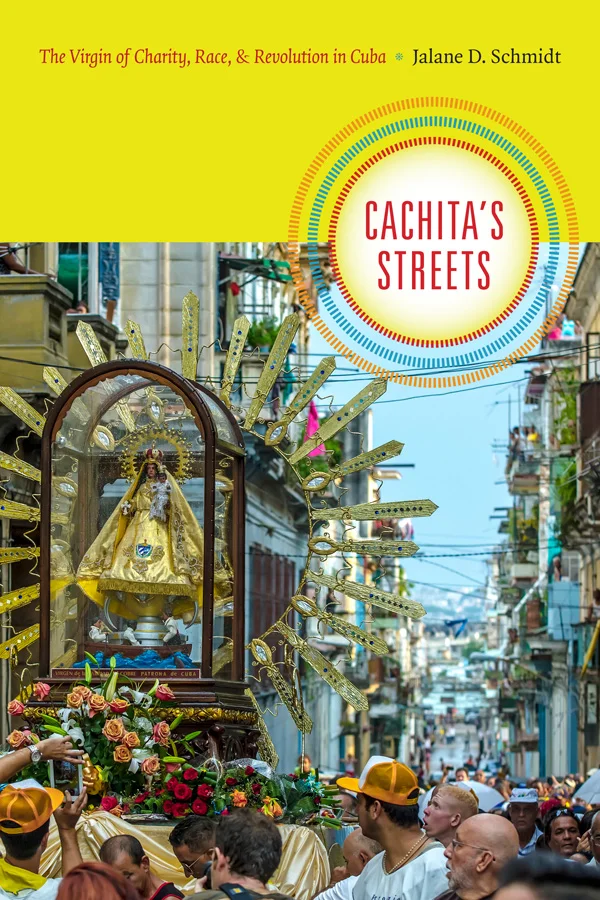
Cachita′s Streets cover image

Religious Cultures of African and African Diaspora People

More about this series

Book

Pages: 376

Illustrations: 27 illustrations

Published: August 2015

Cuba’s patron saint, the Virgin of Charity of El Cobre, also called Cachita, is a potent symbol of Cuban national identity. Jalane D. Schmidt shows how groups as diverse as Indians and African slaves, Spanish colonial officials, Cuban independence soldiers, Catholic authorities and laypeople, intellectuals, journalists and artists, practitioners of spiritism and Santería, activists, politicians, and revolutionaries each have constructed and disputed the meanings of the Virgin. Schmidt examines the occasions from 1936 to 2012 when the Virgin's beloved, original brown-skinned effigy was removed from her national shrine in the majority black- and mixed-race mountaintop village of El Cobre and brought into Cuba's cities. There, devotees venerated and followed Cachita's image through urban streets, amassing at large-scale public ceremonies in her honor that promoted competing claims about Cuban religion, race, and political ideology. Schmidt compares these religious rituals to other contemporaneous Cuban street events, including carnival, protests, and revolutionary rallies, where organizers stage performances of contested definitions of Cubanness. Schmidt provides a comprehensive treatment of Cuban religions, history, and culture, interpreted through the prism of Cachita.

Praise

"Cachita's Streets is a powerful and sweeping story, as the Virgin and her devotees make their persistent and steady progress through many decades of tumultuous historic political events. There is no scholar of religion who knows more about the history of Cuba, and there is no historian of the Caribbean who knows as much about religion, as Jalane D. Schmidt. Cachita's Streets will certainly become one of the definitive books on race and religion in Cuba and Latin America."
- Jennifer Scheper Hughes, author of Biography of a Mexican Crucifix: Lived Religion and Local Faith from the Conquest to the Present

"The Virgin of Charity, as Jalane D. Schmidt tells her story in this ambitious and beautifully realized book, is not a symbol indexing the political history of Cuba, but a living presence in the island's streets and homes. Based on the deepest historical research and on long ethnographic study, Cachita’s Streets is a masterful study of the social life of sacred presence."
- Robert A. Orsi, author of Between Heaven and Earth: The Religious Worlds People Make and the Scholars Who Study Them

"[W]hat makes Cachita's Streets special is the attention the author gives to the many different contexts within which the Virgin has been venerated, supplicated, politicized, and racialized over the centuries—Cuba's  tumultuous 20th century in particular.  Providing a careful study of all the facets of the Virgin’s role in Cuban life, Schmidt documents the multidimensional and contested Cachita of the streets, not merely the Virgin of the shrine in El Cobre.  The result is an exemplary socioreligious history." - D. Jacobsen, Choice

"The book is carefully researched and is a special contribution to the study of religion, particularly in the Oriente (Eastern region of Cuba)....Schmidt’s work represents a unique approach to the study of religion in Cuba and uses rich archival research to follow worship of La Virgen de la Caridad throughout the island’s history." - Danielle Pilar Clealand, Ethnic and Racial Studies

"Cachita’s Streets is deeply researched and skillfully crafted." - Reinaldo L. Román, New West Indian Guide

"Schmidt offers up a history of the Virgin and her devotees, but in the process, she engages the reader in a sweeping narrative of Cuban politics, identity, race and religion over the past four centuries. . . . Schmidt sheds light on the importance of the Cuban streets as a stage for political and religious leaders to influence their audience, the Cuban people." - Caroline Barnett, AmeriQuests

"[Schmidt's] ethnographic research is unparalleled . . . . The book adds a much-needed piece to the study of historical and contemporary Cuban religion." - Michelle Gonzalez Maldonado, Religious Studies Review

"Careful and captivating. . . . One of the best histories of Marian devotion that I have read, and one of the best books on Cuba overall." - Linda B. Hall, Catholic Historical Review

Buy

Availability: Loading...

Price: Loading...

Request a desk or exam copy Spring 2026 Web Sale

Information

Author/Editor Bios

Back to Top
Jalane D. Schmidt is Assistant Professor of Religious Studies at the University of Virginia.

Table Of Contents

Back to Top
Acknowledgments  vii

Introduction. "Antes": Processions Past  1

Part I. Cuba Produnda, 1612–1927

1. From Foundling to Intercessor: Our Lady Help of Slaves  17

2. Mambisa Virgin: Patrona of the Patria  49

Part II. Regal Streets, 1931–1936

3. Royalty in Exile: Banishing Bembes  69

4. Crowning La Caridad: The Queen of Republican Cuba  94

Part III. Martial Streets, 1951–1958

5. The Virgin General on the March: Conquering Cuba?  131

6. Rebel Sierras and Lowlands: Petitioning the Mother of Cuba  164

Part IV. Revolutionary Streets, 1959–1998

7. "¡Todos a la Plaza!": Mobilizing in Revolutionary Time and Space  185

8. "The Streets Are for Revolutionaries!": Prohibiting Processions  207

9. Luchando in the Special Period: Papal Visit  235

Conclusion. Processions Present: Returning to the Streets, 1998–2012  273

Notes  299

Bibliography  323

Index  347

Rights

Back to Top

Sales/Territorial Rights: World

Rights and licensing

Additional Information

Back to Top
Paper ISBN: 978-0-8223-5937-1 / Hardcover ISBN: 978-0-8223-5918-0 / eISBN: 978-0-8223-7531-9 / DOI: https://doi.org/10.1215/9780822375319

Publicity material