
Home / Books / Cold War Camera

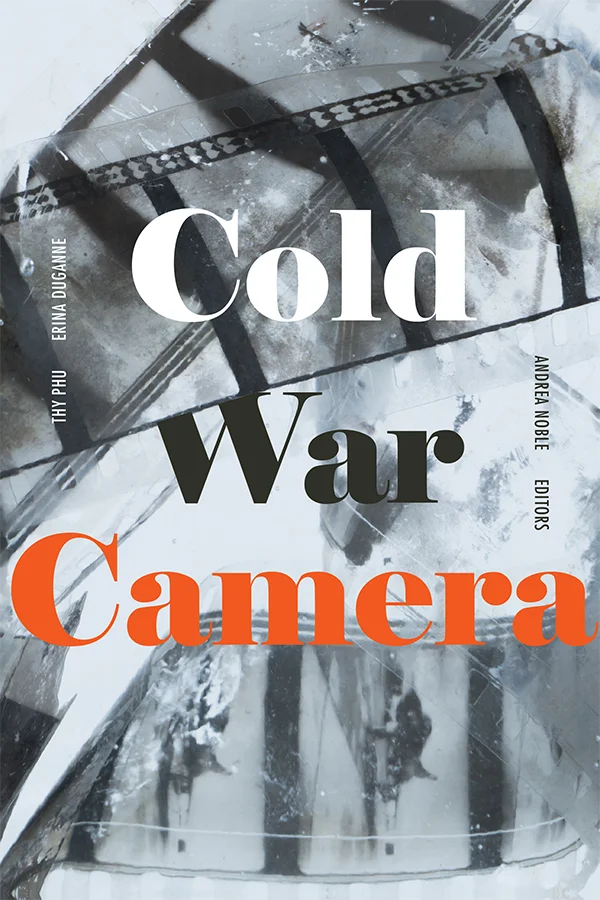
Cold War Camera

Book

Pages: 432

Illustrations: 104 illustrations, incl. 29 in color

Published: December 2022

Cold War Camera explores the visual mediation of the Cold War and illuminates photography’s role in shaping the ways it was prosecuted and experienced. The contributors show how the camera stretched the parameters of the Cold War beyond dominant East-West and US-USSR binaries and highlight the significance of photography from across the global South. Among other topics, the contributors examine the production and circulation of the iconic figure of the “revolutionary Vietnamese woman” in the 1960s and 1970s; photographs connected with the coming of independence and decolonization in West Africa; family photograph archives in China and travel snapshots by Soviet citizens; photographs of apartheid in South Africa; and the circulation of photographs of Inuit Canadians who were relocated to the extreme Arctic in the 1950s. Highlighting the camera’s capacity to envision possible decolonialized futures, establish visual affinities and solidarities, and advance calls for justice to redress violent proxy conflicts, this volume demonstrates that photography was not only crucial to conducting the Cold War, it is central to understanding it.

Contributors. Ariella Azoulay, Jennifer Bajorek, Erina Duganne, Evyn Lê Espiritu Gandhi, Eric Gottesman, Tong Lam, Karintha Lowe, Ángeles Donoso Macaya, Darren Newbury, Andrea Noble, Sarah Parsons, Gil Pasternak, Thy Phu, Oksana Sarkisova, Olga Shevchenko, Laura Wexler, Guigui Yao, Donya Ziaee, Marta Ziętkiewicz

Praise

“This bold reframing of the understandings of the Cold War through questions of visuality and photography transcends the conventional Soviet--USA geopolitical axis by accounting for global South dynamics beyond the limited nomenclature of subsidiary proxy wars. This timely book breaks scholarship on photography out of the problematic Euro-American orientation, and it will undoubtedly spark considerable debate.” - Patricia Hayes, coeditor of Ambivalent: Photography and Visibility in African History

“A sparkling and expertly sculpted set of essays that brings a neglected period and politics into new and vivid focus. Understanding the Cold War as a global conflict (as much North--South as East--West) the volume lays out an authoritative new cultural cartography showing how power and visibility were distributed. Providing a valuable optic on past history, it also now serves as a lens on a rapidly darkening future.” - Christopher Pinney, Professor of Anthropology and Visual Culture, University College London

"Cold War Camera takes readers from South Africa to Ethiopia, Vietnam to Palestine and Iran, from Chile to China, the Arctic Circle, and beyond. Its reach is sweeping, revealing a world entirely, if differentially, impacted as its most powerful quarreled to suture their place at the top. Just as it sheds light on this rich and storied past, Cold War Camera illuminates the present, proving that the tension and violence associated with the 'official' Cold War-era never ceased but only took on different forms." - Liz Hallgren, International Journal of Communication

"Cold War Camera more than makes the case for photography’s significance as a site of Cold War contestation and modality for reckoning with its violences, including at the most intimate of scales. . . . It is in the contributions of the book as a collective endeavor, exemplified by the collaboratively written introduction and essays, that the promises of a critically global approach to Cold War structures of seeing emerge most powerfully, as vital for tracing the operations and ramifications of a set of knowledge projects premised, at least in part, on their obfuscation." - Nadine Attewell, The Communication Review

"Cold War Camera brings together some exceptional photography writers in a collection exploring an astonishing range of source images. . . ." - Georgia Vesma, History of Photography

"Cold War Camera offers visual studies scholars a collection of case studies examining how photography was used to shape, and respond to, the political landscape of the Cold War era. . . . [it] successfully fills a gap in the literature stemming from academic tendencies to focus primarily on conflicts between the Soviet Union and the United States, as all of the book’s chapters demonstrate how aggressions arising from ideological conflicts between the US and USSR generated ripple effects in photography and cultural politics throughout the globe." - Anke Therese Schulz, Visual Studies

"In its breadth and coverage of the politics of photography in the twentieth century, Cold War Camera is unmatched. . . . [it] represents a new generation of the historiography and critique of political photography." - Delinda Collier, Art Bulletin

"An anthology with a comprehensive geographic scope, Cold War Camera focuses on photography-mediated visual culture and politics in a transnational, interconnected world, struck by proxy wars and ideological warfare. The authors address how photographs have been produced, appropriated, interpreted, circulated, and received, while aligning with, or reacting against, regimes shaped by Cold War geopolitics across countries and continents." - Isotta Poggi, ARLIS/NA

"Cold War Camera is a book about wounds and truths. It shows how a gentle and careful look at the wounds that never heal or those that leave irreparable scars allows one to salvage the truths about the historical geography of violence. The case here is a photographic look at the historical geography of the global Cold War." - Seçil Binboga, University of Toronto Quarterly

"Containing over one hundred high-quality figures that ground analysis and bring the arguments, quite literally, to light, and printed on glossy thick-stock paper, Cold War Camera is a volume that feels important, the excellent content mirrored by the book’s format itself."
  - Jack A. W. Bowman, H-Socialisms, H-Net Reviews

Buy

Availability: Loading...

Price: Loading...

Request a desk or exam copy

Information

Author/Editor Bios

Back to Top
Thy Phu is Professor of Media Studies at the University of Toronto, Scarborough, and author of Warring Visions: Photography and Vietnam, also published by Duke University Press.

Erina Duganne is Professor of Art History at Texas State University and author of The Self in Black and White: Race and Subjectivity in Postwar American Photography.

Andrea Noble (1968–2017) was Professor of Latin American Studies at Durham University and author of Mexican National Cinema.

Table Of Contents

Back to Top
List of Illustrations  ix
Acknowledgments  xv
Cold War Camera: An Introduction / Thy Phu, Andrea Noble, and Erina Duganne  1
Visual Alliances
1. Ernest Cole's House of Bondage, the United States Information Agency, and the Cultural Politics of the World War / Darren Newbury  33
2. Icon of Solidarity: The Revolutionary Vietnamese Woman in Vietnam, Palestine, and Iran / Thy Phu, Evyn Lê Espiritu Gandi, and Donya Ziaee  67
3. Group Material's "Art for the Future": Visualizing Transnational Solidarity at the End of the Global Cold War / Erina Duganne  113
4. Interrogating the Cold War's Geo-Politics from Down South: Chile from Within (1990) and the Construction of a Situated Visuality / Ángeles Donoso Macaya  143
5. Decolonization and Nonalignment: African Futures, Lost and Found / Jennifer Bajorek  167
Photo Essays
6. Bifurcated and Parallel Histories / Tong Lam  195
7. Preservation of Terror / Eric Gottesman  203
Structures of Seeing
8. Ending World War II: The Visual Literacy Class in Cold War Human Rights / Ariella Aïsha Azoulay  213
9. “Planted There Like Human Flags”: Photographs of the High Arctic and Cold War Anxiety, 1951–1956 / Sarah Parsons  239
10. Urban Albums, Village Forms: Chinese Family Photographs and the Cold War / Laura Wexler, Karintha Lowe, and Guigui Yao  263
11. Travel, Space, and Belonging in Soviet Domestic Photo Collections of the Cold War Era / Oksana Sarkosova and Olga Shevchenko  293
12. Exhibiting Ethnic Minorities, Democratizing History: Cold War Legacies and the Jews in Poland's Visible Sphere / Gil Pasternak and Marta Ziętkiewicz  327
Bibliography  359
Contributors  389
Index  395

Rights

Back to Top

Sales/Territorial Rights: World

Rights and licensing

Additional Information

Back to Top
Related Links Paper ISBN: 978-1-4780-1859-9 / Hardcover ISBN: 978-1-4780-1595-6 / eISBN: 978-1-4780-2319-7 / DOI: https://doi.org/10.1215/9781478023197