
Home / Books / Crip Genealogies

Crip Genealogies

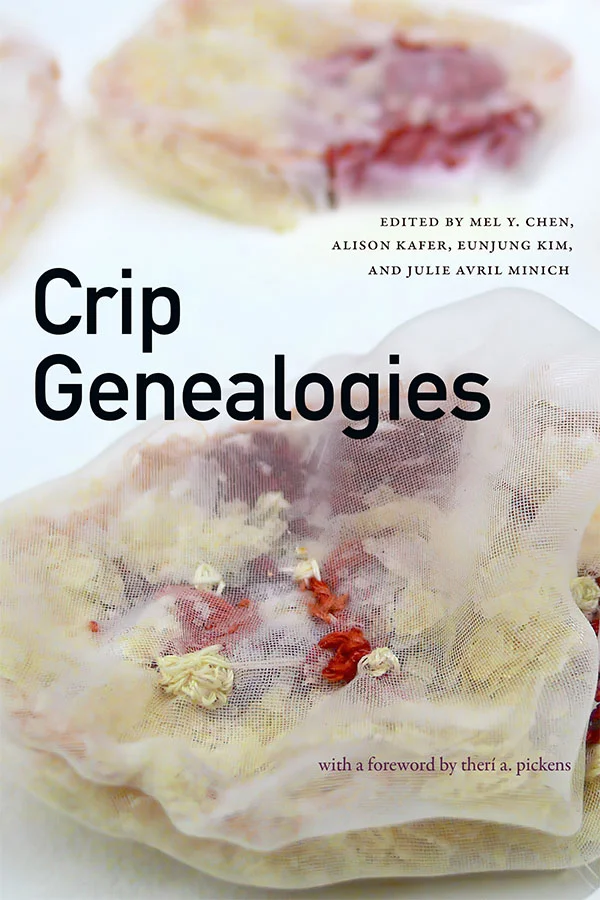
Crip Genealogies cover image

ANIMA: Critical Race Studies Otherwise

More about this series

Read the Introduction

Book

Pages: 384

Illustrations: 12 illustrations

Published: March 2023

The contributors to Crip Genealogies reorient the field of disability studies by centering the work of transnational feminism, queer of color critique, and trans scholarship and activism. They challenge the white, Western, and Northern rights-based genealogy of disability studies, showing how a single coherent narrative of the field is a mode of exclusion that relies on logics of whiteness and imperialism. The contributors examine how disability justice activists work in concert with other social justice projects, explore crip environments, create alternate disciplinary genealogies, and reject notions of the model minority. Throughout, they demonstrate how the mandate for a single genealogy of the discipline whitewashes disability and continues forms of violence. By cripping disability studies, the contributors allow for divergent histories, the coexistence of anti-ableist and antiracist theorizing, and a radically just and capacious understanding of disability.

Contributors. Suzanne Bost, Mel Y. Chen, Sony Coráñez Bolton, Natalia Duong, Lezlie Frye, Magda García, Alison Kafer, Eunjung Kim, Yoo-suk Kim, Kateřina Kolářová, James Kyung-Jin Lee, Stacey Park Milbern, Julie Avril Minich, Tari Young-Jung Na, Therí A. Pickens, Leah Lakshmi Piepzna-Samarasinha, Jasbir K. Puar, Sami Schalk, Faith Njahîra Wangarî

Praise

"This is an essential anthology that challenges the existing (white, Western/Northern, imperialist) frameworks of disability studies in favor of lenses focused on transnational feminism and queer/trans of color critique and activism." - Karla J. Strand, Ms.

"Through its insightful introduction and a collection of well-crafted essays, the book guides readers to critically examine disability studies' white-centric, English-focused, and US-based tendencies.  . . . By bridging disability studies, critical race and ethnicity studies, and transnational scholarship, this volume will resonate not only with scholars in these fields but also with anyone seeking to understand the connections between disability and systematic violence, , as well as the ways ableism shapes everyday life." - Qianqian Li, E3W Review of Books

"This collection, in short, offers a necessary and radical rethinking of what anti-ableist and antiracist scholarship can look like, what forms it can take, and whose voices it can prioritize." - Caroline Hensley, Journal of the Midwest Modern Language Association

"This lively volume calls for an expansive, open field of crip and disability scholarship, advocacy, activism, oriented toward a future of radical generosity and justice." - Sophia Booth Magnone, Visual Studies

"For readers unfamiliar with disability justice or disability studies, the intro is a great primer on the contradictions in which authors in the field now find themselves. . . . The goal of Crip Genealogies is to read the oppressive and liberatory elements of disability studies in dialogue with one another, and on this front, the introduction—and the collection—succeed mightily." - Jonathan Sterne, American Literary History

Buy

Availability: In stock

Price: $29.95

Buy the e-book:

Open Access

Read OA Edition

Funding information for the OA format is found at the bottom of the page.

Request a desk or exam copy

Information

Author/Editor Bios

Back to Top
Mel Y. Chen is Associate Professor of Gender and Women’s Studies at the University of California, Berkeley.

Alison Kafer is Associate Professor of Women’s and Gender Studies and English at the University of Texas at Austin.

Eunjung Kim is Associate Professor of Women’s and Gender Studies and Disability Studies at Syracuse University.

Julie Avril Minich is Associate Professor of English and Mexican American and Latina/o Studies at the University of Texas at Austin.

Therí A. Pickens is Professor of English at Bates College.

Table Of Contents

Back to Top
Acknowledgments  xi
Foreword: When Being Reader #1 Is Awesome / Therí A. Pickens  xiii
Introduction: Crip Genealogies / Mel Y. Chen, Alison Kafer, Eunjung Kim, and Julie Avril Minich  1
Part I. Mobilization and Coalition
1. Institutionalization, Gender/Sexuality Oppression, and Incarceration without Walls in South Korea: Toward a More Radical Politics of the Deinstitutionalization Movement / Tari Young-Jung Na and translated by Yoo-Suk Kim  61
2. Toward a Feminist Genealogy of US Disability Rights: Mapping the Discursive Legacies and Labor of Black Liberation / Lezlie Frye  85
3. Crip Lineages, Crip Futures: A Conversation by Stacey Park Milbern and Leah Lakshmi Peipzna-Samarasinha  / Stacey Park Milbern and Leah Lakshmi Peipzna-Samarasinha  103
4. Critical Disability Studies and the Question of Palestine: Toward Decolonizing Disability / Jasbir K. Puar  117
Part II. Crip Ecologies and Senses
5. Rhizophora: Queering Chemical Kinship in the Agent Orange Diaspora / Natalia Duong  137
6. Disability Beyond Humans: Aurora Levins Morales and Inclusive Ontology / Suzanne Bost  165
7. “My Mother, My Longest Lover”: Cripping South Texas in Noemi Martinez’s South Texas Experience Zine Project and South Texas Experience: Love Letters / Magda García  183
Part III. Genealogies
8. Can I Call My Kenyan Education Inclusive? / Faith Njahîra Wangarî / 201
9. Crip Genealogies from the Postsocialist East / Kateřina Kolářová / 217
10. The Black Panther Party’s 504 Activism as a Genealogical Precursor to Disability Justice Today / Sami Schalk  239
Part IV. Institutional Undoing
11. Model Minority Life, Interrupted: Asian American Illness Memoirs / James Kyung-Jin Lee  257
12. Filipina SuperCrip: On the Crip Poetics of Colonial Ablenationalism / Sony Coráñez-Bolton  277
13. Differential Being and Emergent Agitation / Mel Y. Chen  297
Afterwords: Crip Genealogies in 800 Words  319
Bibliography  327
Contributors  351
Index  357

Rights

Back to Top

Sales/Territorial Rights: World

Rights and licensing

Additional Information

Back to Top
Related Links Paper ISBN: 978-1-4780-1922-0 / Hardcover ISBN: 978-1-4780-1658-8 / eISBN: 978-1-4780-2385-2 / DOI: https://doi.org/10.1215/9781478023852

Funding Information

Back to Top
Open access of this book was made possible by the support of University of Texas at Austin, University of California at Berkeley, and College of Arts and Sciences at Syracuse University.