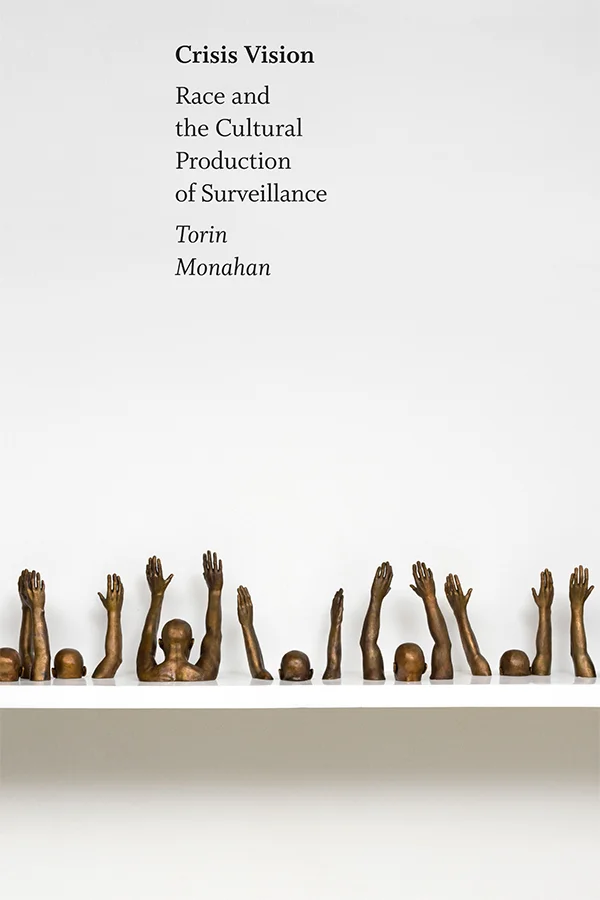
“With his deeply researched new analytic of crisis vision, Torin Monahan illuminates the violent workings of surveillance to index and atomize the extractive logics of racial capitalism. Framing creative output and interventions through analytics of transparency, avoidance, disruption, and the radical possibilities of opacity, Crisis Vision is an indispensable interrogation of the political potentiality of critical surveillance art to reveal, question, unsettle, disrupt, and, at times, mirror the very logics of surveillance.” - Simone Browne, author of Dark Matters: On the Surveillance of Blackness
“This book provides a vital new theory for understanding how racial logics constrain social and political possibilities in the present. Crisis vision is a way of seeing that magnifies differences among people, transfers blame for economic and environmental crises onto the marginalized, and promotes violence. Torin Monahan carefully considers the capacity of surveillance artworks to improve our understanding of this harmful way of seeing and generate alternative visions that foster an ethics and poetics of relationality in its stead.” - Rachel Hall, author of The Transparent Traveler: The Performance and Culture of Airport Security
"A methodical and insightful account of the cultural production of differential systems of oppression that characterize the surveillant present. . . . What’s notable throughout is the incisiveness of Monahan’s critique which refuses to shy away from scrutiny even as he lauds each artwork for its investigation of crisis vision." - Gary Kafer, Journal of Cultural Economy
"The contribution of Monahan’s Crisis Vision: Race and the Cultural Production of Surveillance to the surveillance studies body of work is unique in its line of inquiry and the theoretical tools that it gifts to the intersectional field of surveillance studies scholars and artists." - Ausma Bernot, International Journal for Crime, Justice and Social Democracy
"Crisis Vision offers a richly textured methodological framework for better understanding the myriad ways in which visuality is put to the service of surveillance cultures rooted in racial prejudice and violence. Monahan 's call for a disruptive politics rooted in relations of collective opacity, and his thoughtful deliberation on contemporary art practices that answer this call, is a most welcome addition to the field of critical surveillance studies." - Claudette Lauzon, Surveillance & Society
"In many ways, Crisis Vision mirrors the artists featured throughout its pages by challenging current and future critical/cultural communication studies scholars to consider their roles within these systems in an ever-evolving digital age. Monahan offers scholars an illuminating work that both presents a vital new theory describing how racial systems persevere through our digital age, while also magnifying marginalized voices and their aspirations toward peace and the freedom to exist." - Jacob Pedersen, Southern Communication Journal
"Crisis Vision is both an exemplary cultural critique of racialized surveillance and a celebration of makers whose works interrupt this status quo. . . . Crisis Vision provides its readers with an aesthetic vocabulary for refusing assimilation by surveillant logics, seeking instead to dismantle them through depiction." - Atilla Hallsby, Cultural Studies
"Monahan’s Crisis Vision offers an incisive critique not only of surveillance but of surveillance studies’ own methodological reliance on visibility, evident in its calls to reveal nefarious technologies or uncover previously hidden systems." - Henry Neim Osman, Film Quarterly
"Crisis Vision is an important and timely addition to the inter/multi/transdisciplinary area of surveillance studies, in which scholarly work around both race and art has been increasing in recent years: Monahan brings these areas explicitly together in this volume with careful and thorough argumentation. . . . For Monahan, critical surveillance art meaningfully challenges the unequal structures upon which the privileged within the global north thrive and demands we dismantle these structures to create a more ethical and just world." - Julia Chan, Visual Studies
"The strength of Crisis Vision is found in Monahan’s astute analyses, which consider the contours of artistic argument firmly located within the active environment of surveillance that informs the work. Other attributes of Crisis Vision are its relative brevity and the conclusions in each chapter, which summarize their respective themes, making the book both an excellent resource in classrooms and a concise read for artists, art enthusiasts, academics, and activists alike." - Tracy Valcourt, Esse
"Crisis Vision is a brilliant book that powerfully demonstrates how surveillance can be satisfactorily analyzed only through a culturalist lens capable of re-embedding the technologies within the ideological hotbed out of which they have sprung." - Andrea Mubi Brighenti, Tecnoscienza
"Crisis Vision breaks new interdisciplinary ground by bridging surveillance studies with visual art and cultural studies, visual cultural analysis, and critical race studies—along with critiques of racial economies and neoliberal capitalism." - Freda L. Fair, Critical Studies in Media Communication