“In this book Michelle Castañeda takes us deep into one of the shadowy recesses of state power—the immigration courtroom---where the immigration regime ritualistically enacts its racializing coloniality through absurd spectacles of the rule of law that are bizarre, irrational, and fundamentally cruel. Disappearing Rooms is a memorable work of exceptional intellectual imagination, critical creativity, and refreshing originality.” - Nicholas De Genova, coeditor of The Deportation Regime: Sovereignty, Space, and the Freedom of Movement
“A provocative and transformative work of scholarship, Disappearing Rooms defies disciplinary boundaries in its exploration of ideas that are unsettling, powerful, and thrilling. Emphasizing the embodied, ritualistic, and affective components of immigration politics, Michelle Castañeda presents necessary and surprising insights about the effects, habitus, and scenography of racialized immigration law in the United States.” - Joshua Chambers-Letson, author of After the Party: A Manifesto for Queer of Color Life
"The book … is a quintessential one in times of increasing hatred towards immigrants. This timely book will help the reader understand the intensity of immigration crises and the need for the growth of a humanitarian world than a world with borders."
- T.S. Gangothri,
Social Identities
"Disappearing Rooms offers us a critique of that system from the point of view that would recommend dismantling much if not all of the system. However, the book does not present as a manifesto of abolition. We are invited to imagine how the rooms of disappearance would change if viewed openly by the population at large, and how in the end, we might imagine (im)migrants as those with transnational identities who move, work, and live within multiple nations, without criminalization." - Gary M. English, Human Rights Quarterly
"Michelle Castañeda’s book Disappearing Rooms... is a tour de force that clearly demonstrates how the study of cultural performance provides an indispensable tool for understanding social performances and everyday life. Castañeda diagnoses various institutions at the sites of their theatrical manipulations—the disappearing rooms in her title—to show how immigration law, the prison-industrial complex, and even sometimes immigration activists stage these institutional mise-en-scènes in ways that play into the (in)visibility of carceral power." - Jennifer Tyburczy, Theatre Journal
"This book offers a thoughtful, evocative analysis of immigration law through the lens of theatre and performance. . . . The research presented in this book is grounded in a range of scholarship, including Performance Studies, Latinx Studies, Ethnic Studies, Sociology, and beyond. As to the field of Performance Studies, this book would be a great resource to introduce upper-division undergraduate or graduate students to concepts such as theatricality, performativity, and embodiment." - Yuge Ma, Gender, Place & Culture
"Drawing on the 'experimental sensibility' (14) that performance artists bring to the space of rehearsal, as well as the forms of improvisation that characterize accompaniment, Castañeda shows the 'plasticity' (9) of that which otherwise seems like a foregone conclusion, including the intransigence of the current border regime. For anyone concerned to find new ways to contemplate such changes, Disappearing Rooms is one of the most compelling and confronting places to begin." - Anne McNevin, Women's Studies Quarterly
"This book is fundamental for scholars in the socially conscious performing arts, law, post-colonialism, and race and ethnicity fields. For activists and practitioners involved with the justice system, Castañeda’s writings provide a powerful tool for self-reflection as she highlights her position of privilege while occupying those spaces, challenging readers to consider in what ways even those combating degrading immigration practices may end up contributing to the establishment of such policies." - Thais Moreira de Andrade, International Criminal Justice Reveiw
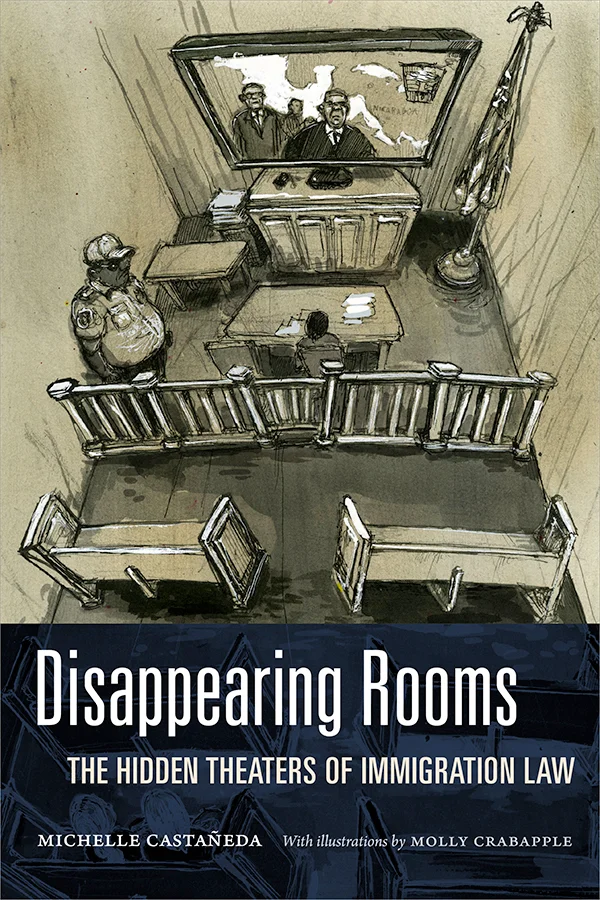
"The book is useful for its insights into the history of US immigration practices and the attempts to strengthen, reform, or rectify them. It is also praiseworthy for its application of performance studies to legal procedures, with illustrations by Molly Crabapple being helpful in conveying the scenography of intimidating courtroom settings. . . . Moreover, it offers important insights for theatre scholars and practitioners as to how to comprehend and expose the hidden underbelly of the asylum process." - S.E. Wilmer, Modern Drama
"Immigration law is a strange, terrorizing law that lacks legitimacy. We migration law scholars can forget this fact. Disappearing Rooms is here to remind us and to teach others. . . . Like the practice of migrant accompaniment (more below) that she enacts, depicts, and theorizes, this slim volume places us inside harrowing scenes and then challenges us to step out into the world and shatter the stage set." - Daniel I. Morales, Law, Culture and the Humanities