
Home / Books / Dulcinea in the Factory

Dulcinea in the Factory

Myths, Morals, Men, and Women in Colombia's Industrial Experiment, 1905-1960
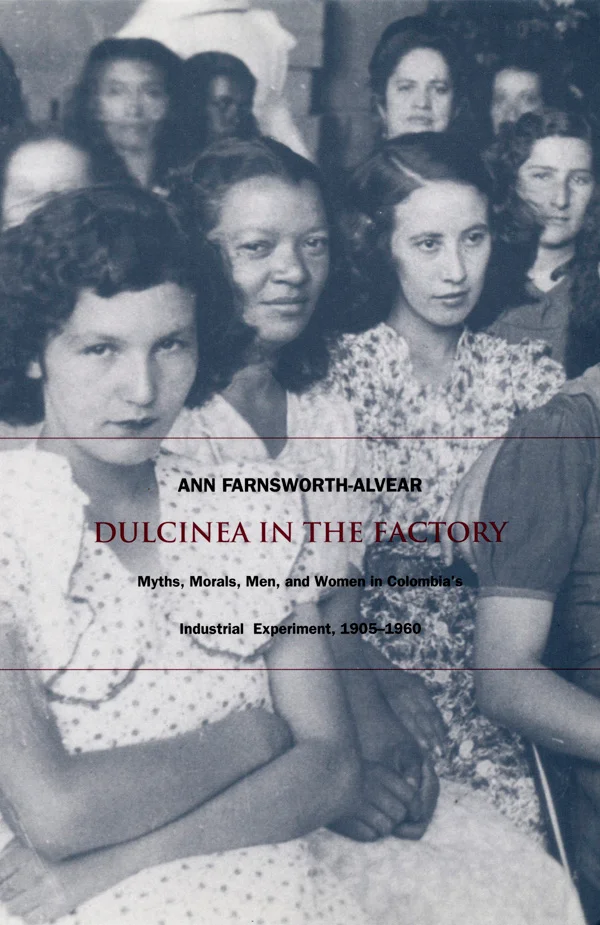
Dulcinea in the Factory cover image

Comparative and International Working-Class History

More about this series

Book

Pages: 320

Illustrations: 14 b&w photographs, 8 tables, 4 maps, 9 figures

Published: March 2000

Before it became the center of Latin American drug trafficking, the Colombian city of Medellín was famous as a success story of industrialization, a place where protectionist tariffs had created a “capitalist paradise.” By the 1960s, the city’s textile industrialists were presenting themselves as the architects of a social stability that rested on Catholic piety and strict sexual norms. Dulcinea in the Factory explores the boundaries of this paternalistic order by investigating workers’ strategies of conformity and resistance and by tracing the disciplinary practices of managers during the period from the turn of the century to a massive reorganization of the mills in the late 1950s.

Ann Farnsworth-Alvear’s analyses of archived personnel records, internal factory correspondence, printed regulations, and company magazines are combined with illuminating interviews with retired workers to allow a detailed reconstruction of the world behind the mill gate. In a place where the distinction between virgins and nonvirgins organized the labor market for women, the distance between chaste and unchaste behavior underlay a moral code that shaped working women’s self-perceptions. Farnsworth-Alvear challenges the reader to understand gender not as an opposition between female and male but rather as a normative field, marked by “proper” and “improper” ways of being female or male. Disputing the idea that the shift in the mills’ workforce over several decades from mainly women to almost exclusively men was based solely on economic factors, the author shows how gender and class, as social practices, converged to shape industrial development itself.

Innovative in its creative employment of subtle and complex material, Dulcinea in the Factory addresses long-standing debates within labor history about proletarianization and work culture. This book’s focus on Colombia will make it valuable to Latin Americanists, but it will also appeal to a wide readership beyond Latin American and labor studies, including historians and sociologists, as well as students of women’s studies, social movements, and anthropology.

Praise

Dulcinea in the Factory is a magnificent achievement, a remarkably accomplished piece of historical writing.” - William C. Roseberry, New York University

“A major contribution to Colombian history, both substantive and methodological. Dulcinea in the Factory takes the reader inside the culturally specific and evolving conceptualizations of femininity, paternalism, morality, honor, and modernity in the industrializing city of Medellín.” - Catherine LeGrand, McGill University

“This book not only revises Latin American labor and gender history but sets a new standard for social history. Taking advantage of all contemporary debates about accommodation and resistance and bringing them to a new level of sophistication, Ann Farnsworth-Alvear combines deep theoretical insights with rich ethnographic material.” - Temma Kaplan, State University of New York, Stony Brook

“This compelling study represents a major advance, indeed the maturation of the ‘new social history of national capitalism.’ Farnsworth-Alvear provides a deft accounting of complex exchanges, dialogues, and social negotiations in a changing crucible of class and gender relations.” - Michael F. Jiménez, University of Pittsburgh

Buy

Availability: Loading...

Price: Loading...

Request a desk or exam copy Spring 2026 Web Sale

Information

Author/Editor Bios

Back to Top

Ann Farnsworth-Alvear is Associate Professor of History at the University of Pennsylvania.

Table Of Contents

Back to Top
List of Illustrations viii
Preface xi
Acknowledgments xiv
Introduction 1
Part I. The Place of Female Factory Labor in Medellin
One. Medellin, 1900-1960 39
Two. The Making of La Mujer Obrera, 1910-20 73
Three. New Workers, New Workplaces, 1905-35 102
Part II. The Making and Unmaking of La Moral
Four. Strikes, 1935-36 123
Five. Gender by the Rules: Anticommunism and La Moral, 1936-53 148
Six. La Moral in Practice, 1936-53 181
Seven. Masculinization and El Control, 1953-60 209
Conclusion 229
Appendix: Persons Interviewed 239
Notes 241
Bibliography 283
Index 297

Rights

Back to Top

Sales/Territorial Rights: World

Rights and licensing

Awards

Back to Top

Co-winner, Book Award, Latin American Studies Association Labor Section

Additional Information

Back to Top
Paper ISBN: 978-0-8223-2497-3 / Hardcover ISBN: 978-0-8223-2461-4 / eISBN: 978-0-8223-8026-9 / DOI: https://doi.org/10.1215/9780822380269

Publicity material