
Home / Books / For Emplacement

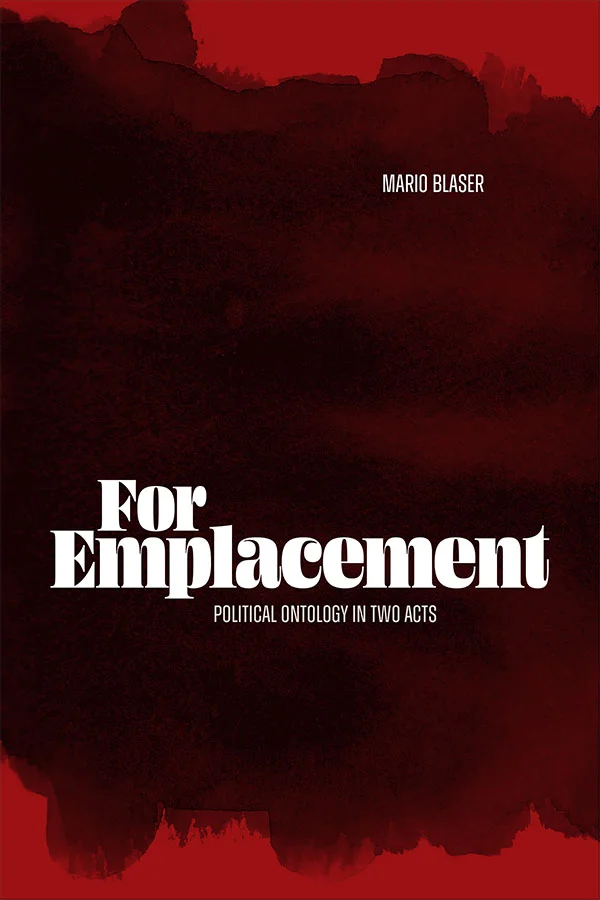
For Emplacement

Political Ontology in Two Acts
Book

Pages: 256

Illustrations: 8 illustrations

Published: January 2025

Author: Mario Blaser

In For Emplacement, Mario Blaser proposes a new lens for contending with the momentous challenges facing the world, from anthropogenic climate change to rampant socioeconomic inequalities to the rise of neofascism. Blaser shows that the prevalent solutions to these problems—which often depend on intensifying globalization, technological development, and extractivism—only deepen these crises. Effectively addressing these issues, he suggests, might require grounding our ways of being in the specificities of place. Drawing on decades of ethnographic experience in South America and the Canadian subarctic, and engaging with material semiotics, Blaser recasts the fundamental political question of how to live together well as a cosmopolitical one: how to become emplaced with others, in divergence. Ultimately, he presents a political ontology where visions of the good life oriented to the specificities of place guide us through the promises and challenges that a journey toward emplacement holds.

Praise

“Mario Blaser offers a new and vibrant conceptual and political vocabulary to approach the problems of our times in relation to indigeneity, environment, and knowledge. Drawing on anthropology, science and technology studies, and political theory, this book helps us escape colonizing forms of thought and keeps space open for alternative forms of being and living. For Emplacement is a bold invitation built on careful thinking, meticulous consideration of ethnographic worlds, and potent writing.” - Andrea Ballestero, author of A Future History of Water

“In this impressive and important book, Mario Blaser sharpens the conceptual and political stakes of political ontology. He makes a compelling argument for a political orientation toward the ‘small’ in the face of a politics of the global, universal, and transcendent. This ‘small’ politics would help build a pluriverse consisting of a set of emergent and connected yet divergent collectives. Complex, thoughtful, and provocative, For Emplacement will find a wide readership in anthropology, geography, Latin American studies, development studies, and Indigenous studies.” - Bruce Braun, Professor of Geography, University of Minnesota

“This is a book that contributes significantly to the discussion of the heterogeneity of life projects, without the anxiety of homogenizing them, and thereby maintaining the richness that comes with non-response, lack of strategy, and the constant recreation of our relationship with place.”

- Cristóbal Emilfork, Reviews in Anthropology

"Carefully composed and original in its form, the new book from Blaser is set to attract an interdisciplinary audience and spark conversations." - Julia Turska, Journal of Anthropological Research

Buy

Availability: In stock

Price: $27.95

Buy the e-book:

Open Access

Read OA edition

Funding information for the OA format is found at the bottom of this page.

Request a desk or exam copy

Information

Author/Editor Bios

Back to Top
Mario Blaser is Professor of Anthropology, Archaeology, and Geography at Memorial University of Newfoundland, author of Storytelling Globalization from the Chaco and Beyond, and coeditor of A World of Many Worlds, both also published by Duke University Press.

Table Of Contents

Back to Top
Preface  ix
Introduction. Political Ontology and the Problem of Displacement/Emplacement  1
Prelude. Small Stories  33
Act I. Uncommoning the Territory of the Common Good (on Being Faithful to the Pluriverse)  59
Interlude. Big Stories  96
Act II. Being Careful with Atiku, Killing Caribou (the Science Question in Cosmopolitics)  124
Postlude. Viably Small Stories for the Displaced  158
Acknowledgments  185
Notes  187
Bibliography  211
Index

Rights

Back to Top

Sales/Territorial Rights: World

Rights and licensing

Additional Information

Back to Top
Paper ISBN: 978-1-4780-3129-1 / Hardcover ISBN: 978-1-4780-2807-9 / eISBN: 978-1-4780-6028-4 / DOI: https://doi.org/10.1215/9781478060284

Funding Information

Back to Top
The open access edition of this work was made possible by generous funding from the Social Sciences and Humanities Research Council of Canada.