
Home / Books / From the Revolution to the Maquiladoras

From the Revolution to the Maquiladoras

Gender, Labor, and Globalization in Nicaragua
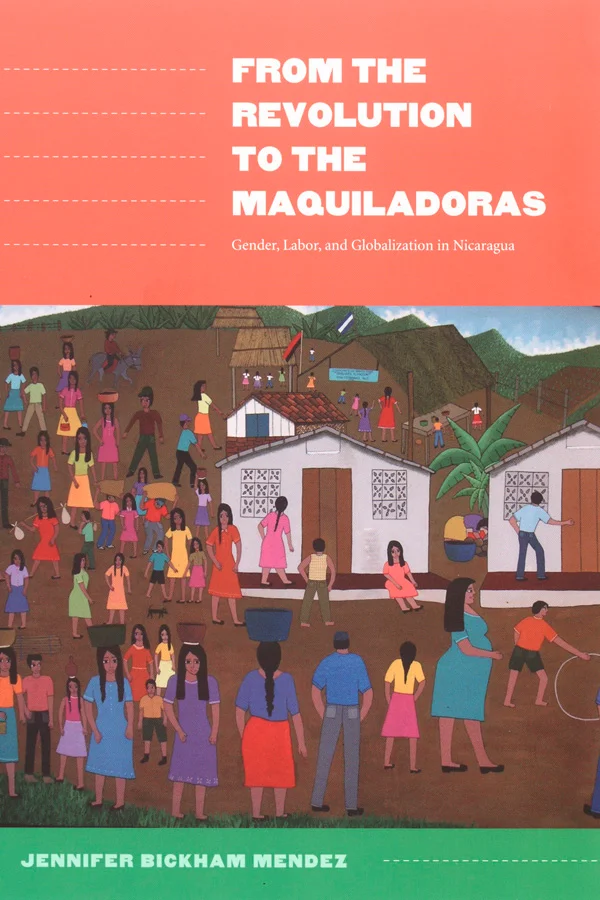
From the Revolution to the Maquiladoras cover image

American Encounters/Global Interactions

More about this series

Book

Pages: 304

Illustrations: 14 b&w photos, 1 map

Published: September 2005

From the Revolution to the Maquiladoras is a major contribution to the study of globalization, labor, and women’s movements. Jennifer Bickham Mendez presents a detailed ethnographic account of the Nicaraguan Working and Unemployed Women’s Movement, “María Elena Cuadra” (mec), which emerged as an autonomous organization in 1994. Most of its efforts revolve around organizing women workers in Nicaragua’s free trade zones and working to improve conditions in maquiladora factories. Mendez examines the structural and cultural elements of mec in order to demonstrate how globalization affects grassroots advocacy for social and economic justice. She argues that globalization has created opportunities for new forms of organizing among those local populations that suffer its effects and that mec, which has forged vital links with transnational feminist and labor groups, exemplifies the possibilities—and pitfalls—of this new type of organizing.

Mendez draws on interviews with leaders and program participants, including maquiladora workers; her participant observation while she worked as a volunteer within the organization; and analysis of the public statements, speeches, and texts written by mec members. She provides a sense of the day-to-day operations of the group as well as its strategies. By exploring the tension between mec and transnational feminist, labor, and solidarity networks, she illustrates how mec women’s outlooks are shaped by both their revolutionary roots within the Sandinista regime and their exposure to global discourses of human rights and citizenship. The complexities of the women’s labor movement analyzed in From the Revolution to the Maquiladoras speak to social and economic justice movements in the many locales around the world.

Praise

From the Revolution to the Maquiladoras is both a critical analysis and a salute to grassroots feminist organizing. While it contributes most obviously to feminist academic scholarship in the Global South, it could be well utilized in graduate courses in various disciplines on globalization and social movements, women and development, and Latin American social movements.” - Marina Karides, Mobilization

From the Revolution to the Maquiladoras is written on the basis of ethnographic research and the author’s personal involvement over the course of a decade; it is therefore a historical chronicle, an investigation into the operations of a unique women’s organization, and a personal testimony.” - Patricia Fernández-Kelly, Signs

From the Revolution to the Maquiladoras makes two very useful contributions which should appeal to teachers and scholars wishing to pursue more research. First, Bickham places gender at the forefront of larger economic forces; and second, the author goes to great lengths to show how local politics can shape the outside processes.” - Alberto E. Nickerson, World History Connected

“A must-read text for anyone interested in contemporary women’s movements, labor organizing, and issues of transnationalism and globalization in Latin America and elsewhere.” - Lynn Stephen, American Ethnologist

“A respectful but not uncritical account of MEC. From the Revolution to the Maquiladoras does more than trace the inspiring and complicated story of a fledgling group of Nicaraguan women fighting for justice in rapidly changing local, national, and global contexts. Through their example, the women in Méndéz’s book push readers to ask what they, themselves, have done to make the world more fair, and to take additional action if they have not yet done enough.” - Jeff Kelly Lowenstein, Hispanic Outlook in Higher Education

“As a feminist ethnography of globalization, this book serves up ample food for thought and discussion. . . . Students in anthropology, women’s studies, and Latin American studies should likewise find it very useful.” - Florence E. Babb, EIAL

“Mendez offers a rich portrait of MEC and its leadership. . . . Mendez remains firmly committed to feminist transnational politics and to the ways in which feminist supporters from the North can help to make information—for example, about human rights—flow more effectively to their partners in the South.” - Donna R. Gabaccia, Journal of Women's History

“The book is . . . . valuable to those seeking to understand the rise and fall of the Nicaraguan revolution, as well as to those interested in feminist ethnography and social movement theory.” - Matilde Zimmermann, Journal of Social History

“This well-written, well-organized and accessible book is exemplary in its ability to locate a case study within a larger context and reveal the connections between day-today organizing and the transnational links and multiple global spheres stimulated by globalization.” - Norma Stoltz Chinchilla, Contemporary Sociology

“Jennifer Bickham Mendez provides a nuanced ethnography that does not simply assert the gendered intricacies of local and global political-economic processes but artfully traces their unfolding in the contemporary Nicaraguan context. She reveals the organizational and discursive possibilities presented through the international feminist and human rights movements and also elucidates the constraints and tensions across local political hierarchies of organized labor, state bureaucracies, and a national/regional women’s movement fractured along class lines. Mendez’s analysis of MEC and the wider regional Network provides a powerful lens on the range of tactics, coping mechanisms, and organizational strategies currently being enacted on a stage that is simultaneously local, regional, and global.” - Carla Freeman, author of High Tech and High Heels in the Global Economy

“This is a compelling case study of a women’s NGO organizing women workers in a Free Trade Zone in post-Sandinista Nicaragua. Jennifer Bickham Mendez’s account reveals the challenges faced by a feisty NGO trying to survive and maintain its autonomy—from capital, the state, and the good intentions of international donors. It is a testimony to the strengths, but also the fragility, of civil society in today’s struggling democracies.” - Jane S. Jaquette, coeditor of Women and Democracy: Latin America and Central and Eastern Europe

Buy

Availability: In stock

Price: $34.95

Request a desk or exam copy Spring 2026 Web Sale

Information

Author/Editor Bios

Back to Top

Jennifer Bickham Mendez is Associate Professor of Sociology at the College of William and Mary.

Table Of Contents

Back to Top
About the Series vi
Preface vii
Acknowledgments xi
1. "Just Us and Our Worms": The Working and Unemployed Women's Movement, "Maria Elena Cuardra" 1
2. Oppositional Politics in Nicaragua and the Formation of MEC 25
3. Gendering Power and Resistance in an Era of Globalizations 59
4. "Autonomous but Organized" : MEC's Search for an Organizational Structure 79
5. "Rompiendo Esqruemas" : MEC's Political Strategies and the Free Trade Zone 133
6. MEC and the Postsocialist State : Democracy, Rights, and Citizenship under Globalization 177
7. Resistance Goes Global : Power and Opposition in an Age of Globalization 205
Notes 227
Abbreviations and Acronyms 239
Bibliography 241
Index 267

Rights

Back to Top

Sales/Territorial Rights: World

Rights and licensing

Additional Information

Back to Top
Paper ISBN: 978-0-8223-3565-8 / Hardcover ISBN: 978-0-8223-3552-8 / eISBN: 978-0-8223-8730-5 / DOI: https://doi.org/10.1215/9780822387305

Publicity material