
Home / Books / Hailing the State

Hailing the State

Indian Democracy between Elections
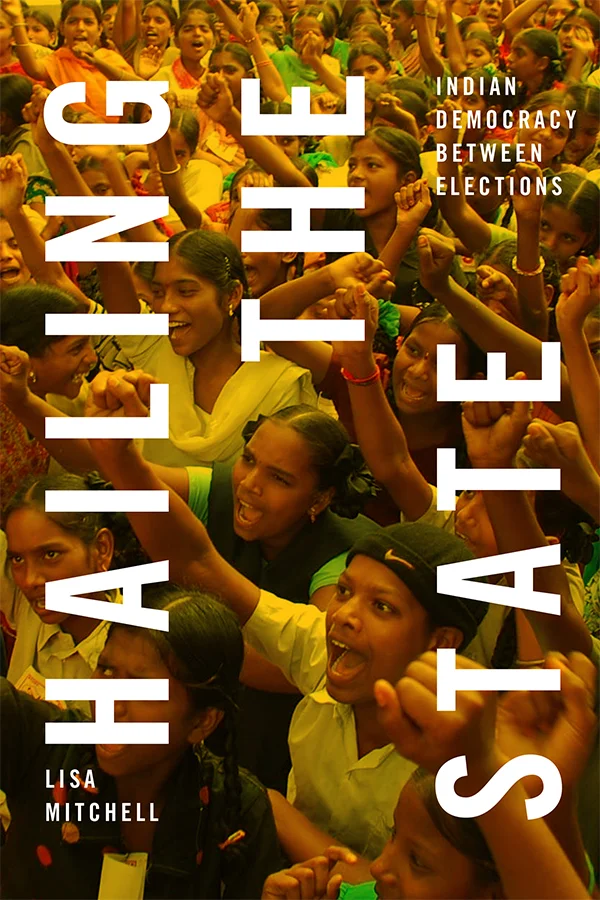
Book

Pages: 320

Illustrations: 21 illustrations

Published: April 2023

Author: Lisa Mitchell

In Hailing the State, Lisa Mitchell explores the methods of collective assembly that people in India use to hold elected officials and government administrators accountable, demand inclusion in decision making, and stage informal referendums. Mitchell traces the colonial and postcolonial lineages of collective forms of assembly, in which—rather than rejecting state authority—participants mobilize with expectations that officials will uphold the law and fulfill electoral promises. She shows how assembly, which ranges from sit-ins, hunger strikes, and demands for meetings with officials to massive general strikes and road and rail blockades, is fundamental to the functioning of democracy in India. These techniques are particularly useful for historically marginalized groups and others whose voices may not be easily heard. Moving beyond an exclusive focus on electoral processes, Mitchell argues that to understand democracy—both in India and beyond—we must also pay attention to what occurs between elections, thereby revising understanding of what is possible for democratic action around the world.

Praise

Hailing the State asks us to think beyond collective action as ‘resistance’ and to consider instead the ways in which such action seeks to elicit recognition from and access to the state. Packed with richly detailed ethnographic and historical examples, the book offers an alternative perspective on the relationship between popular action in the streets, electoral politics, and state authority.” - Sherry B. Ortner, author of Screening Social Justice: Brave New Films and Documentary Activism

“Lisa Mitchell’s intensively researched and impressively perceptive book shows something of fundamental importance about the reality of India’s democracy that has escaped any previous interpreter: just how actively and inventively it is realized through the energies of its own citizens.” - John Dunn, author of Setting the People Free: The Story of Democracy

“By being attentive to and stressing the various forms of hailing the state, Lisa Mitchell has produced a richly textured and theoretically nuanced study of how democracy is practiced in those long stretches between elections, the stretches that are arguably the most important aspect of how ordinary people participate. Conceiving of democracy in terms of its everyday practices and what it means for nonelites, Mitchell makes a distinctive and important contribution to a materialist political theory of democracy.” - Ajay Skaria, author of Unconditional Equality: Gandhi’s Religion of Resistance

"In redefining democratic practice to include collective assembly, Mitchell weaves an intricate picture of how people understand themselves as democratic citizens. Deftly combining approaches from anthropology, history, and political theory, she brings alive the mosaic of actions that they employ in what she terms “hailing the state.” She draws on very rich archival and ethnographic material to tell us the ways in which people have and continue to hail the state." - Lipika Kamra, Review of Politics

"The depth and breadth of Mitchell’s engagement through each of her cases, helps us to understand collective assemblies as being fundamental to democracy, and indeed to colonial and postcolonial genealogies thereof; addressing issues that get to the heart of not just what democracy is, when it is not just about elections, but also how we understand relations across colonial histories, and North-South divides." - Samarjit Ghosh, Democratization

"The book is conceptually very vibrant, so much so that there is a democracy framework ensuing throughout, dealing with the relationship between democracy and collective assemblies. It also dwells on the significance of these collective assemblies for a democracy in general and more centrally, for a democracy like India." - Survesh Pratap Singh, TheDaak

“Mitchell weaves an intricate picture of how people understand themselves as democratic citizens. Deftly combining approaches from anthropology, history, and political theory, she brings alive the mosaic of actions that they employ in what she terms ‘hailing the state.’” - Lipika Kamra, Review of Politics

"A critical intervention in socio-political thought." - Chinmaya Lal Thakur, Contemporary South Asia

“Michell’s book is historically rich, ethnographically grounded, and theoretically innovative. Her intervention is at once timely and cautionary for Indian democracy, as it highlights and situates the stakes of political recognizability for marginalized populations. Readers interested in political anthropology and history and subaltern and South Asian studies will no doubt find this book insightful.”
  - Roderick Wijunamai, Exertions

"Mitchell’s monograph is comprehensively researched, immersive, and a fascinating insight into the practise of democracy within Telangana and India, extensively employing both archival data and contemporary ethnography. She simultaneously centres democratic or dialogic attempts to compel an audience with the state, whilst taking care to acknowledge literature and action from those, like anarchists, who view themselves as oppositional to it or even oscillate between these two modes." - Harish Goutam, Journal of the Anthropological Society of Oxford

"Peppered with many arresting photographs of protests and political posters, the book allows one to feel the energy and almost hear the loud chants of the demonstrators as they go about “hailing the state.” Although the book’s empirical data come primarily from Telangana, Andhra Pradesh, Tamil Nadu, Delhi, and parts of Uttar Pradesh, its analyses and findings are relevant for all of India and indeed beyond."

  - Zaheer Baber, American Ethnologist

"In this lucidly written book, Mitchell offers a novel approach to reading collective actions as interpellating the state, particularly with her descriptions of the intimacies of embodied democratic acts. . . . Hailing the State offers compelling insights into democratic theory and practice and would be particularly useful for scholars of postcolonial theory, performance and politics, and the Global South." - Rashi Mishra, Performance Research

"This book achieves a remarkable feat in developing a historically nuanced understanding of the democratic politics of historically marginalized citizens who adopt practices such as sit-ins and hunger strikes; petitioning the authorities; general strikes, rail and road blockades; ticketless travels in trains to the sites of power; alarm-chain pulling and people’s roar assemblies, through multi-sited ethnography of these practices. . . . The book successfully narrates the story of enchantment and longing for the democratic state in the lives of historically marginalized citizens in India." - Kunal Kishore, Studies in Indian Politics

Buy

Availability: Loading...

Price: Loading...

Buy the e-book:

Open Access

Read OA Edition

Funding information for the OA format is found at the bottom of the page.

Request a desk or exam copy

Information

Author/Editor Bios

Back to Top
Lisa Mitchell is Professor of History and Anthropology in the Department of South Asia Studies at the University of Pennsylvania and author of Language, Emotion, and Politics in South India: The Making of a Mother Tongue.

Table Of Contents

Back to Top
A Note on Transliteration and Spelling  ix
Acknowledgments  xi
Introduction. Hailing the State: Collective Assembly, Democracy, and Representation  1
Part I. Seeking Audience
1. Sit-In Demonstrations and Hunger Strikes: From Dharna as Door-Sitting to Dharna Chowk  43
2. Seeking Audience: Refusals to Listen, “Style,” and the Politics of Recognition  67
3. Collective Assembly and the “Roar of the People”: Corporeal Forms of “Making Known” and the Deliberative Turn  94
4. The General Strike: Collective Action at the Other End of the Commodity Chain  122
Part II. The Criminal and the Political
5. Alarm Chain Pulling: The Criminal and the Political in the Writing of History  151
6. Rail and Road Blockades: Illiberal or Participatory Democracy?  168
7. Rallies, Processions and Yātrās: Ticketless Travel and the Journey to “Political Arrival”  197
Conclusion. Of Human Chains and Guinness Records: Attention, Recognition, and the Fate of Democracy amidst Changing Mediascapes  216
Notes  225
Bibliography  265
Index  287

Rights

Back to Top

Sales/Territorial Rights: World, excluding South Asia

Rights and licensing

Additional Information

Back to Top
Related Links Paper ISBN: 978-1-4780-1876-6 / Hardcover ISBN: 978-1-4780-1612-0 / eISBN: 978-1-4780-2339-5 / DOI: https://doi.org/10.1215/9781478023395

Funding Information

Back to Top
The author was supported by the Department of South Asia Studies at the University of Pennsylvania, the European Union's Horizon 2020 research and innovation programme under grant agreement No 853051, and the Max Planck Institute for Social Anthropology, and this title is freely available in an open access edition thanks to the generous support from these institutions.