
Home / Books / How Do We Look?

How Do We Look?

Resisting Visual Biopolitics
Book

Pages: 248

Illustrations: 45 illustrations

Published: January 2022

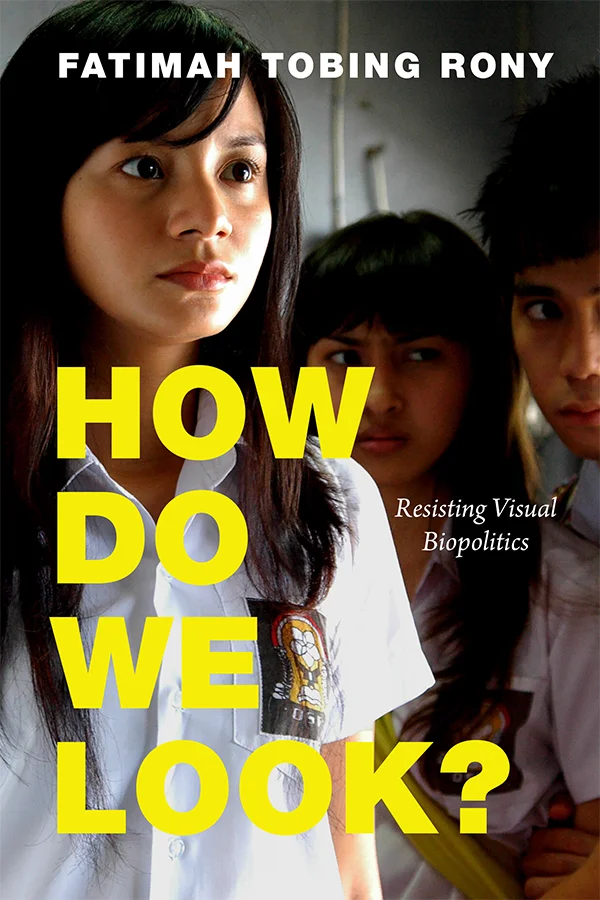
In How Do We Look? Fatimah Tobing Rony draws on transnational images of Indonesian women as a way to theorize what she calls visual biopolitics—the ways visual representation determines which lives are made to matter more than others. Rony outlines the mechanisms of visual biopolitics by examining Paul Gauguin’s 1893 portrait of Annah la Javanaise—a trafficked thirteen-year-old girl found wandering the streets of Paris—as well as US ethnographic and documentary films. In each instance, the figure of the Indonesian woman is inextricably tied to discourses of primitivism, savagery, colonialism, exoticism, and genocide. Rony also focuses on acts of resistance to visual biopolitics in film, writing, and photography. These works, such as Rachmi Diyah Larasati’s The Dance that Makes You Vanish, Vincent Monnikendam’s Mother Dao (1995), and the collaborative films of Nia Dinata, challenge the naturalized methods of seeing that justify exploitation, dehumanization, and early death of people of color. By theorizing the mechanisms of visual biopolitics, Rony elucidates both its violence and its vulnerability.

Praise

“Fatimah Tobing Rony's passionate appeal for a different kind of filmmaking that might interrupt the representational violence of what she calls visual biopolitics animates every page of this innovative and important book. Building a powerful argument about how habitual ways of seeing and not seeing are produced, reproduced, and resisted via visual media, Rony makes a welcome and original contribution to both film studies and Southeast Asian studies.” - Karen Strassler, author of Demanding Images: Democracy, Mediation, and the Image-Event in Indonesia

“Fatimah Tobing Rony traces a fascinating visual archive across time, media, and sites of power, drawing out chilling resonances among primary media texts with great erudition, critical force, and lyricism. No other author is a sophisticated art historian, critical ethnographer, postcolonial feminist theorist, and filmmaker all in one. This powerful and remarkable book positions Rony as a brilliant and essential cultural voice.” - Patricia White, author of Women’s Cinema, World Cinema: Projecting Contemporary Feminisms

"[Rony's] multifaceted, deeply empathetic, and imaginative book will make a great contribution to any advanced course in the fields of women’s and gender studies, anthropology, and global studies." - Eva Hoffmann, Resources for Gender and Women's Studies

Buy

Availability: Loading...

Price: Loading...

Request a desk or exam copy

Information

Author/Editor Bios

Back to Top
Fatimah Tobing Rony is Professor of Film and Media Studies at the University of California, Irvine, and author of The Third Eye: Race, Cinema, and Ethnographic Spectacle, also published by Duke University Press.

Table Of Contents

Back to Top
Acknowledgments  ix
Tongue  1
Introduction. How Do We Look?  3
The Peonies  24
1. Annah la Javanaise  27
Under the Tree  70
2. The Still Dancer  72
The Dressing Down  108
3. Mother Dao  110
Flight  147
4. Nia Dinata  148
Conclusion. The Fourth Eye  187
Notes  191
Bibliography  213
Index  225

Rights

Back to Top

Sales/Territorial Rights: World

Rights and licensing

Additional Information

Back to Top
Paper ISBN: 978-1-4780-1460-7 / Hardcover ISBN: 978-1-4780-1367-9 / eISBN: 978-1-4780-2190-2 / DOI: https://doi.org/10.1215/9781478021902