
Home / Books / Interface Frictions

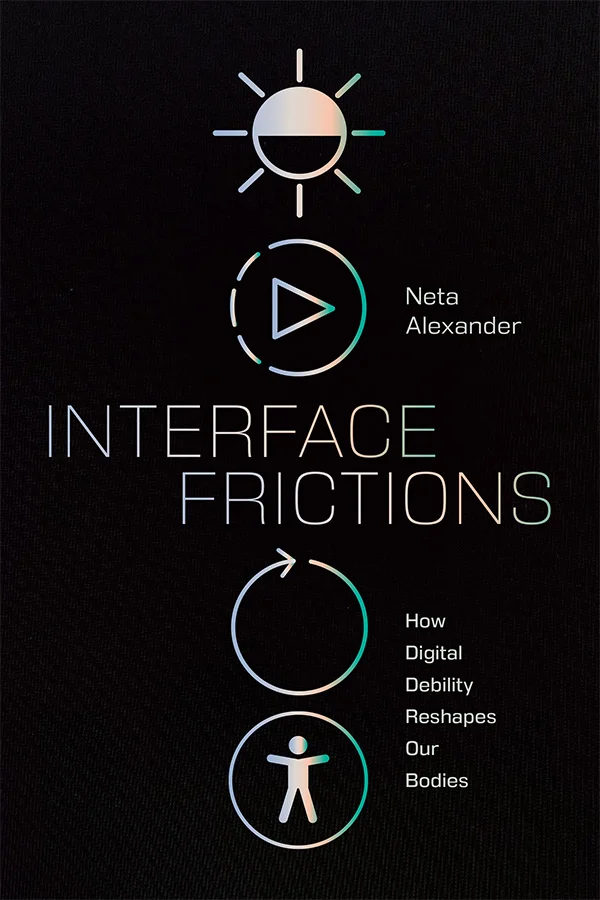
Interface Frictions

How Digital Debility Reshapes Our Bodies
Book

Pages: 232

Illustrations: 26 illustrations

Published: August 2025

Author: Neta Alexander

In Interface Frictions, Neta Alexander explores how ubiquitous design features in digital platforms reshape, condition, and break our bodies. She shows that while features such as refresh, playback speed, autoplay, and night mode are convenient, they can lead to “digital debility”—the slow and often invisible ways that technologies may harm human bodies. These features all assume an able-bodied user and at the same time push users to ignore their bodily limitations like the need for rest, nourishment, or movement. Building on the lived experiences of people with disabilities, Alexander explores alternative design solutions that arise from a multisensorial approach to communication. She demonstrates what can be gained from centering the nonaverage user, such as blind people who pioneered ways to control the playback speed of media, and Netflix subscribers with invisible disabilities like PTSD who successfully pushed the company to redesign its previews autoplay feature. Drawing on artworks, video games, and creative hacking by users with disabilities, Alexander challenges our understanding of media consumption, the attention economy, and the digital interface.

Praise

“Honing its attention on design features, rather than the sprawling scale of platforms or software, this brilliant book points the way to a new media studies. Neta Alexander offers critical theories of refresh, playback speed, autoplay, and Night Shift, foregrounding the ways these seemingly transparent media functions configure and debilitate their users. The book does not end with this diagnosis—rather, Alexander delves into the ‘interface frictions’ experienced (and sometimes encouraged) by disabled and other edge users, finding at this juncture further sources of critique and ‘alternate imaginings of digitality.’” - Mara Mills, Director, New York University Center for Disability Studies

“Our bodies are breaking from the strain of being always online. But our debility, Interface Frictions shows, is no accident; it is the intentional result of design decisions to extract profit from us. Neta Alexander’s book is both a passionate manifesto and an incisive history of streaming media retold from the impaired or ‘nonaverage’ user’s perspective. It points us to the ways that access and disability can be reimagined and to the creative strategies by which we might steal back the time to rest and survive.” - Tung-Hui Hu, author of Digital Lethargy: Dispatches from an Age of Disconnection

"The false promise of the internet has yet to be fully exposed, because there is simply too much profit tied up with tech. However, a searing, deeply personal book like Interface Frictions chips away at the veneer of equity, free choice, and intimate personalization that for too long has been the bait-and-switch tactic of the rapacious platforms that have eluded regulatory scrutiny in both the United States and Europe. . . . [A]  brave and well-argued manifesto. Essential. All readership levels." - Choice

Buy

Availability: In stock

Price: $28.95

Request a desk or exam copy

Information

Author/Editor Bios

Back to Top
Neta Alexander is Assistant Professor of Film and Media at Yale University and coauthor of Failure.

Table Of Contents

Back to Top
Introduction. Disabled/Enabled  1
1. Repetition, Reloaded: On Refreshing, Latency, and Frictional Aesthetics  25
2. The Right to Speed Watch (or, When Netflix Discovered Its Blind Users)  55
3. Automating Trauma: On Autoplay and the Unbingeable  85
4. “Log In, Chill Out”: On “Horizontal Media,” Night Modes, and Sleep Apps  118
Coda. On Digital Disability and the Normalization of Fatigue  150
Acknowledgments  165
Notes  169
Bibliography  197
Index  213

Rights

Back to Top

Sales/Territorial Rights: World

Rights and licensing

Additional Information

Back to Top
Paper ISBN: 978-1-4780-3216-8 / Hardcover ISBN: 978-1-4780-2892-5 / eISBN: 978-1-4780-6112-0 / DOI: https://doi.org/10.1215/9781478061120