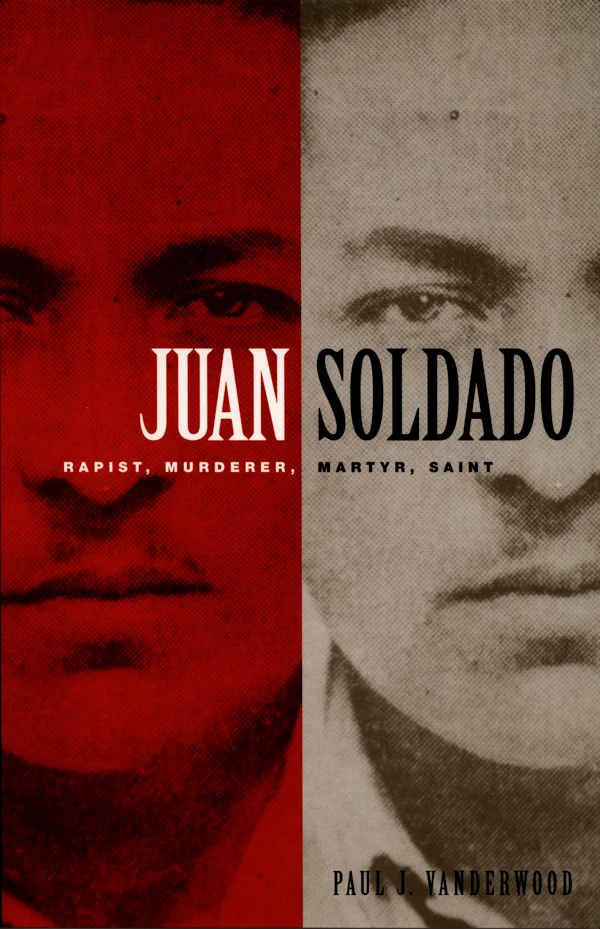
“Juan Soldado is a beautifully and sensitively written book that will prove invaluable to anyone interested in religion in the borderlands and/or in popular Catholic devotionalism.” - Tisa Wenger , Western Historical Quarterly
“Juan Soldado will help historians of society, culture, and politics to think beyond the binary framework of crime and punishment, a model that has become increasingly imposed on Latin American examples. The book goes beyond a description of the crime and the punishment to analyze what the occasioned. Vanderwood contributes to the study of violent death by demonstrating that it continued to cause shifts in systems of belief.”
- Patrick Timmons , Latin American Research Review
“[Juan Soldado] tells a strange and riveting tale about sexual homicide eventuating in religious devotion. . . . The history of Tijuana, background for the final discussion of the devotion, is interesting in itself. More than local history, however, the book serves as a case study in folk Catholicism and as a contribution to the growing literature on boundaries and borders. The tale is intriguing, as stories about crime and punishment often are, but this one resonates with perplexing questions about the relation between violence and the sacred and about social embodiment and ghostly voices.” - John M. Ingham, History of Religions
“[A] splendid exposition of the life and afterlife of Juan Soldado.” - Susan Schroeder , Catholic Historical Review
“[A] wonderfully eccentric reading of the life, death, and afterlife of Juan Soldado. . . . Juan Soldado represents borderlands history at its best.” - Robert M. Buffington , The Historian
“[T]he book should appeal to several groups: the strength of the story and the narrative style will engage a non-academic audience; historians will be interested in the interplay between national and local politics in post-revolutionary Mexico; while anthropologists will be drawn to the detailed observations concerning the everyday worship of a popular cult.” - Keith Brewster , History
“[T]his book provides a wealth of information about both Juan Soldado and popular devotions in general.” - John T. Ford , Religious Studies Review
“[V]ivid and compelling. . . . Juan Soldado is an elegant study of the ways that a popular devotional movement emerges and changes within and according to its historical context. In addition, it provides an evocative social history of the U.S.-Mexican borderlands, and Tijuana in particular, over the past hundred years or so. And it is a great read.” - Elizabeth Emma Ferry , Anthropological Quarterly
“In Juan Soldado, a gripping true-crime mystery opens up into a much larger and more elusive mystery of faith and belief, a fascinating book, that I highly recommend.” - Dennis Moore, San Diego WriteWay
“In this extraordinary book, Paul J. Vanderwood provides an incredibly nuanced study. . . . Vanderwood makes a highly original contribution to readers interested in the production of religious symbols, U.S.-Mexican social relations, borderlands, and the politics of history. His book should be of particular interest to students of history, folklore, religion, cultural studies, anthropology, and ethnic studies. Beautifully illustrated with rare photographs and maps, and written in lucid prose, it will fascinate specialists and nonspecialists alike.” - Olga Nájera-Ramírez , American Historical Review
“The story is as fascinating as it is gripping, and Vanderwood recounts it with great historical rigor and literary skill.” - Christopher R. Boyer , Journal of Interdisciplinary History
“Vanderwood’s book on Juan Soldado is a masterpiece of historical research and interpretation. . . . [I]n highly readable, lucid prose, he has laid bare an important part of border culture, and provided us with an absolutely indispensable study. . . . This is a book about here and now among our close neighbors, not a detached examination of something that happened back then and over there. It gives a voice to parts of the population who frequently remain silent in documentary histories. I heartily recommend it.” - Jim Griffith , Journal of Arizona History
"Juan Soldado charts an innovative course for analyzing popular religious beliefs in Mexico. . . . While Vanderwood argues that devotion to this popular saint reflects the changing circumstances of Tijuana, his investigation most convincingly contextualizes Juan Soldado within an enormously widespread range of similar religious traditions that, as he shows through abundant examples, extend across centuries and nations."
- Amy Robinson , The Americas
"[A] fascinating book that is part crime story, part history and part psychology text." - Jim Levy , Santa Fe New Mexican
"[H]ighly captivating. . . . Vanderwood has done a wonderful job in evoking a popular religion that is dynamic, largely autonomous, and profoundly meaningful. This highly accessible, compellingly narrated book, which often reads like a murder mystery, will appeal to both academic and nonacademic audiences interested in the culture and religion of Mexico and Latin America." - Adrian Bantjes , Hispanic American Historical Review
"By expanding his research beyond the multiple existent stories surrounding Olga's rape and murder to the political and social circumstances in Tijuana, Vanderwood has done a great service for both the general readers and academics interested in lay religiosity, state-building in post-revolutionary Mexico, and borderlands studies. . . . [A]t times I felt like I was reading a good novel. . . . Overall, Juan Soldado will be an entertaining and informative read for both scholars and non-scholars alike. This is another solid performance by a veteran scholar on the history of Mexico." - Andrae Marak , Canadian Journal of History
"It is the rare academic who knows when to let go of his discipline. Vanderwood has the grace to do so when he allows Juan Soldado's followers to speak for themselves, recording their comments without judgment. Those devotees, he writes, 'helped me to appreciate that there are many ways of knowing this world.' His intriguing book invites us to do the same." - Judy Goldstein Botello , San Diego Union-Tribune
"The rich material yielded by analyzing Castillo Morales' iconization and Vanderwood's own felicitous prose combine to produce a compelling twentieth-century history of the U.S.-Mexico border." - Patrick Timmons, Virginia Quarterly Review
"The scope of this book is broad and it is highly readable and informative on its several levels of historical, sociological, and religious interests. It will be of interest to students in many disciplines as well as to the lay reader." - Richard Fantina, Journal of Latin American Anthropology
"Those who enjoyed [Vanderwood's] book on Teresa Urrea will not be disappointed with Juan Soldado. . . . Vanderwood presents an intriguing variation on popular saints never given the Church's official seal of approval. . . ." - Nicole von Germeten , The Latin Americanist
"Vanderwood eloquently intertwines the major issues of the period with local venues. - Jaime R. Aguila , Journal of San Diego History
"Vanderwood has crafted a highly readable historical account of devotions to a local saint in 20th-century Tijuana. . . . The book . . . is much more than a gripping tale of the crime, trial, and execution of Morales. . . Recommended." - B.R. Larkin , Choice
“Juan Soldado is a rich, exuberant, and sensitive account of the making of a folk saint in Tijuana. It is based on extensive use of newspapers and remarkable interviews with eyewitnesses to events in the 1930s.” - William A. Christian Jr., author of Visionaries: The Spanish Republic and the Reign of Christ
“Juan Soldado is a true cannot-put-it-down read that combines deep research, strong narrative, and remarkable insight about how a spontaneous religious devotion comes into being and consolidates itself. I know of no other work that portrays the elements of this particular sort of religious belief—its spontaneity, its stubbornness in the face of the Church’s indifference, and the matter-of-fact way it is practiced in daily life.” - Eric Van Young, author of The Other Rebellion: Popular Violence, Ideology, and the Mexican Struggle for Independence, 1810–182