
Home / Books / King′s Vibrato

King′s Vibrato

Modernism, Blackness, and the Sonic Life of Martin Luther King Jr.
Book

Pages: 368

Illustrations: 30 illustrations

Published: September 2022

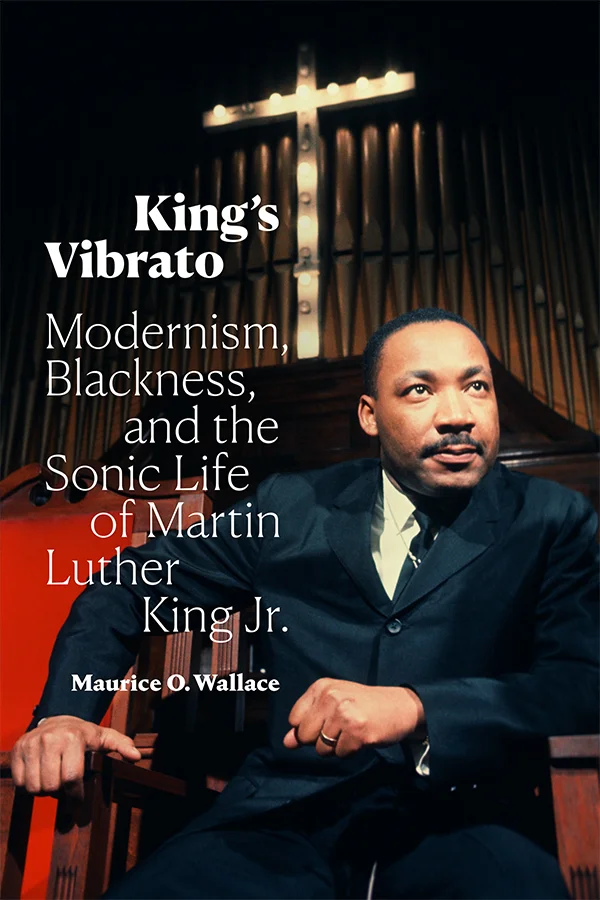
In King’s Vibrato Maurice O. Wallace explores the sonic character of Martin Luther King Jr.’s voice and its power to move the world. Providing a cultural history and critical theory of the black modernist soundscapes that helped inform King’s vocal timbre, Wallace shows how the qualities of King’s voice depended on a mix of ecclesial architecture and acoustics, musical instrumentation and sound technology, audience and song. He examines the acoustical architectures of the African American churches where King spoke and the centrality of the pipe organ in these churches, offers a black feminist critique of the influence of gospel on King, and outlines how variations in natural environments and sound amplifications made each of King’s three deliveries of the “I Have a Dream” speech unique. By mapping the vocal timbre of one of the most important figures of black hope and protest in American history, Wallace presents King as the embodiment of the sound of modern black thought.

Praise

“In this personal, thoughtfully written, and deeply insightful book, Maurice O. Wallace helps us to further understand and appreciate Martin Luther King Jr.’s extraordinary contributions to American culture and black life. Off these pages leaps a version of King that kept on honing his craft to become both a trumpet of America’s conscience and a sonic tributary for black America. This field-changing work greatly adds to our knowing and hearing King, a voice that we still desperately need.” - Salamishah Tillet, author of In Search of The Color Purple: The Story of an American Masterpiece

“In this ambitious and accomplished book, Maurice O. Wallace takes Martin Luther King Jr. as a point of departure into a textured analysis of the aural exorbitance of black cultural history. At once thoroughly researched and theoretically deft, King’s Vibrato offers a new vocabulary and a new set of questions for black sound studies. By engaging the social, cultural, and historical determinants that contributed to King’s way of sounding, Wallace’s treatment of King as exemplary and emblematic of general tendencies within post-Emancipation African American culture is a crowning achievement.” - Anthony Reed, author of Soundworks: Race, Sound, and Poetry in Production

"King's Vibrato provides the opportunity to listen to and hear black cultural history through the ears of Maurice O. Wallace." - Diane Grams, Ethnic and Racial Studies

"King’s Vibrato is a commendable entry into the growing discourse around history, blackness, and aesthetics, and will be of particular interest to historians of American religion looking for ways to further develop the kinds of subjects available for this sort of inquiry—in this case, the sound of an individual’s voice. This book has relevance, too, for scholars of African American history interested in an innovative look at a familiar subject." - Adam Sweatman, Reading Religion

"The achievement of Maurice O. Wallace’s superb King’s Vibrato is that it allows us to understand King’s epochal abilities beyond the singularity of King himself. . . . Wallace’s focus on sound lets us understand King’s celebrated orations as collaborations between King, his audiences, and the physical environments in which they met. King’s Vibrato goes into intricate detail about how various churches were designed and built with sonic effects in mind." - David T. Smith, Journal of Religious History

"Wallace’s tome is a compelling distillation of the Black modern life that produced King’s sound. As he plumbs the depths of the spiritual, spatial, and sonic landscape of King’s vibrato, Wallace brings to bear a bevy of interdisciplinary modes of critique to make sense of Black modern life’s infrangible links to one of the world’s most recognizable voices." - Joshua Lawrence Lazard, Yale Journal of Music & Religion

"Wallace’s work provides a transformative view of a twentieth-century Black modernism that sounds from even the photographs of the era. Wallace’s nuanced discussion of these aspects intervenes in conventional discourses of religion, rhetoric, and Black cultural history. . . ." - Noelle Morrissette, Journal of American Ethnic History

Buy

Availability: Loading...

Price: Loading...

Request a desk or exam copy

Information

Author/Editor Bios

Back to Top
Maurice O. Wallace is Associate Professor of English at Rutgers University–New Brunswick, author of Constructing the Black Masculine: Identity and Ideality in African American Men’s Literature and Culture, 1775–1995, and coeditor of Pictures of Progress: Early Photography and the Making of African American Identity, both also published by Duke University Press.

Table Of Contents

Back to Top
Acknowledgments  ix
Introduction  1
I. Architectures of the Incantatory
1. Dying Words: The Aural Afterlife of Martin Luther King Jr.  21
2. Swinging the God Box: Modernism, Organology, and the Ebenezer Sound  43
3. The Cantor King: Reform Preaching, Cantorial Style, and Acoustic Memory in Chicago’s Black Belt  71
II. Nettie’s Nocturne
4. King’s Gospel Modernism: The Politics of Lament, the Politics of Loss  97
5. Four Women: Alberta, Coretta, Mahalia, Aretha  138
III. Technologies of Freedom
6. King’s Vibrato: Visual Oratory and the “Sound of the Photograph”  185
7. Dream Variations: “I Have a Dream” and the Sonic Politics of Race and Place  229
Epilogue. “It’s Moanin’ Time”: Black Grief and the End of Words  273
Notes  281
Bibliography  325
Index  343

Rights

Back to Top

Sales/Territorial Rights: World

Rights and licensing