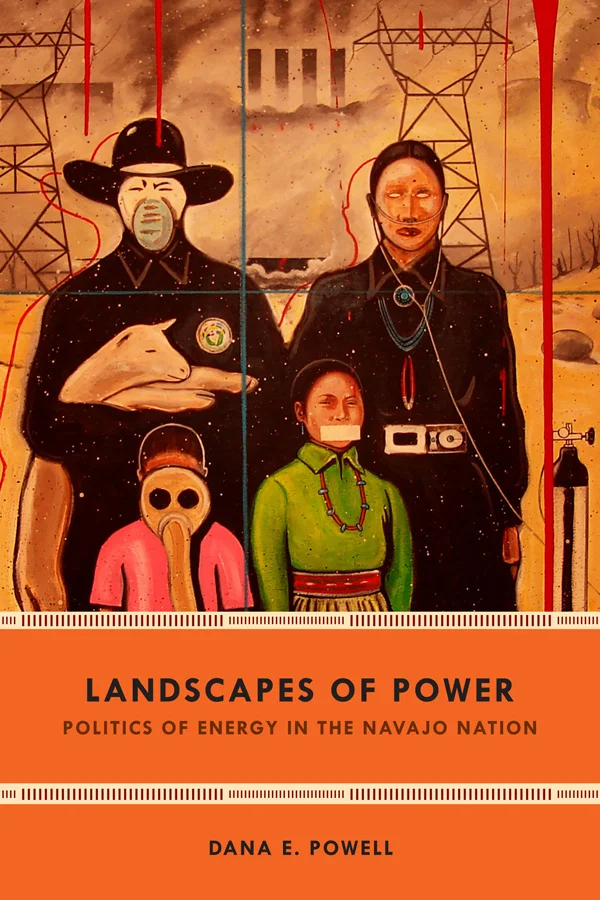
"In this masterful study Dana E. Powell weaves a rich narrative that intertwines Navajo leaders' efforts to reverse a depressed economy with the complexities of the political atmosphere, tribal sovereignty, the imperative to address environmental justice and climate change, and Navajo concerns about land use. Landscapes of Power is indispensable to the study of Native nations, their relationships to energy and development projects, and to understanding the Navajo nation's twenty-first-century history." - Jennifer Nez Denetdale (Diné), University of New Mexico
"Expertly tracing the legacy of the thwarted Desert Rock project, Dana E. Powell identifies an ethical project among Navajo activists that signals politics beyond straightforward environmentalism—a politics that matters for Navajo sovereignty, territory, and ethical ways of life, as well as for energy activism and policy everywhere. As with #NoDAPL and Standing Rock, the Desert Rock struggle goes to the core of what politics look like within, across, and in solidarity with Indian Country. This is essential reading." - Jessica R. Cattelino, author of High Stakes: Florida Seminole Gaming and Sovereignty
“Powell's book is impressive and creative. Essential reading for scholars of the Navajo nation and Indian country more broadly. Essential. Upper-division undergraduates through professionals.” - R. E. O'Connor, Choice
“Dana Powell’s Landscapes of Power offers a fresh, astute, and important look at contemporary life within the context of energy politics on an American Indian Reservation in what is arguably the first modern and consciously post-colonial ethnography of the Diné. This book should draw interest from a broad range of readers.” - Gilbert A. Quintero, Medical Anthropology Quarterly
"Dana Powell is a gifted writer and exquisite storyteller, and the book is engaging, readable, and carries the reader through from beginning to end." - Kristina Jacobsen, Canadian Journal of Native Studies
"Landscapes of Power seeks to explain what energy justice and climate justice look like for marginalized communities embedded in ecologies rich in energy minerals. The book complicates common understandings of sovereignty as absolute independence; instead, it considers the variant forms of struggles and redefinitions of sovereignty among the Diné in their ongoing contestations over land, minerals, and energy...." - Jorge Ramirez, Radical History Review
"No other work has gone so far to provide a ground-level understanding of how individual tribal members experienced development and how those experiences shaped the debates about and ultimate policy toward further projects." - James Robert Allison III, American Historical Review
"A welcome addition to ethnographies of governance and power in Native communities. . . . A timely contribution to literature on energy projects that threaten Indigenous lands. It gives voice to Navajo people who were ignored or marginalized during institutional deliberations of the power plant." - Andrew Curley, Environment and Society
"A theoretically sound and thoughtful narrative that moves from the imagined landscapes of pollution and degradation to how the politics of tribal sovereignty is entwined with the environmental justice activism that emerges from the sociocultural life of the inhabitants of the Diné Nation. . . . Landscapes of Power is particularly well suited for American Indian studies and anthropology courses that examine the intersecting challenges and interests of economic development, environmental justice, and tribal sovereignty." - Sean P. Bruna, American Ethnologist
"Landscapes of Power will prove valuable for social scientists, scholars, and educators to explore the deep sociopolitical, cultural, and economic coloniality of energy development during this time of great transition, one hopes, from extractive to renewable resources in the current Anthropocene." - James V. Fenelon, Mobilization
"Its accessible prose makes it a good choice for the classroom. Landscapes of Power will spark interesting discussions among undergraduates and graduate students in anthropology, Native American and ethnic studies, and the history of environmental justice movements. For scholars of the modern Navajo Nation it is essential reading." - Marsha Weisiger, Anthropos
"Overall this book affords groundbreaking insight into discourses of climate change, tribal sovereignty, dynamics of governance and power, and the voices of local Navajo energy-justice activism." - Bruce Gjeltema, Western Historical Quarterly
"This work is … an important contribution to the anthropology of climate change because it qualifies what is meant by such catch-all terms as 'environmentalism' and 'climate justice' in an indigenous context." - Nimisha Thankur, Allegra Laboratory
"Landscapes of Power is empirically rich and effectively puts issues of colonialism, indigenous sovereignty, and expertise at the heart of debates about environmental and energy justice. It makes clear that the practice of energy justice is always about more than forms and technologies of energy. Readers interested in the history of technology and the energy humanities will glean much from this analysis of the plurality of energy politics and the ways technology opens up new spaces for forging alliances and futures from the ground up." - Caleb Wellum, Technology and Culture