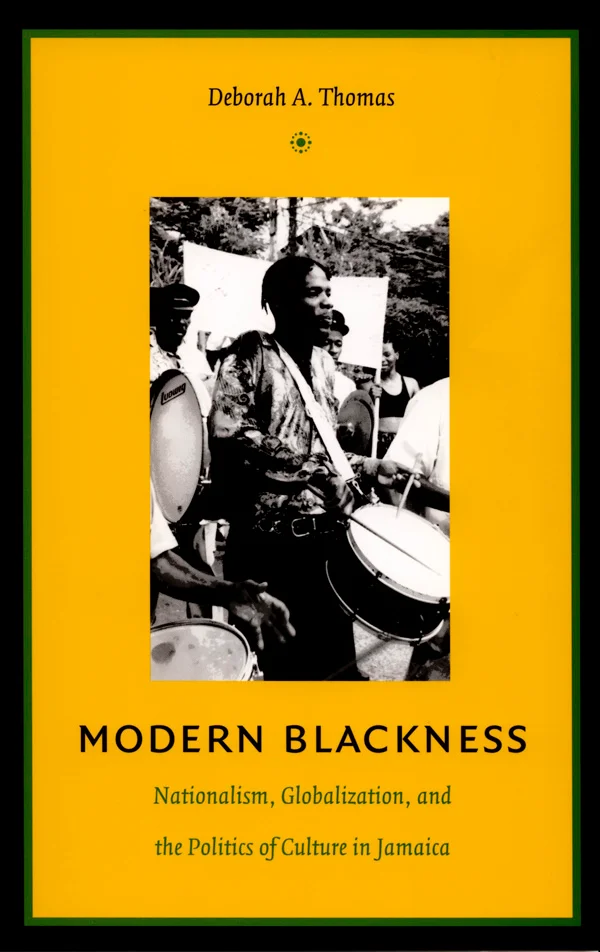
“Modern Blackness is historically conscious and methodologically grounded in ethnography.” - Shana Higgins , Ethnic and Racial Studies
“[T]his wonderfully insightful book is essential reading for Caribbeanists.” - Charles V. Carnegie , New West Indian Guide
“In Thomas's brilliant multisited research and multilayered analysis, the political economy of development-specifically, neoliberal capitalist globalization-is critical in understanding the politics of Jamaican culture and identity. Highly recommended.” - E. Hu-DeHart , Choice
“Thomas gives us a profound understanding of the ways many Jamaicans perceive themselves and each other. . . . [H]er book is a substantial and worthwhile contribution to the literature.” - Anita M. Waters , Journal of Anthropological Research
“Thomas has produced an excellent book that will be of great interest to students and scholars interested in race and blackness, not just in the Caribbean, but in the Americas and the Black Atlantic more widely. I think it will appear on many course reading lists and be popular with students. I tis good to see great ethnography deployed to good effect to address issues that are of central concern to many different disciplines.” - Peter Wade , Critique of Anthropology
“Thomas’ book is a provocative and timely contribution to Caribbean anthropology. It is an evocative text which speaks to issues of racial politics and expressive culture, as well as to questions of nation building and the fate of nationalist institutions within an increasingly transnational and diasporic context. It is sure to be of interest to scholars of the Caribbean and Latin America as well as to those interested more widely in issues of nationalism, class relations, and the politics of culture.”
- Yarimar Bonilla , Journal of Latin American Anthropology
"Modern Blackness is an exploration of the counterculture that has come to dominate Jamaica's national identity-despite what anybody in authority asserts. . . . Thomas gets to the heart of what the war is all about-a proxy battle over the concept of the nation-state." - Colin Channer , TLS
"Modern Blackness contributes to a scholarly understanding of the relationship between modern Jamaican politics and culture. It provides a useful synthesis of that country's political and cultural policies in the nineteenth and twentieth centuries and, in the interviews its author has conducted with the people of Mango Mount, lets readers 'hear' the voices of ordinary Jamaicans." - Juanita de Barros , Canadian Journal of History
"Modern Blackness is a well written, well researched book that challenges established views of Jamaican nationalism and the nation-state." - Barbara Nelson, Jamaica Gleaner
"[Thomas's] analysis is consistent with contemporary anthropology in its careful evaluation and preference for description. Even so, one comes away from the book with a clear sense of modern blackness’s critique of state-sponsored identities and colonial hierarchies, not to mention its liberatory potential." - Wayne Marshall , Interventions
"The most valuable part of the work is its insight into what ordinary Jamaicans want Jamaican society to be. . . . One of the most penetrating and thought-provoking studies of contemporary Caribbean society available today. As such it is essential reading for academics, students and the general public interested in the Caribbean and Latin America." - Don Robotham , Social and Economic Studies
“Modern Blackness is an important book. It is well written, it puts forth a creative theoretical apparatus, and it displays Deborah A. Thomas’s keen ethnographic eye. It is on a topic of extreme importance to the discipline of anthropology as well as to African diaspora and Caribbean and Latin American studies, engaging as it does some of the effects of neoliberalism and structural adjustment in today’s world.” - Kevin A. Yelvington, author of Producing Power: Ethnicity, Gender, and Class in a Caribbean Workplace
“In its critique of creole respectability, Modern Blackness challenges established views of Jamaican nationalism and the nation-state. Deborah A. Thomas argues that the young and black who live in Kingston have forged social values and transnational links that reflect their disillusion with education and aspirations to the middle class. She confronts the reader with the reality of life among the ‘lower sets’ and provides a provocative agenda for rethinking blackness.” - Diane Austin-Broos, author of Jamaica Genesis: Religion and the Politics of Moral Orders