
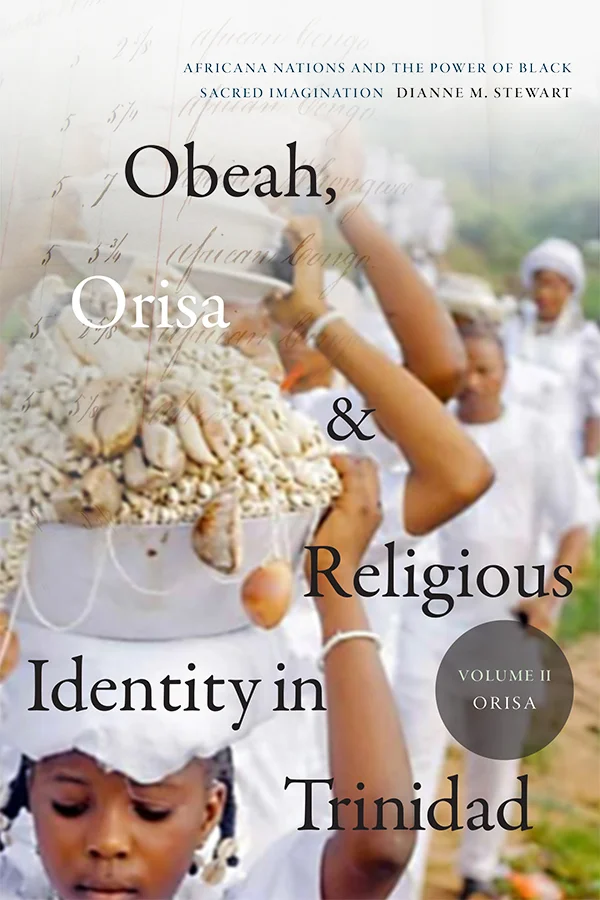
Obeah, Orisa, and Religious Identity in Trinidad, Volume II, Orisa
Africana Nations and the Power of Black Sacred Imagination
Book
Pages: 368
Illustrations: 53 illustrations
Published: October 2022
Author: Dianne M. Stewart
Contributor: Tracey E. Hucks
Subjects
Religious Studies, African American Studies and Black Diaspora, Anthropology > Cultural Anthropology
Religious Studies, African American Studies and Black Diaspora, Anthropology > Cultural Anthropology
Praise
Buy
Availability: In stock
Price: $28.95
This title will be released on October 07, 2022
Buy the e-book:
Open Access
Funding information for the OA format is found at the bottom of the page.
Information
Author/Editor Bios
Back to Top
Dianne M. Stewart is the Samuel Candler Dobbs Professor of Religion and African American Studies at Emory University and author of Three Eyes for the Journey: African Dimensions of the Jamaican Religious Experience and Black Women, Black Love: America’s War on African American Marriage.
Table Of Contents
Back to Top
List of Abbreviations Used in Text ix
Note on Orthography and Terminology xi
Preface xiii
Acknowledgments xix
Introduction to Volume II 1
1. I Believe He Is a Yaraba, a Tribe of Africans Here: Establishing a Yoruba-Orisa Nation in Trinidad 9
2. I Had a Family That Belonged to All Kinds of Things: Yoruba-Orisa Kinship Principles and the Poetics of Social Prestige 52
3. “We Smashed Those Statues or Painted Them Black”: Orisa Traditions and Africana Religious Nationalism since the Era of Black Power 83
4. You Had the Respected Mothers Who Had Power! Motherness, Heritage Love, and Womanist Anagrammars of Care in the Yoruba-Orisa Tradition 147
5. The African Gods Are from Tribes and Nations: An Africana Approach to Religious Studies in the Black Diaspora 221
Afterword. Orisa Vigoyana from Guyana 249
List of Abbreviations Use in Notes 255
Notes 257
Bibliography 305
Index 327
Note on Orthography and Terminology xi
Preface xiii
Acknowledgments xix
Introduction to Volume II 1
1. I Believe He Is a Yaraba, a Tribe of Africans Here: Establishing a Yoruba-Orisa Nation in Trinidad 9
2. I Had a Family That Belonged to All Kinds of Things: Yoruba-Orisa Kinship Principles and the Poetics of Social Prestige 52
3. “We Smashed Those Statues or Painted Them Black”: Orisa Traditions and Africana Religious Nationalism since the Era of Black Power 83
4. You Had the Respected Mothers Who Had Power! Motherness, Heritage Love, and Womanist Anagrammars of Care in the Yoruba-Orisa Tradition 147
5. The African Gods Are from Tribes and Nations: An Africana Approach to Religious Studies in the Black Diaspora 221
Afterword. Orisa Vigoyana from Guyana 249
List of Abbreviations Use in Notes 255
Notes 257
Bibliography 305
Index 327
Rights
Back to TopSales/Territorial Rights: World
Rights and licensingAdditional Information
Back to Top
Related Links
Paper ISBN:
978-1-4780-1486-7 /
Hardcover ISBN:
978-1-4780-1392-1 /
eISBN:
978-1-4780-2215-2 /
DOI:
https://doi.org/10.1215/9781478022152
Publicity material
Funding Information
Back to TopThis book is freely available in an open access edition thanks to TOME (Toward an Open Monograph Ecosystem)—a collaboration of the Association of American Universities, the Association of University Presses, and the Association of Research Libraries—and the generous support of Emory University and the Andrew W.
Mellon Foundation. Learn more at the TOME website.