
Home / Books / Oceaning

Oceaning

Governing Marine Life with Drones
Book

Pages: 248

Illustrations: 36 illustrations

Published: February 2024

Author: Adam Fish

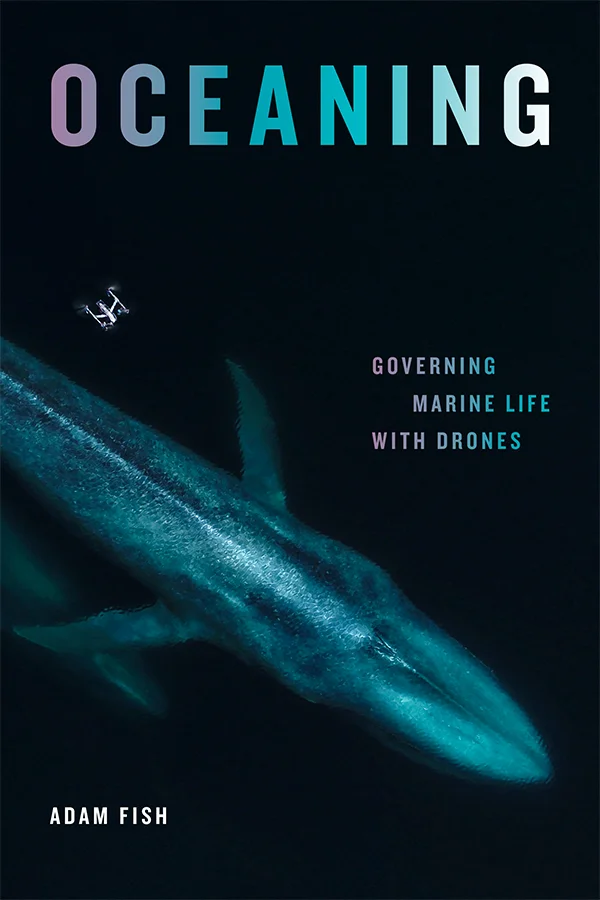
Drones are revolutionizing ocean conservation. By flying closer and seeing more, drones enhance intimate contact between ocean scientists and activists and marine life. In the process, new dependencies between nature, technology, and humans emerge, and a paradox becomes apparent: Can we have a wild ocean whose survival is reliant upon technology? In Oceaning, Adam Fish answers this question through eight stories of piloting drones to stop the killing of porpoises, sharks, and seabirds and to check the vitality of whales, seals, turtles, and coral reefs. Drone conservation is not the end of nature. Instead, drone conservation results in an ocean whose flourishing both depends upon and escapes the control of technologies. Faulty technology, oceanic and atmospheric turbulence, political corruption, and the inadequacies of basic science serve to foil governance over nature. Fish contends that what emerges is an ocean/culture—a flourishing ocean that is distinct from but exists alongside humanity.

Praise

Oceaning is full of fascinating stories, finely rendered and theorized, about today’s tools of ocean monitoring. Adam Fish’s tales of marine conservation technologies maps fresh configurations of oceanic bodies, intimacies, and elementalities. You will not see that drone hovering above the seashore in quite the same way after you read this absorbing book.” - Stefan Helmreich, author, A Book of Waves

“This beautifully crafted, elegantly written, and poignant book offers a nuanced and complex rendering of the power and potentiality of drones to remake ocean conservation. Rooted in the lively materialities of ocean life, Oceaning foregrounds animal lives in a crucial way and never strays from considering the ethical dilemmas of conservation practices, eschewing the politics of purity as it demands we do something about the human impact on nonhuman life. This outstanding work is an absolute delight to read.” - Stephanie Rutherford, author of Governing the Wild: Ecotours of Power

“The invisibility and inaccessibility of Earth’s oceans has meant they are exposed to all the tragedies of the commons. That is changing quickly. Drones are part of increasingly granular webs of planetary sensing upon which any robust ecological governance depends. Adam Fish’s book explores how as oceans and their myriad forms of life are increasingly visible, they become more conservable, defensible, and governable.” - Benjamin Bratton, University of California, San Diego

"This text describes technology, primarily the use of drones, that extends direct observation into otherwise inaccessible marine locations. . . . In addition to describing these uses of drones, the author provides insights into the professional drone operator community, which illustrate the limitations of current drone technology and give some information on the user groups relying on drone-derived information." - S. R. Fegley, Choice

"Fish’s book provides an important stepping stone in advancing care-filled, drone enabled conservation at sea, as well as an invitation to further reflect on its limits, from bottlenecks in processes and elemental grappling, to further interrogating the who and what of ocean droning." - Anna Jackman, H-Oceans, H-Net Reviews

"Fish has written a fascinating and sure-to-be-controversial ethnography exploring the use of drones in marine conservation that makes a bold biocentric argument in favor of surveillance, intervention, and enforcement of marine conservation law." - Aaron van Neste, H-Environment, H-Net Reviews

"For those interested in contemporary media practices in marine conservation efforts or searching for a new epistemological framework that best exemplify the blue humanities, Oceaning would be an excellent resource." - Ennuri Jo, Journal of Environmental Media

“[Fish] makes a novel contribution to drone studies by centering the more-than-human in his analysis, rather than reverting to only thinking about drone ethics through the lens of human rights and needs. . . . While we discuss more ecologically just futures, Oceaning’s attention to the imperfect yet passionate work of marine conservationists, activists, and researchers reminds us that we must build those futures right now with all tools at our disposal.”

- Amy Gaeta, Visual Studies

Buy

Availability: In stock

Price: $26.95

Request a desk or exam copy

Information

Author/Editor Bios

Back to Top
Adam Fish is a Scientia Associate Professor of Arts and the Media at the University of New South Wales, author of Technoliberalism and the End of Participatory Culture in the United States, and coauthor of Hacker States and After the Internet.

Table Of Contents

Back to Top
Acknowledgments  ix
1. Beginning: Intimacies of Conservation Theology  1
2. Technicity: Touching Whale Exhale with Drones  28
3. Elementality: Confronting Whalers Through the Air and on the Seas  49
4. Governmentality: Flying to the Limits of the Law Against Shark Fin Poachers  72
5. Storying: Tracking Northern Fur Seals and Their Extinction Media  96
6. Crashing: Falling Drones and Abandoned Tern Colonies  119
7. Living: Coexisting with Sharks  140
8. Ending: Coral/Cultures  164
References  191
Index  223

Rights

Back to Top

Sales/Territorial Rights: World

Rights and licensing

Additional Information

Back to Top
Paper ISBN: 978-1-4780-3001-0 / Hardcover ISBN: 978-1-4780-2580-1 / eISBN: 978-1-4780-5901-1 / DOI: https://doi.org/10.1215/9781478059011