
Home / Books / Point of Reckoning

Point of Reckoning

The Fight for Racial Justice at Duke University
Book

Pages: 400

Illustrations: 30 illustrations

Published: February 2021

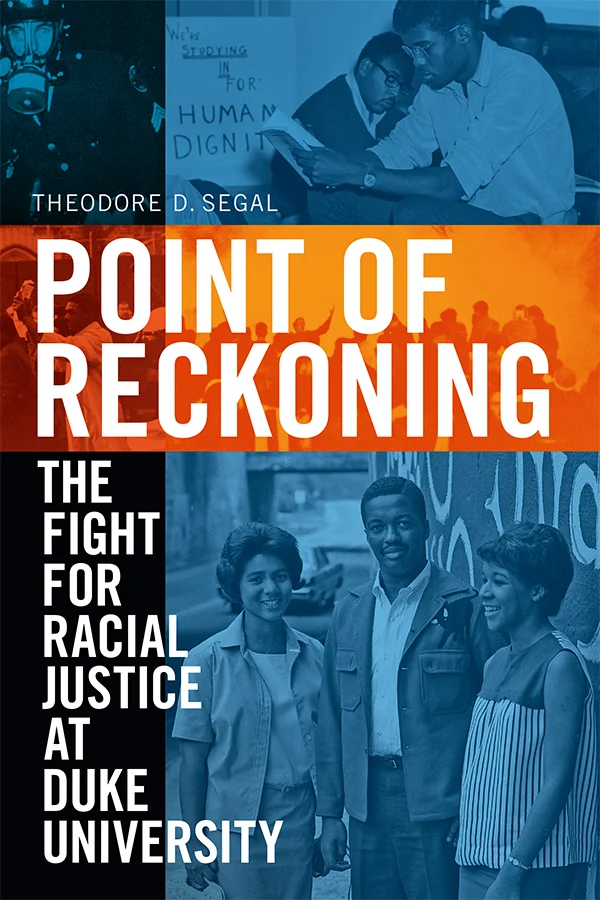
On the morning of February 13, 1969, members of Duke University's Afro-American Society barricaded themselves inside the Allen administration building. That evening, police were summoned to clear the building, firing tear gas at students in the melee that followed. When it was over, nearly twenty people were taken to the hospital, and many more injured. In Point of Reckoning, Theodore D. Segal narrates the contested fight for racial justice at Duke from the enrollment of the first Black undergraduates in 1963 to the events that led to the Allen Building takeover and beyond. Segal shows that Duke's first Black students quickly recognized that the university was unwilling to acknowledge their presence or fully address its segregationist past. By exposing the tortuous dynamics that played out as racial progress stalled at Duke, Segal tells both a local and national story about the challenges that historically white colleges and universities throughout the country have faced and continue to face.

Praise

Point of Reckoning is a remarkable and unforgettable story that traces the white racial foundations of Duke University while uncovering how whiteness actively resists change in the face of Black dehumanization. Segal renders the unremarkable existence of racism remarkable and painfully reveals what happens to a dream deferred—it explodes. As we currently bear witness to Black suffering and inequity, righteous indignation and Black protests near and far, Point of Reckoning is an urgent text that offers hope as it dares to illuminate the past in order that we might not be condemned to repeat it.” - George Yancy, Samuel Candler Dobbs Professor of Philosophy at Emory University

“In vivid detail, Theodore D. Segal introduces us to men and women, Black and white, who tried to differentiate between integration and desegregation, between being welcomed and included and remaining true to themselves as Black Americans and becoming darker versions of white Americans. As Segal uncovers, not only did the actors have conflicting notions of what was at stake, but they often differed on what was desired. In that sense, he exposes the long history of today's raging debates on campus about race and diversity.” - Professor Earl Lewis, Director and Founder of the Center for Social Solutions, University of Michigan

"[A] doggedly researched narrative . . .  [providing] a candid view of institutional resistance to social justice and its dismantling by determined activism.” - Kirkus Reviews

"Excellent, accessible. . . ." - Mark I. Pinsky, New York Journal of Books

"A methodological strength of Point of Reckoning is how Segal grounds the narrative almost entirely in oral history, which helps provide a broad, accessible, and well-balanced perspective. . . . This book will be required reading for all of the university’s constituents as a common reference point for continuing to move the university forward according to its stated values." - Brandon K. Winford, Black Perspectives

"A useful volume for any library supporting graduate study in the management and history of higher education. Recommended. Graduate students, faculty, and professionals." - Choice

Point of Reckoning makes clear that race and racial issues have been a central conflict at Duke since its inception. . . . Individuals who are interested in higher education, race and education, civil rights, social movements, and Black history will greatly benefit from a careful reading of Point of Reckoning.” - Brian Daugherity, Journal of Southern History

"The most compelling part of the book follows an AAS protest in 1969. The narrative is so engaging because it’s largely based on interviews Segal conducted with activists just ten years after the protest. . . . Point of Reckoning is a solid case study of Black student activism." - Matthew Johnson, Journal of African American History

"Point of Reckoning is an important contribution to the histography of how Black Americans have sacrificed their lives—spiritual, emotional, physical—to enter into hostile white spaces 'bathed in the commitment [of ] wanting to make a difference' in their community and in America (277)." - Dwonna Naomi Goldstone, American Historical Review

Buy

Availability: Loading...

Price: Loading...

Open Access

Request a desk or exam copy

Information

Author/Editor Bios

Back to Top
Theodore D. Segal is a lawyer and member of the board of directors for the Center for Documentary Studies at Duke University. He received his undergraduate degree from Duke in 1977.

Table Of Contents

Back to Top
List of Abbreviations  xi
List of Key Actors  xiii
Acknowledgments  xv
Introduction: A Historic Encounter  1
1. A Plantation System: Desegregation  5
2. Like Bare Skin and Putting Salt on It: First Encounters  32
3. Rights, as Opposed to Privileges: Race and Space  60
4. We Were Their Sons and Daughters: Occupation of University House  102
5. Hope Takes Its Last Stand: The Silent Vigil  125
6. Humiliating to Plead for Our Humanity: Negotiations  160
7. Now They Know, and They Ain't Gonna Do: Planning  182
8. No Option to Negotiate: Confrontation  208
9. We Shall Have Cocktails in the Gloaming: Aftermath  242
Epilogue: Something Has to Change—2019, Fifty Years Later  276
Notes  287
Bibliography  347
Index  357

Rights

Back to Top

Sales/Territorial Rights: World

Rights and licensing