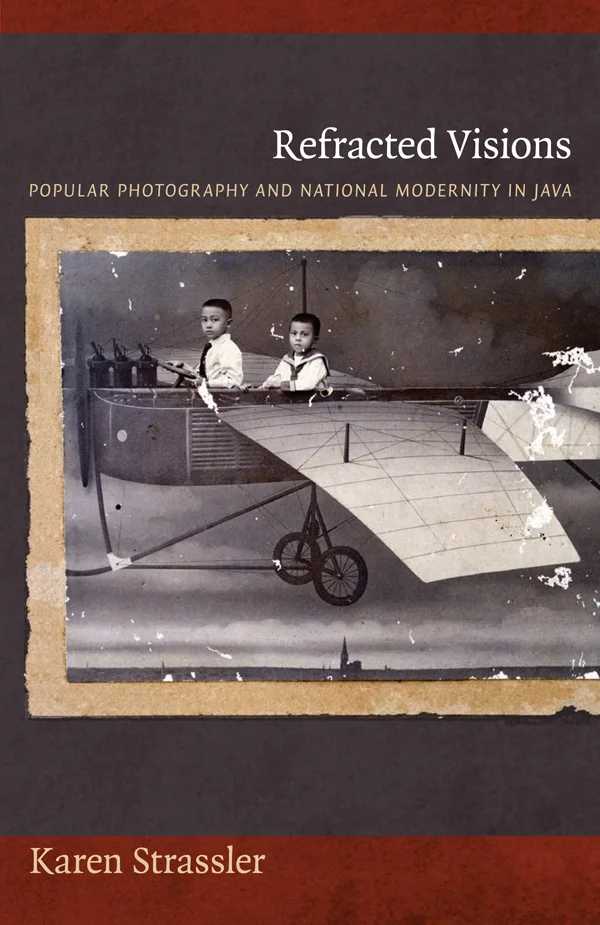
“Refracted Visions is a substantial and well-researched study of contemporary popular photography in Indonesia, a result of anthropologist Karen Strassler’s extensive fieldwork in Java since the mid-1990s. . . . This rich and provocative study offers a thorough understanding of the changing role of photography in Javanese society at the popular level. . . .” - Iftikhar Dadi, CAA Reviews
“An original and finely crafted book . . . . Besides Refracted Visions’ many compelling arguments, including the one that lays out the centrality of Chinese-Indonesians to the historical process of imagining Indonesia, Strassler expresses herself in clear, nuanced language that combines subtle analysis with vivid description and an acute eye for historically situated, ethnographic detail.” - Patricia Spyer, International Journal of Asian Studies
“[Strassler] is in the text, recording snatches of conversations, often giving an
informant’s particular choice of words in Indonesian to convey the nuance and the moment. Woven around all this are reflections on the modern Indonesian nation, the relationship of individual to the state, and how visual records reflect, perpetuate or subvert official discourse. Thanks to a subvention from the Getty Foundation, the book is lavishly illustrated, so readers can see for themselves the photographs so thoughtfully analysed.” - Jean Gelman Taylor, Journal of Southeast Asian Studies
“[This] book is an important contribution to the anthropology of photography, and a special contribution to the understanding of modern Indonesian society.” - Heddy Shri AHIMSA-PUTRA, Asian Anthropology
“As an ethnography of popular culture, art history, and social history, the book is rare, even unique in the field of Indonesian studies. . . . Refracted Visions satisfies a gap in the literature of Asian art history and technological studies by charting the slow and formative impact of photography as a distinct enframing device for Indonesian identity.” - Doreen Lee, Indonesia
“As this short review of Refracted Visions indicates, this highly readable and carefully produced volume, which received the 2011 Gregory Bateson book prize of the AAA’s Society for Cultural Anthropology, will arouse the interest of Indonesianists of various disciplinary backgrounds, as well as anthropologists working in Southeast Asia (and beyond) and the broader readership concerned with visual cultures.” - Martin Slama, The Asia Pacific Journal of Anthropology
“Strassler’s often brilliant effort to forge a discourse appropriate to the complexities of her subject points to what is ultimately at stake in all national histories: the demarcation of identity in general.” - Geoffrey Batchen, Art Bulletin
“This intriguing and sophisticated book addresses the complex interface of popular photographic practices, history, politics, and identity in Java. . . . The
six genres of popular photography are also marvellously illustrated with 127 photographs, mostly in colour. Duke University Press is to be congratulated on combining extremely high production values with the swift publication of a low-priced paperback. This will help to ensure that this ethnography of popular photography will influence future analyses of visual and expressive cultures in Indonesia and elsewhere.” - Felicia Hughes-Freeland, Journal of the Royal Anthropological Institute
“Refracted Visions is a tour de force. Karen Strassler has a sophisticated grasp of contemporary theories of representation in both anthropology and photography studies, a deep and carefully attentive ethnographic eye, and a refined aesthetic sensibility. She limns the boundary between new historicist cultural studies and old fashioned anthropology with uncommon grace.” - Rosalind C. Morris, editor of Photographies East: The Camera and Its Histories in East and Southeast Asia
“Refracted Visions is a genuinely marvelous work which merits reading and rereading.” - John Pemberton, author of On the Subject of “Java”
“Refracted Visions is a truly brilliant piece of work, beautifully written and characterized by a profound learning and engagement with Indonesian ethnography and a range of debates around visuality and representation. It will be hailed as a classic.” - Christopher Pinney, author of The Coming of Photography in India
“. . . [N]ot only an in-depth study of ethnic Chinese in Indonesian photographic history, but a beautifully written historical study of visuality, representation and the cultural significance of popular photography in the context of colonial and post-colonial Java.” - Charlotte Setijadi-Dunn, Inside Indonesia
“Refracted Visions is an innovative and inspiring book because it demonstrates eloquently how people in urban Java started to participate
in national modernity through photography. . . . [T]his highly original and well written book, with no fewer than 127 telling illustrations, is a landmark in the anthropology of visuality. . . . Refracted Visions is, in my view, a strong candidate to win prestigious academic prizes.” - Henk Schulte Nordholt, Asian Studies Review
“In conclusion, the main contribution of Refracted Visions lies in its conceptualization of popular photographs as exceeding the private domain and engaging with collective aspirations and affiliations in ways that both support and subvert them. This point should be taken as a caution against the common display of photographs of late colonial and early postcolonial Asia to evoke nostalgia for a depoliticized, aestheticized past that never was.”
- Maurizio Peleggi, Pacific Affairs