
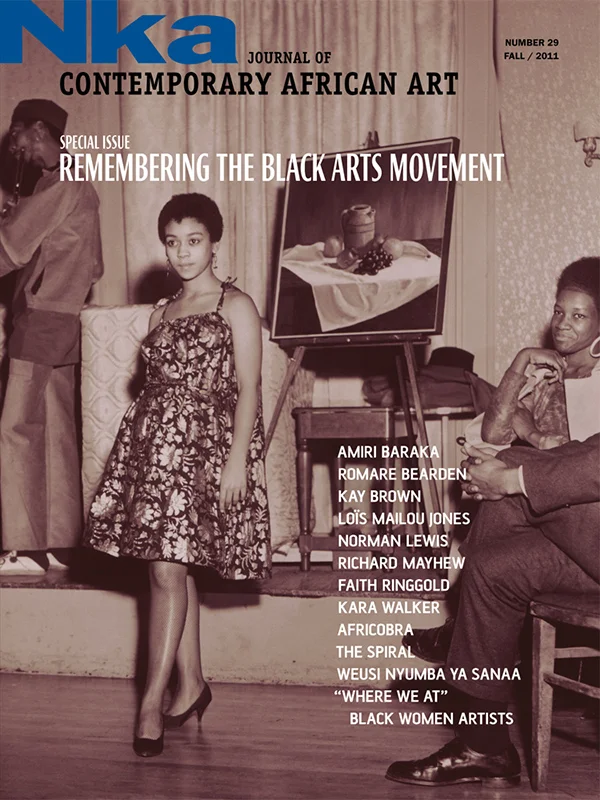
Remembering the Black Arts Movement
An issue of: Nka
Buy
For more information or to access this journal, visit the Nka page.
Price: $30.00
Information
Table Of Contents
Back to TopRemembering the Black Arts Movement
Hassan, S. M.
Black Aesthetics Unbound
Crawford, M. N.
How did the Black Arts movement become an antitext movement? How did the black aesthetic of this movement use the tension between the bound and the unbound? This essay examines the movement’s critique of a dominant "museum exhibit" cultural industry that transformed grass-roots culture into highbrow capital. The author argues that the movement resisted the "museum exhibit" of the dominant-culture industry by dramatizing the tension points between inner space, outside space, and unbound space. The aesthetic warfare of the movement is shown to be a struggle against the textualization of gesture and process. This antitext struggle is brought into close relation with the often unrecognized conceptual art movement at the core of the Black Arts movement. The AfriCOBRA tenet of "mimesis at mid-point" leads the author to a reconsideration of the explicit theorizing, during this movement, about the need for both representation and abstraction. As artists worked books for their most antitext and anti-object possibilities, words were worked for their most oral and visual possibilities. The antitext impulse became the impulse to shape the black aesthetic around sonic imagetexts (textual performances that aimed to somehow avoid framing and containing ephemeral but excessive acts of sounding black, looking black, and becoming black).
The Black Arts Movement: Its Meaning and Potential
Baraka, A.
This essay outlines the development and activities of the Black Arts Repertory Theater/School. Its members set up classes on history, politics, and drama; hosted plays, poetry readings, and new music concerts; and stalked through the community preaching about Blackness. Despite its trials, including fighting among members and criticism from the rest of the art world, the theater and school, along with the Black Arts Movement, has made a significant impact. The continuing task faced by revolutionary Black artists and intellectuals is to further the Cultural Revolution.
Studios in the Street: Creative Community and Visual Arts
Widener, D.
The visual arts played a critical role in the cultural awakening that began with the Second World War and flourished in the aftermath of the Watts riots. In searching for new means of expression rooted in and relevant to the communities from which they came, black artists based in Los Angeles pushed the parameters of consciously black art by offering a fundamental reevaluation of the meaning art could have in black lives. Much like avant-garde jazz musicians, visual artists developed a unique mixed-media language that combined themes of political insurgency, communitarian engagement, and familiar cultural tropes of migration, musical, spirituality, and family. Augmented by a cross-generic engagement with sound and text, this bricolage avoided the formal limits of realist representation while producing a culturally specific aesthetics that artists could take as emblematic of the black liberation movement’s broader critique of the limits of American society for what Duke Ellington had called "the sun-tanned tenth of the nation."
Death Proof: Trauma, Memory, and Black Power-Era Images in Contemporary Visual Culture
Ongiri, A.
In Death 24x a Second Laura Mulvey argues that cinematic images belie the deathlike qualities of still photography because of their ability to invoke the appearance of life through motion. This essay examines film and video projects that use found footage and still images from the Black Power era by redeploying them in