
Home / Books / Revolution and Disenchantment

Revolution and Disenchantment

Arab Marxism and the Binds of Emancipation
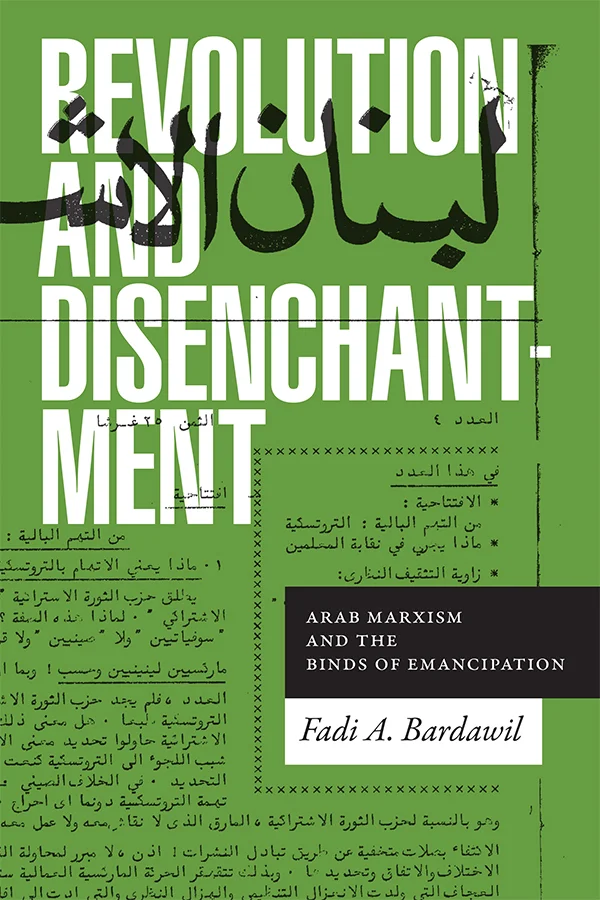
Book

Pages: 280

Illustrations: 4 illustrations

Published: April 2020

The Arab Revolutions that began in 2011 reignited interest in the question of theory and practice, imbuing it with a burning political urgency. In Revolution and Disenchantment Fadi A. Bardawil redescribes for our present how an earlier generation of revolutionaries, the 1960s Arab New Left, addressed this question. Bardawil excavates the long-lost archive of the Marxist organization Socialist Lebanon and its main theorist, Waddah Charara, who articulated answers in their political practice to fundamental issues confronting revolutionaries worldwide: intellectuals as vectors of revolutionary theory; political organizations as mediators of theory and praxis; and nonemancipatory attachments as impediments to revolutionary practice. Drawing on historical and ethnographic methods and moving beyond familiar reception narratives of Marxist thought in the postcolony, Bardawil engages in "fieldwork in theory" that analyzes how theory seduces intellectuals, cultivates sensibilities, and authorizes political practice. Throughout, Bardawil underscores the resonances and tensions between Arab intellectual traditions and Western critical theory and postcolonial theory, deftly placing intellectuals from those traditions into a much-needed conversation.

Praise

“Fadi A. Bardawil's Revolution and Disenchantment is at once a rich redescription and rehistoricization of the rise and fall of the Lebanese New Left, and an exemplary illustration of how to rework the problem of theory in relation to the practices of nonmetropolitan political intellectuals. With a timely attunement to the paradoxical conundrums of his present and an uncommon generosity of spirit, Bardawil challenges us to reconceive the contemporary demand for a dialogue between Arab intellectual traditions and the traditions of Western critical theory.” - David Scott, Columbia University

“Conceptually brilliant, prodigiously researched, and appealingly written, Revolution and Disenchantment tracks the theoretical innovations and political stakes of Arab revolutionary Marxism in the postwar era, contributing to timely debates about the necessity of decolonizing critical theory and the relationship between revolutionary militancy and political disenchantment. Fadi A. Bardawil's innovative archival excavation recovers the theoretical labor of Arab intellectuals, theorists, and militants from Lebanon, Syria, Egypt, and Palestine in the midst of a multiplicity of political upheavals.” - Omnia El Shakry, author of The Arabic Freud: Psychoanalysis and Islam in Modern Egypt

"Is the question of social inequality eclipsed by sectarianism in the Near East? Is it possible to found a Left which is both autonomous and critical of nationalism? Fadi Bardawil brings this important episode of theoretical elaboration back to the history of Arab thought. Further, he invites us to break away from the colonial perspective which stipulates that social theory is created in the North and applied to the South." (translated from French) - Jean-Michel Landry, Le Monde Diplomatique

"Revolution and Disenchantment brings Lebanon back into the story of the twentieth century francophone left and elegantly delivers a new framework for understanding the translation and transformation of theory." - Sarah K. Miles, Global Intellectual History

"Bardawil’s timely 'fieldwork in theory' offers important insights into a laboratory of political imagination out of the radar of mainstream critical theory and explores the cosmopolitical traffic of leftist theories. His work overcomes the distinction that depicts 'Western' universal theory as opposed to non-Western local theories, highlighting the transnational modulations of critical theory in a new light and in multiple directions." - Alexander Koensler, Anuac

Revolution and Disenchantment…dismantles the ‘critique of Eurocentrism’ as the only way to conduct critical scholarship in Arab thought. Most significantly, it deftly and incisively performs the theoretical ground-clearing that will enable scholars of Arab and postcolonial thought to stage the fine-grained, sustained, generous-yet-critical readings of Arab intellectuals as thinkers….” - Yasmeen Daifallah, Postcolonial Studies

“[Bardawil] composes an extremely rich analysis from the perspectives of ethnography and intellectual history. This analysis advances an interesting critique of the dominant narrative found in the academic world and, at the same time, offers an archive of thoughts on the Marxist movement from the postcolonial Arab world.” (Translated from Indonesian) - Sawyer Martin French, Suryakanta

"Revolution and Disenchantment is a different kind of academic book, profoundly interdisciplinary as it weaves together the crux of postcolonial studies, intellectual history, political theory and anthropological inquiries…. The book truly pries open the epistemological categories of modern social sciences." - Myriam Amri, LSE Review of Books

“It is this tendency of theory to extend itself beyond its own analytical contours that Bardawil considers the major corollary to his historical narrative, and he wields this insight both in his critique of the interpretative failures of postcolonial theory, and in his repeated rejection of the impulse to canonise an ‘Arab theory’....” - Francesco Anselmetti, Radical Philosophy

Revolution and Disenchantment offers a powerful example of critical ethnographic engagement with radical intellectual and militant movements within a broader intellectual world colored by a postcolonial divide.... Bardawil shows how the militant intellectuals of Socialist Lebanon carefully attend to both global and local forms of domination, with an analytical commitment to centering power relations and the social.”

- Sawyer Martin French, The Maydan

"This volume is an impressive example of critical scholarship examining the intellectual and political dynamics of the modern history of Lebanon and its Arab neighbors. It vividly demonstrates the revolutionary hope and political disenchantment that continue to characterize the Middle East today." - A. Rassam, Choice

“A few pages into this work, the reader knows that they are in good hands, that Bardawil took the time to think seriously, deeply and creatively about Marxism, revolution, and a host of related issues, and that in so doing he broadens our horizons in significant and meaningful ways.” - Yoav Di-Capua, Journal of Arabic Literature

“Conceptually achieved in this persuasive work is a historiography of the heterodox Marxist tradition, written outside fixed positions and evolutionary worldviews.... Exiting Marxism is not an exit from Marxism but an entrance through which Bardawil is able to write an unsealed history of past struggles.” - Salma Shamel, Rethinking Marxism

“[Bardawil’s] thoughtful excavation of [a] forgotten archive of Arab Marxist theory, critical attention to social and political conditions, and nuanced analysis of the relationship between theory and practice produce a provocative argument about the pitfalls of adopting binary visions of power relations.” - Kevin M. Jones, American Historical Review

Buy

Availability: Loading...

Price: Loading...

Open Access

Read OA Edition

Funding information for the OA format is found at the bottom of the page.

Request a desk or exam copy

Information

Author/Editor Bios

Back to Top
Fadi A. Bardawil is Assistant Professor of Asian and Middle East Studies at Duke University.

Table Of Contents

Back to Top
A Note on Transliteration and Translation  ix
Prologue  xi
Introduction  1
Part I. Time of History
1. O Youth, O Arabs, O Nationalists: Recalling the High Tides of Anticolonial Pan-Arabism  27
2. Dreams of a Dual Birth: Socialist Lebanon's Theoretical Imaginary (1964–1970)  53
3. June 1967 and Its Historiographical Afterlives  82
Part II. Times of the Sociocultural
4. Paradoxes of Emancipation: Revolution and Power in Light of Mao  113
5. Exit Marx/Enter Ibn Khaldun: Wartime Disenchantment and Critique  138
6. Traveling Theory and Political Practice: Orientalism in the Age of the Islamic Revolution  165
Epilogue  187
Acknowledgments  195
Notes  201
Bibliography  241
Index  255

Rights

Back to Top

Sales/Territorial Rights: World

Rights and licensing

Awards

Back to Top

Honorable Mention, Nikki Keddie Book Award, presented by the Middle East Studies Association

Funding Information

Back to Top
Publication of this open monograph was the result of Duke University's participation in TOME (Toward an Open Monograph Ecosystem), a collaboration of the Association of American Universities, the Association of University Presses, and the Association of Research Libraries. Funding from Duke University Libraries made it possible to open this publication to the world.