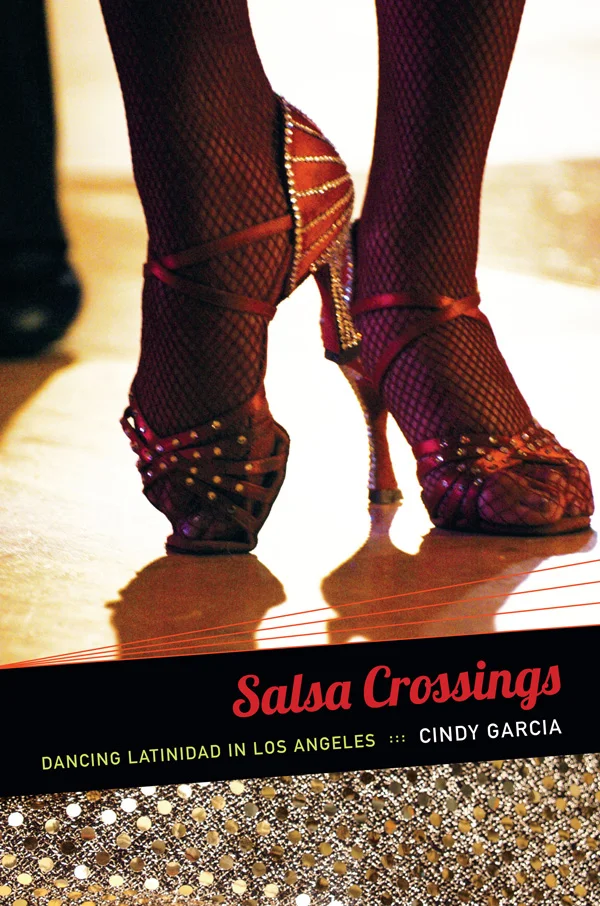
"Salsa Crossings is a nuanced ethnography of the embodied pleasures, struggles, and sociopolitical aspirations that Latinos enact in L.A. salsa clubs. Cindy García analyzes the relationships among dancers, club promoters, wallflowers, and socializers as they negotiate the issues of belonging and exclusion that animate latinidad. She brilliantly positions the libidinal economies and stylistic hierarchies of salsa dancing in Los Angeles within the larger political economy of and among Latinos in the United States. This book makes important and illuminating contributions to the fields of dance and Latino studies." - Deborah Paredez, author of Selenidad: Selena, Latinos, and the Performance of Memory
"With her skilled recognition of the meanings and genealogies of dance styles, Cindy García sets the record straight by illuminating the social hierarchies and conflicts emerging in the salsa clubs of Los Angeles. Scholars of salsa dancing who have focused on the Caribbean and New York until now will no longer be able to ignore California and the West Coast." - Frances Aparicio, author of Listening to Salsa: Gender, Latin Popular Music, and Puerto Rican Cultures
“Readers concerned with Latina/o studies, salsa dance, ethnography, cultural and national identity will be interested in this book. Through her wonderfully descriptive ethnographic storytelling, Garcia offers a cogent study of the power systems emerging from a particular culture’s struggle to deal with contradictions and inequalities brought on by globalization, migration, and transnational labor practices.” - James Moreno, Dance Chronicle
“In her introduction and title, García promises a bold new approach to analyzing salsa dance…. García is at her best when she is thick in everynight action and thick in description. This approach yields brilliant moments, such as when she meditates on the meaning of the preference for arm styling over hip movement in studio salsa, or eavesdrops on the conversations among girlfriends in a nightclub restroom.” - Celeste Fraser Delgado, Dance Research Journal
“[Garcia’s] vibrant study extends well beyond a mere examination of an evolving art form...García’s potent, lively text goes a long way to fill a void and to bring an art form dependent on movement into full flight in the reader’s imagination. For those interested in dance, Latino or otherwise, and complex issues of race, gender, and social hierarchies, this is an indispensible study on the richness of an evolving dance form… Highly recommended.” - J. Fisher, Choice
“Through her experience as a dance ethnographer in a heated urban performance space, Cindy García is able to show – in a highly detailed and refined fashion – how the salsa environment is a prism of immigration and integration problems, globalization and its standardizations and codifications, and contested enactments of ‘Latinidad’ in the US today.” - Jonathan Skinner, Journal of the Royal Anthropological Institute
"[A] valuable contribution to literature in dance and ethnic studies. Whether she is painting a vignette in one of the many loosely disguised L.A. clubs that figures prominently in the text or delving into theories of ethnic identity, Garcia’s prose is captivating and easily accessible to the nonspecialist. Her focus on how gender intersects with race, ethnicity, sexuality, and class on the dance floor continues to expand the work of scholars who are illuminating how dancing bodies construct and disrupt hierarchies of power." - Juliet McMains, American Anthropologist
“Another of the book’s strengths is its readability. Rare is the scholarly monograph that genuinely speaks to the “educated general reader” while retaining the scholarly rigor necessary to make a significant contribution to academic debates…. In summary, Salsa Crossings is an important look at a topic that until now has been neglected in scholarly investigations of dance and that also adds much to the broader field of Latina/o and Chicana/o cultural studies. It is a useful source for scholars researching questions of Latina/o embodiment that will also prove quite teachable.” - Julie Avril Minich, Aztlán
"In Salsa Crossings, Cindy García expertly weaves description and analysis in her first-person narrative, taking the reader along as she navigates the Los Angeles salsa scene, both on and off the dance floor." - Ana Paula Hofling, Latin American Research Review