
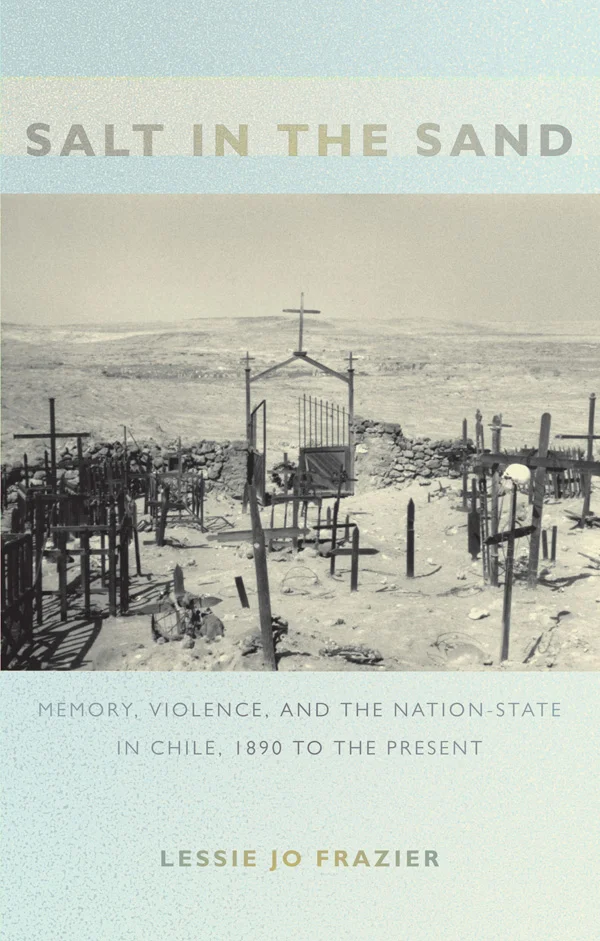
Salt in the Sand
Memory, Violence, and the Nation-State in Chile, 1890 to the Present
Politics, History, and Culture
Book
Pages: 408
Illustrations: 13 illustrations, 5 maps
Published: July 2007
Author: Lessie Jo Frazier
Subjects
Latin American Studies > Southern Cone, Anthropology > Cultural Anthropology, Postcolonial and Colonial Studies
Latin American Studies > Southern Cone, Anthropology > Cultural Anthropology, Postcolonial and Colonial Studies
Praise
Buy
Availability: Unavailable
Price: Current Pricing Unavailable
Checkout is temporarily unavailable.
Buy the e-book:
Information
Author/Editor Bios
Back to TopLessie Jo Frazier is Assistant Professor of Gender Studies and Adjunct Assistant Professor of History at Indiana University, Bloomington. She is a coeditor of Gender’s Place: Feminist Anthropologies of Latin America.
Table Of Contents
Back to Top
List of Illustrations xi
Acknowledgments xiii
Introduction: Ethnography, History, and Memory 1
Part I. Templates
1. Memory and the Camanchacas Calientes of Chilean Nation-State Formation 21
2. Structures of Memory, Shapes of Feeling: Chronologies of Reminiscence and Repression in Tarapaca (1890-Present) 58
Part II. Conjunctures
3. Dismantling Memory: Structuring the Forgetting of the Oficina Ramirez (1890-1891) and La Coruna (1925) Massacres 85
4. Song of the Tragic Pampa: Structuring the Remembering of the Escuela Santa Maria Massacre (1907) 117
5. Conjunctures of Memory: The Detention Camps in Pisagua Remembered (1948, 1973, 1990) and Forgotten (1943, 1956, 1984) 158
6. The Melancholic Economy of Reconciliation: Talking with the Dead, Mourning for the Living 190
Conclusion: Democratization and Arriving at the “End of History” in Chile 243
Notes 261
Selective Bibliography 355
Index 365
Rights
Back to TopSales/Territorial Rights: World
Rights and licensingAdditional Information
Back to Top
Paper ISBN:
978-0-8223-4003-4 /
Hardcover ISBN:
978-0-8223-3986-1 /
eISBN:
978-0-8223-8966-8 /
DOI:
https://doi.org/10.1215/9780822389668
Publicity material