
Home / Books / Sentient Flesh

Sentient Flesh

Thinking in Disorder, Poiesis in Black
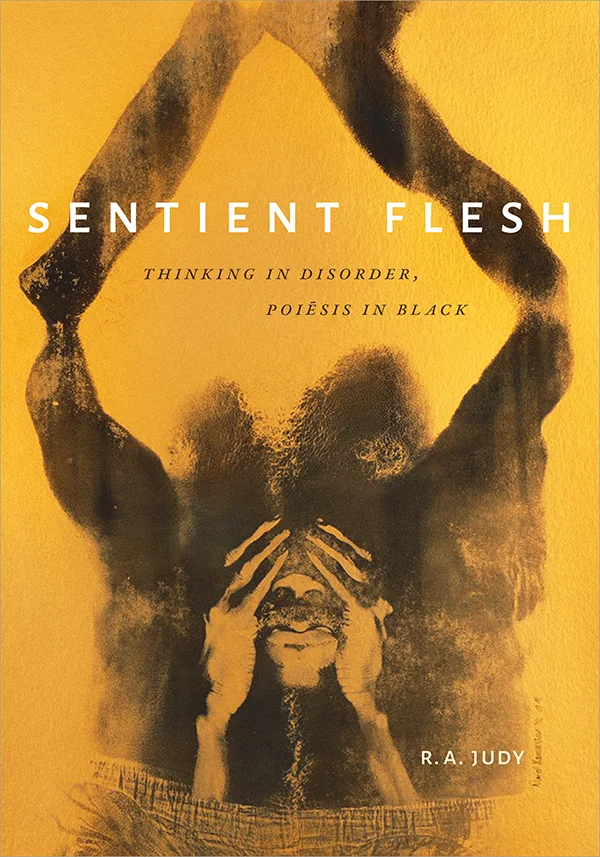
Sentient Flesh cover image

Black Outdoors: Innovations in the Poetics of Study

More about this series

Read the Introduction

Book

Pages: 624

Illustrations: 18 illustrations

Published: October 2020

Author: R. A. Judy

 In Sentient Flesh R. A. Judy takes up freedman Tom Windham’s 1937 remark “we should have our liberty 'cause . . . us is human flesh" as a point of departure for an extended meditation on questions of the human, epistemology, and the historical ways in which the black being is understood. Drawing on numerous fields, from literary theory and musicology, to political theory and phenomenology, as well as Greek and Arabic philosophy, Judy engages literary texts and performative practices such as music and dance that express knowledge and conceptions of humanity appositional to those grounding modern racialized capitalism. Operating as critiques of Western humanism, these practices and modes of being-in-the-world—which he theorizes as “thinking in disorder,” or “poiēsis in black”—foreground the irreducible concomitance of flesh, thinking, and personhood. As Judy demonstrates, recognizing this concomitance is central to finding a way past the destructive force of ontology that still holds us in thrall. Erudite and capacious, Sentient Flesh offers a major intervention in the black study of life. 

Praise

Sentient Flesh constitutes a unique and emphatic announcement of what a certain fundamental strain of black studies has long been—the disruptive turning and overturning of the ontological, metaphysical, and epistemological foundations of the modern world. Its extreme and profound generativity is bracing and invigorating, and it forces and allows its readers to do more, confront more, read more, and think more. I love this book, I feel this book, I am pleased by this book because I am undone and disturbed and disrupted and transported by this book.” - Fred Moten, author of Black and Blur

“Weaving a clear and critical story about the making of the so-called Negro and how this making is deeply connected to questions of the flesh not the body, R. A. Judy makes one of the most critical arguments in contemporary humanities. Sentient Flesh is well placed to make a major intervention.” - Anthony Bogues, author of Empire of Liberty: Power, Desire, and Freedom

“This text is nothing if not a call for communal forms of thinking.... R.A. Judy has presented us with an opening to consider and reconsider what it means to be Black in this world and I hope it is a challenge that is taken up and serves to enrich the archive of Black Radical Thought.” - Michael E. Sawyer, New Formations

"R. A. Judy’s Sentient Flesh, in its 600 or so pages, stands as a monumental contribution to this literature, leading us through, sometimes in dazzling detail, a teeming array of figures, themes, disciplinary scenes, and texts in order to arrive at a full account of its main conceptual contributions." - Emanuela Bianchi, Cultural Critique

Buy

Availability: Loading...

Price: Loading...

Request a desk or exam copy

Information

Author/Editor Bios

Back to Top
R. A. Judy is Professor of Critical and Cultural Studies at the University of Pittsburgh and author of (Dis)forming the American Canon: African-Arabic Slave Narratives and the Vernacular.

Table Of Contents

Back to Top
List of Illustrations  ix
Notes on Translation and Transliteration  xi
Preface: Preliminary Signposts  xiii
Acknowledgments  xxi
Introduction: Body and Flesh  1
[1st Set]
On Lohengrin's Swan  25
Sentient Flesh  150
[2nd Set]
Sentient Flesh Dancing  215
Poiēsis in Black  252
Para-Semiosis  319
Coda: Gifting Blues Love-Improper  418
Notes  457
Bibliography  543
Index  573

Rights

Back to Top

Sales/Territorial Rights: World

Rights and licensing

Awards

Back to Top

Winner of the 2023 Truman Capote Literary Trust Award for Literary Criticism

Additional Information

Back to Top
Related Links Paper ISBN: 978-1-4780-1102-6 / Hardcover ISBN: 978-1-4780-0996-2 / eISBN: 978-1-4780-1255-9 / DOI: https://doi.org/10.1215/9781478012559