
Home / Books / Slavery Unseen

Slavery Unseen

Sex, Power, and Violence in Brazilian History
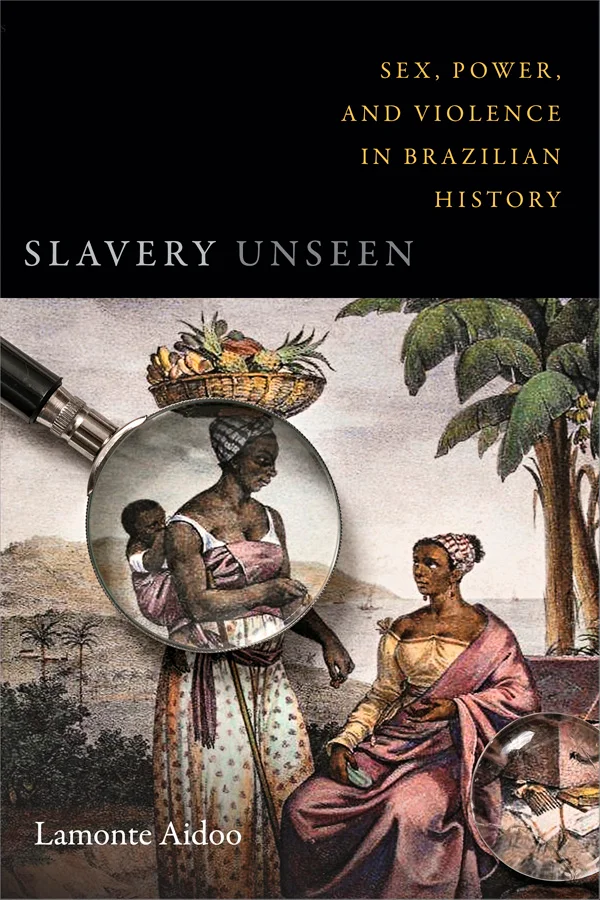
Book

Pages: 272

Illustrations: 9 illustrations

Published: April 2018

Author: Lamonte Aidoo

In Slavery Unseen, Lamonte Aidoo upends the narrative of Brazil as a racial democracy, showing how the myth of racial democracy elides the history of sexual violence, patriarchal terror, and exploitation of slaves. Drawing on sources ranging from inquisition trial documents to travel accounts and literature, Aidoo demonstrates how interracial and same-sex sexual violence operated as a key mechanism of the production and perpetuation of slavery as well as racial and gender inequality. The myth of racial democracy, Aidoo contends, does not stem from or reflect racial progress; rather, it is an antiblack apparatus that upholds and protects the heteronormative white patriarchy throughout Brazil's past and on into the present.

Praise

"Revealing how Brazil's myth of racial democracy obscures the sexual exploitation and racialized violence of enslaved blacks by white, mixed, and even free black Brazilians, Lamonte Aidoo offers a groundbreaking and heartbreaking critique of how Brazilian racial fluidity originated in a system of white supremacy that dominates much of contemporary Brazilian life today. A daring and tremendously illuminating work." - Salamishah Tillet, author of Sites of Slavery: Citizenship and Racial Democracy in the Post-Civil Rights Imagination

“Lamonte Aidoo's brilliant and original account of how notions of masculinity, gender, and sexuality in Brazilian literature are shaped by the legacy of slavery is compelling and leads to questions about how very much such submerged images form our own Anglophone worldview. An important book not only because it illuminates the impact of race in a lesser known literary culture but because it highlights many of our North American fantasies about race and sexual identity.” - Sander L. Gilman, coauthor of Are Racists Crazy? How Prejudice, Racism, and Antisemitism Became Markers of Insanity

Slavery Unseen offers a sophisticated interpretation of slavery and its legacy in Brazil in relation to sexual violence, racial terror, and antiblack social prejudice. Lamonte Aidoo engages a wide range of literary texts and other cultural artifacts in showing the central role of sexual violence—and the obscuring of this violence—in Brazil's racial formation. Along the way, he offers a magnificent rereading of the nineteenth-century Brazilian literary canon.” - Christopher Dunn, Tulane University

"An eloquent interpretation of many insidious aspects of slavery that [goes] beyond the legal relationship between 'slave' and 'free.'" - Elizabeth Anne Kuznesof, EIAL

"Slavery Unseen is an interesting effort to present a little-known side of Brazilian slavery. The book is a good reading both for specialists and for members of the broader public who want to understand the roots of racism and violence that characterize Brazilian society up to the present day." - Ynaê Lopes dos Santos, Labor

"Slavery Unseen goes beyond typical studies of power and sexual violence by moving away from the quintessential master and enslaved female dialectic. . . . Aidoo has crafted a brilliant and engaging piece of research that will pave the way for future studies of sexuality, power, and violence across the transatlantic world." - Rachael Pasierowska, H-Net Reviews

"Slavery Unseen is revelatory and will change the field of Brazilian history. . . . [Aidoo] has managed to condense an enormous amount of archival information into a compelling text with major implications for history, literature, gender studies, critical race studies, and Luso-Brazilian studies." - Gregory Mitchell, European Review of Latin American and Caribbean Studies

“Originally conceived, meticulously researched, and well written and argued, [Aidoo’s] book is an intellectually sophisticated interdisciplinary study that examines the race relations and interracial sexual violence that are embedded in Brazilian slavery. . . . Slavery Unseen will certainly leave its vital mark in the fields of Luso-Brazilian studies and Afro-Diaspora studies for years to come.” - Emanuelle K. F. Oliveira-Monte, Revista Hispánica Moderna

Buy

Availability: Loading...

Price: Loading...

Request a desk or exam copy

Information

Author/Editor Bios

Back to Top
Lamonte Aidoo is Andrew W. Mellon Assistant Professor of Romance Studies at Duke University and the coeditor of Emerging Dialogues on Machado de Assis and Lima Barreto: New Critical Perspectives.

Table Of Contents

Back to Top
Acknowledgments  ix
Introduction. Secrets, Silences, and Sexual Erasures in Brazilian Slavery and History  1
1. The Racial and Sexual Paradoxes of Brazilian Slavery and National Identity  11
2. Illegible Violence: The Rape and Sexual Abuse of Male Slaves  29
3. The White Mistress and the Slave Woman: Seduction, Violence, and Exploitation  67
4. Social Whiteness: Black Intraracial Violence and the Boundaries of Black Freedom  111
5. O Diabo Preto (The Negro Devil): The Myth of the Black Homosexual Predator in the Age of Social Hygiene  149
Afterword. Seeing the Unseen: The Life and Afterlives of Ch/Xica da Silva  187
Notes  197
Bibliography  227
Index  249

Rights

Back to Top

Sales/Territorial Rights: World

Rights and licensing

Awards

Back to Top

Winner of the Nicolás Cristóbal Guillén Batista Outstanding Book Award from the Caribbean Philosophical Association

Additional Information

Back to Top
Related Links Paper ISBN: 978-0-8223-7129-8 / Hardcover ISBN: 978-0-8223-7116-8 / eISBN: 978-0-8223-7168-7 / DOI: https://doi.org/10.1215/9780822371687

Publicity material