
Home / Books / Staple Security

Staple Security

Bread and Wheat in Egypt
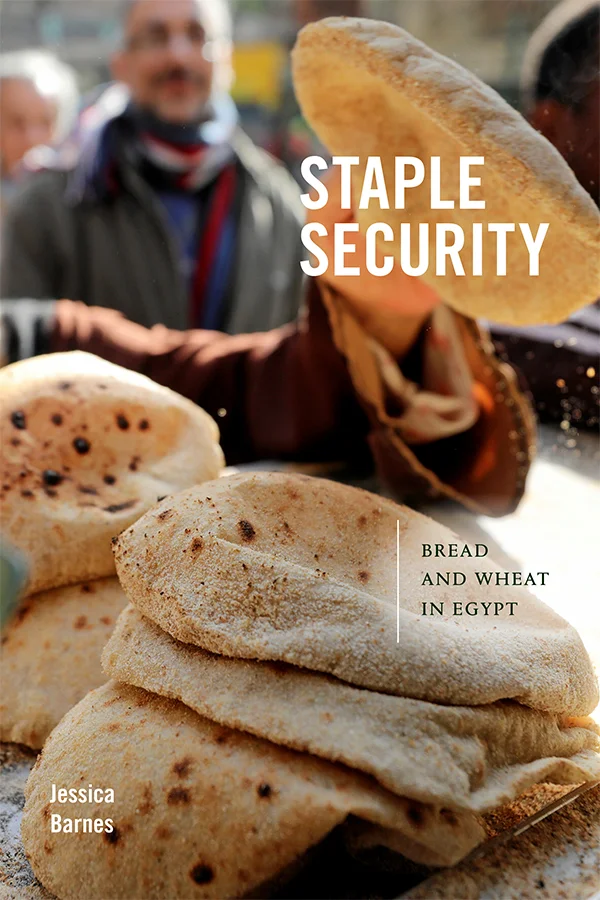
Staple Security cover image Read the Introduction
Access the course guide for Staple Security.

Book

Pages: 320

Illustrations: 45 illustrations

Published: September 2022

Author: Jessica Barnes

Egyptians often say that bread is life; most eat this staple multiple times a day, many relying on the cheap bread subsidized by the government. In Staple Security, Jessica Barnes explores the process of sourcing domestic and foreign wheat for the production of bread and its consumption across urban and rural settings. She traces the anxiety that pervades Egyptian society surrounding the possibility that the nation could run out of wheat or that people might not have enough good bread to eat, and the daily efforts to ensure that this does not happen. With rich ethnographic detail, she takes us into the worlds of cultivating wheat, trading grain, and baking, buying, and eating bread. Linking global flows of grain and a national bread subsidy program with everyday household practices, Barnes theorizes the nexus between food and security, drawing attention to staples and the lengths to which people go to secure their consistent availability and quality.

Praise

“In this detailed ethnography of the daily place of bread in Egypt, Jessica Barnes retheorizes staple foods to advance understandings of food security. Staple Security smartly links the affective condition of feeling cared for, people’s daily actions to ensure household sustenance, and state agricultural and economic policies intended to shore up government support by delivering a sense of security, through daily bread, to its citizenry. Sure to be a new classic in food studies.” - Heather Paxson, author of The Life of Cheese: Crafting Food and Value in America

“Jessica Barnes’s fine-grained and often mouth-watering description of bread at the Egyptian table as both belly-filling staple and eating implement serves as more than a metaphor for the role bread and wheat have played in Egypt’s geopolitical security. As Barnes so vividly shows, the practices of bread procurement at both national and household levels are so affectively important that conventional and abstract concepts of food security miss the mark. Here it really is about bread and its material qualities.” - Julie Guthman, author of Wilted: Pathogens, Chemicals, and the Fragile Future of the Strawberry Industry

"The book’s forte lies in the wider use of a range of sources, including ethnography, interviews with various actors in Egypt, participant observation, newspapers and archival materials. . . . Another strength is how the book draws connections with issues of staple security in countries in Africa but also from other continents. Barnes also provides extensive illustrations that are well linked to the content of each chapter. The concept of staple security is of value to anyone interested in the subject of food and politics as well as food histories." - Chama Kaluba Jickson, H-Environment

"Barnes’s Staple Security is an important contribution to the existing literature that unravels the myriad relationships, histories, and politics coalescing around one commodity or staple, similar, for example, to studies of sugar, coffee, and rice. One could imagine scholars and students from agrifood studies, Middle East and North Africa studies, anthropology, and geography finding much value in this text." - Megan A. Carney, American Anthropologist

"A timely contribution to critical food studies, bringing global attention to the vulnerabilities within grain supply chains and their impact on ordinary people’s lives. . . . The evocative writing, along with numerous images, maps, and wonderful full-page photographs between each chapter, transport the reader to the worlds of bread and wheat in Egypt." - Mona Atia, AAG Review of Books

"The contributions of this book go well beyond wheat (or rice or maize) and help us think more effectively about the politics of food writ large." - Annie Shattuck, AAG Review of Books

"Staple Security is a masterpiece of rich ethnographic detail and collaborative research about the cornerstone of the Egyptian diet: bread and wheat. . . . A major strength of this book is methodological: It provides a blueprint of how to study the human experience of a staple, from its cultivation to consumption." - Katie Meehan, AAG Review of Books

"A concise, focused, and illuminating book. Staple Security makes a valuable contribution to the existing literature on food security by exploring the ways in which people actually understand their own sense of security vis-à-vis food, and how they then go about achieving and safeguarding that security. For these reasons, it is necessary reading for all those concerned with issues of food production, policy, and procurement, not just in Egypt or the Middle East, but in the Global South more broadly." - Timothy Gorman, AAG Review of Books

“Barnes deftly weaves together interviews and ethnographic observations with statistics and newspaper headlines to build her case throughout the book . . . An ambitious accounting of complex processes for ensuring security at multiple scales, from the household to the nation.” - Kimberley G. Connor, Medical Anthropology Quarterly

"Excellent. . . . Jessica Barnes . . . [has] given us a lot to chew on." - Chantal E. Berman, Middle East Journal

"For many Egyptians, bread is life (?aysh). The anchor of every meal, it is a staple food that is equally woven into household subsistence and geopolitical security. Jessica Barnes’s brilliant book, Staple Security, uses bread along with grain and wheat as a lens to understand this dynamic, revealing how ordinary practices of sustenance in the home are linked to global supply chains and Egyptian politics. . . . I would heartily recommend it to scholars in anthropology, geography, and sociology who are interested in the relationship between society and environment." - Rose Wellman, International Journal of Middle East Studies

"Staple Security is clearly an important book, essential reading across the multiple disciplines engaged in understanding the workings of food systems and the pursuit of food security. It is also a delight to read." - Helen Anne Curry, Anthropology Book Forum

Buy

Availability: Loading...

Price: Loading...

Request a desk or exam copy

Information

Author/Editor Bios

Back to Top
Jessica Barnes is Associate Professor in the Department of Geography and the School of Earth, Ocean, and Environment at the University of South Carolina. She is author of Cultivating the Nile: The Everyday Politics of Water in Egypt, also published by Duke University Press, and coeditor of Climate Cultures: Anthropological Perspectives on Climate Change.

Table Of Contents

Back to Top
A Note on Transliteration and Units  vii
Preface  ix
Acknowledgments  xvii
Introduction  1
1. Staple Becomings  39
2. Gold of the Land  81
3. Grain on the Move  113
4. Subsidized Bread (with Mariam Taher)  153
5. Homemade Bread  191
Conclusion  225
Notes  239
References  271
Index  289

Rights

Back to Top

Sales/Territorial Rights: World

Rights and licensing

Awards

Back to Top

Finalist, 2023 PROSE Award for Excellence in Social Sciences (Cultural Anthropology and Sociology), presented by the Association of American Publishers

Honorable Mention, 2022 Meridian Book Award, presented by the American Association of Geographers

Winner of the 2024 Geographies of Food and Agriculture Specialty Group (Association of American Geographers) Book Prize

Winner of the 2024 Southeast Regional Middle East and Islamic Studies Society Book Award