
Home / Books / State of Fear

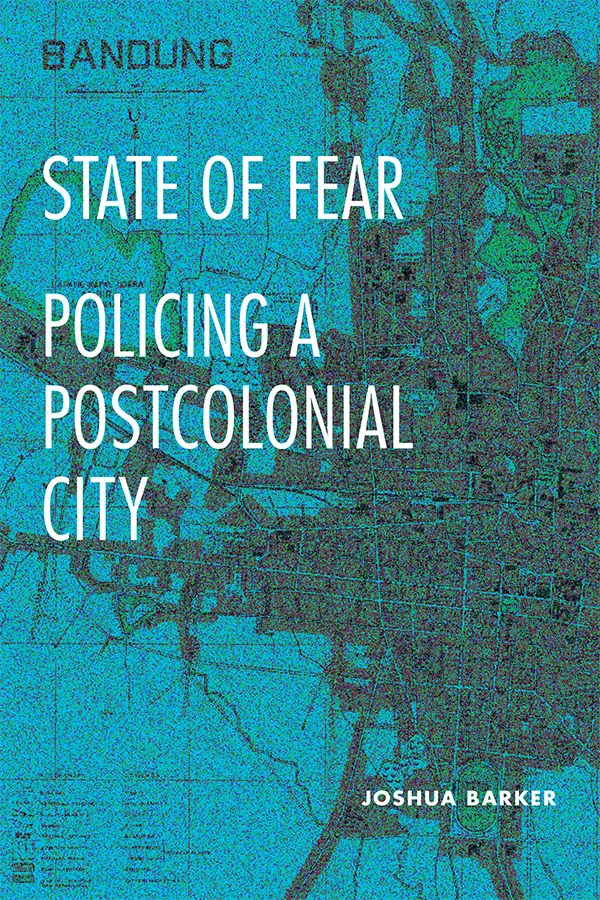
State of Fear

Policing a Postcolonial City
Book

Pages: 328

Illustrations: 10 illustrations

Published: September 2024

Author: Joshua Barker

In State of Fear, Joshua Barker reckons with how fear and violence are produced and reproduced through everyday practices of rule and control. Examining the ethnographic and historical genealogies of Indonesian policing, Barker focuses on the city of Bandung, which is permeated by anxieties about security, in spite of the fact that it’s a relatively safe city according to the data. Drawing from his fieldwork there during the latter years of the authoritarian New Order regime, Barker traces the complex relationship between the state and vigilante groups like neighborhood watch patrols and street gangs. Through interviews with police officers, vigilantes, and street-level toughs, he uncovers a struggle between two visions of social control that continues to animate policing in Indonesia: the modern, bureaucratic approach favored by the state, and a territorial approach that divides the city into fiefdoms overseen by charismatic individuals of authority. Synthesizing insights from in-depth ethnographic, historical, and theoretical work, Barker reveals how authoritarianism can take root not just from the top down but also from the bottom up.

Praise

“A brilliant and arresting account of governance, vigilantism, criminality, and violence in postcolonial Indonesia, Joshua Barker’s State of Fear brings a penetrating ethnographic look at Indonesia’s police and neighborhood security teams together with a revealing exploration of historical materials from the late colonial period. It will leave readers spellbound with its unflinching look at the blurring of law and violence at the margins of the state.” - Kenneth M. George, author of Picturing Islam: Art and Ethics in a Muslim Lifeworld

“In this brilliant, informative, and carefully crafted book Joshua Barker shows how policing performs sovereignty and produces it across scales. Policing, he argues, creates its own target and rationale: Territoriality and surveillance both work by mobilizing a state of fear—an affective condition at the heart of a political order in which the threat of violence structures everyday life. State of Fear makes a signal contribution and contains some of the smartest ethnographic writing and analysis anyone in our discipline has ever produced.” - Danilyn Rutherford, President of the Wenner-Gren Foundation

"Drawing on extensive fieldwork in the neighborhoods and police stations of Bandung, Barker juxtaposes two kinds of order. One is formal, defined by the law that the police claim to enforce, bureaucratic rules, and modern techniques of surveillance. The other is informal, arising from civil society... frequently through violence. These two forms of order often work at cross purposes, but they can also support each other. This fascinating study of how policing works in Indonesia and how it has transformed over time offers a grim reminder: the law does not create its own order." - Pratap Bhanu Mehta, Foreign Affairs

"Barker’s State of Fear is a key contribution to scholarship on security, surveillance and policing in postcolonial Indonesia. His ethnographic and historical analysis provides a nuanced understanding of the mechanisms of power and control shaping daily life. The book is essential reading for scholars of anthropology, criminology and South East Asian studies, offering critical insights into the intersections of state authority, local governance and the ever-present spectre of fear in Indonesia." - Sharyn Graham Davies, South East Asia Research

Buy

Availability: Loading...

Price: Loading...

Request a desk or exam copy

Information

Author/Editor Bios

Back to Top
Joshua Barker is Professor of Anthropology at the University of Toronto and coeditor of Figures of Southeast Asian Modernity and State of Authority: State in Society in Indonesia.

Table Of Contents

Back to Top
Illustrations  ix
Abbreviations  xi
Acknowledgments  xiii
Introduction: Fear, Policing, and State Power  1
Part One: Territoriality
1. Ronda: The Neighborhood Watch  33
2. Neighborhood Fears, Vigilantism, and Street Toughs  56
Part Two: Surveillance
3. Urban Panopticon  81
4. Subjects of Surveillance  113
Part Three: Articulations
5. State of Fear  139
6. The Police Precinct  174
Conclusion: Panopticism and Prowess in a Postcolonial City  214
Glossary  237
Notes  245
References  277
Index  295

Rights

Back to Top

Sales/Territorial Rights: World

Rights and licensing

Awards

Back to Top

Winner of the 2026 Harry J. Benda Prize, presented by the Southeast Asia Council of the Association for Asian Studies

Additional Information

Back to Top
Related Links Paper ISBN: 978-1-4780-3076-8 / Hardcover ISBN: 978-1-4780-2652-5 / eISBN: 978-1-4780-5975-2 / DOI: https://doi.org/10.1215/9781478059752