
Tension
Mental Distress and Embodied Inequality in the Western Himalayas
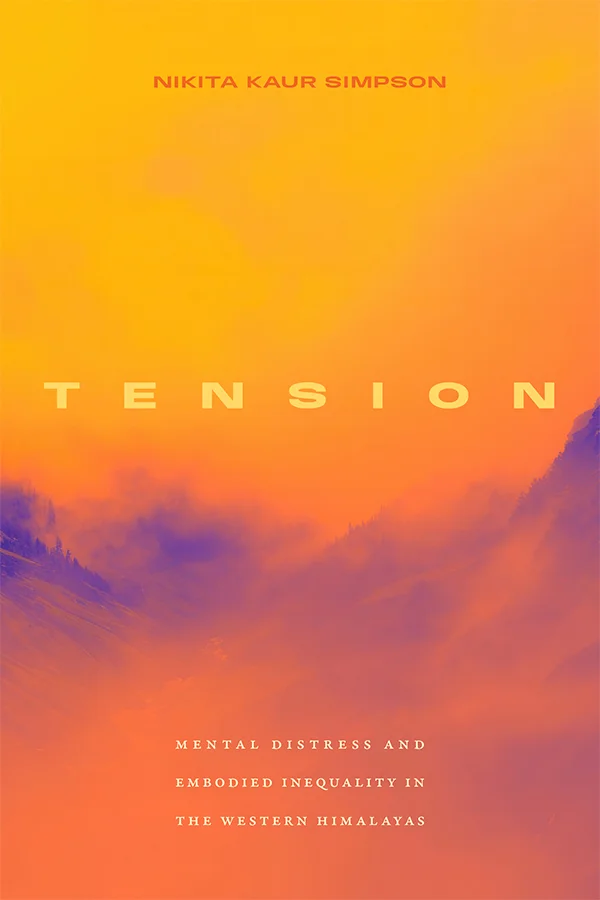
Book
Pages: 238
Illustrations: 22 illustrations
Published: March 2026
Author: Nikita Kaur Simpson
Subjects
Anthropology > Cultural Anthropology, Medicine and Health > Global Health, Asian Studies > South Asia
Anthropology > Cultural Anthropology, Medicine and Health > Global Health, Asian Studies > South Asia
Praise
Buy
Availability: Loading...
Price: Loading...
This title will be released on March 17, 2026
Buy the e-book:
Information
Author/Editor Bios
Back to Top
Nikita Kaur Simpson is Reader in Anthropology at SOAS, University of London.
Table Of Contents
Back to Top
Author’s Note ix
Preface: A Mother’s Body xi
Introduction. What is Tension? 1
1. Opara: Is Distress Relational? 27
2. Kamzori: How Does the Distressed Body Hold Time? 59
3. Ghar Ki Tension: Why is Care So Often the Source of Distress? 89
4. Future Tension: What is It About the Future That Generates Distress? 115
5. Pagal: What Happens When Distress Becomes Deviant? 141
Conclusion. Can Tension Travel? 169
Acknowledgments 179
Select Hindi and Gaddi Glossary 183
Notes 187
Bibliography 201
Index 215
Preface: A Mother’s Body xi
Introduction. What is Tension? 1
1. Opara: Is Distress Relational? 27
2. Kamzori: How Does the Distressed Body Hold Time? 59
3. Ghar Ki Tension: Why is Care So Often the Source of Distress? 89
4. Future Tension: What is It About the Future That Generates Distress? 115
5. Pagal: What Happens When Distress Becomes Deviant? 141
Conclusion. Can Tension Travel? 169
Acknowledgments 179
Select Hindi and Gaddi Glossary 183
Notes 187
Bibliography 201
Index 215
Rights
Back to TopSales/Territorial Rights: World, excluding Afghanistan, Bangladesh, Bhutan, India, Maldives, Nepal, Pakistan, Sri Lanka
Rights and licensingAdditional Information
Back to Top
Related Links
Paper ISBN:
978-1-4780-3329-5 /
Hardcover ISBN:
978-1-4780-2983-0 /
eISBN:
978-1-4780-6204-2 /
DOI:
https://doi.org/10.1215/9781478062042
Publicity material