
Home / Books / The Borders of Responsibility

The Borders of Responsibility

Migration Control in the Mediterranean Sea
Book

Pages: 274

Illustrations: 4 illustrations

Published: May 2026

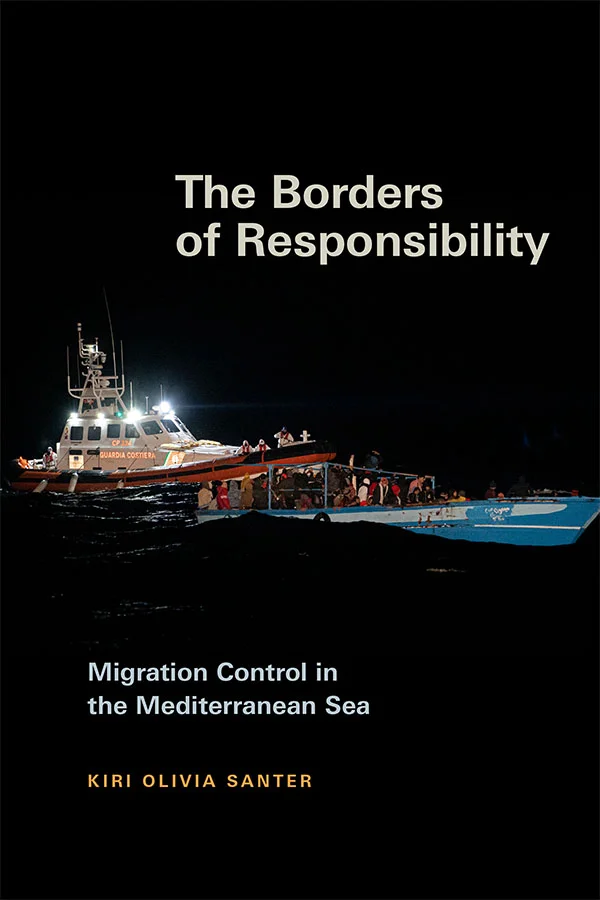
While migrants face many dangers in attempting to reach Europe by crossing the Mediterranean Sea—from drowning to dying of dehydration—they also confront an elaborate legal system that is designed to return them to their countries of origin. In The Borders of Responsibility, Kiri Olivia Santer outlines the architecture of these legal systems and how they help Europe evade legal responsibility for rescuing migrants. Focusing on legal agreements between Italy and Libya that have resulted in the systematic interception of migrants, Santer shows how Europe’s liberal identity is belied by legal agreements that let migrants die at sea or that send them back to dangerous, exploitative situations in post-Gaddafi Libya or their home countries. Law, she argues, is the tool that enables states to affect control beyond territory, whilst disappearing their responsibility for violence across border assemblages. Through ethnographic fieldwork with migrants, lawyers, policy makers, and humanitarian workers, Santer shows how the law is too often used as an instrument of violence against migrants, who fall outside of conventional structures of legal rights.

Praise

“A sophisticated and nuanced understanding of how migrants’ movements across the Central Mediterranean are conditioned and contained through the EU’s strategy of border externalization.” - Gregory Feldman, author of The Subject of Sovereignty: Relationality and the Pivot past Liberalism

“A fascinating and original discussion of pushbacks, pullbacks, coastguards, maritime rescue zones, legal gaps, political games, and humanitarian logistics. Santer’s experience on NGO rescue boats adds powerful insight, nuance, and affect to the account.” - William Walters, editor of Viapolitics: Borders, Migration, and the Power of Locomotion

"[Santer] draws a dynamic picture of how the fragmentation, and even dissolution, of EU and state responsibility is achieved in myriad ways." - Julia Eckert, AnthroTheory Commons

"Kiri Santer's book tells us a lot about the use of legal strategies within border struggles." - Lucia Gennari, AnthroTheory Commons

"A relevant read for those . . . who are keen to gain a deeper understanding of the relation of liberal governmentality and violence." - Leonie Felicitas Jegen, AnthroTheory Commons

"Borders of Responsibility is an important contribution to legal anthropology." - Insa Koch, AnthroTheory Commons

"One of the achievements of The Borders of Responsibility lies in its remarkable capacity to make visible relations that are, by definition, difficult to observe." - Camilla Alberti, AnthroTheory Commons

"Ethically engaged. . . . Worth reading, regardless of one’s position on migration." - Andrew Moravcsik, Foreign Affairs

Buy

Availability: Unavailable

Price: Current Pricing Unavailable

Checkout is temporarily unavailable.

Buy the e-book:

Open Access

Read the OA version here.

Request a desk or exam copy

Information

Author/Editor Bios

Back to Top
Kiri Olivia Santer is Postdoctoral Researcher and Lecturer at the Institute of Social Anthropology at the University of Bern.

Table Of Contents

Back to Top
Abbreviations  ix
Acknowledgments  xiii
Introduction 1
1. Tense Rescues and Double Standards  23
2. Colonial Legacies and the Regulation of Mobility Between Libya and Europe  52
3. Coast Guards and the Legal Architecture of Interdiction  73
4. Offshore Containment Industries at the Margins of Europe  89
5. Assembling Delegated Control  117
6. Border Violence and the Fragmentation of Responsibility  147
Conclusion  176
Notes  187
References  215
Index  245

Rights

Back to Top

Sales/Territorial Rights: World

Rights and licensing

Additional Information

Back to Top
Paper ISBN: 978-1-4780-3866-5 / Hardcover ISBN: 978-1-4780-3378-3 / eISBN: 978-1-4780-6227-1 / DOI: https://doi.org/10.1215/9781478062271

Funding Information

Back to Top
Published with the support of the Swiss National Science Foundation.