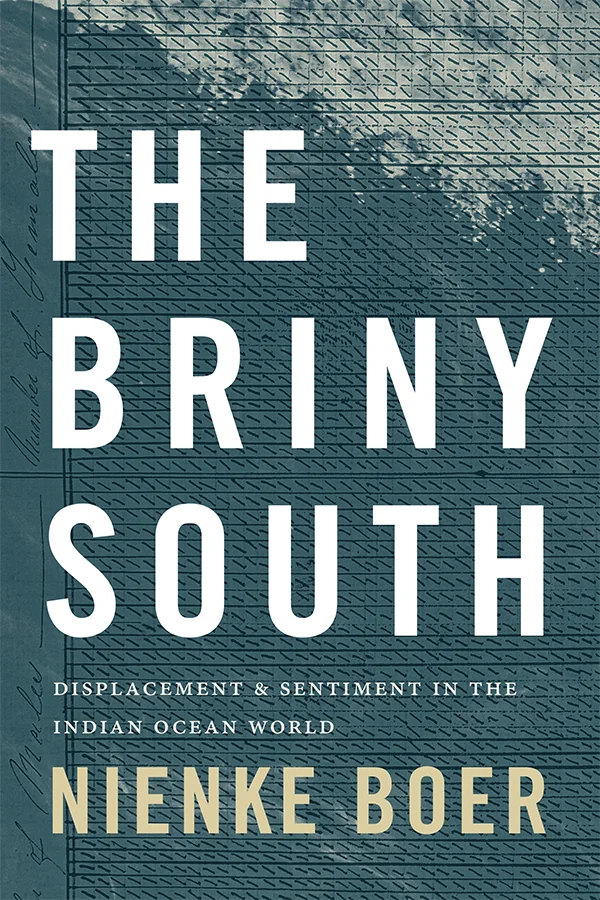
“Drawing together three groups of forced migrants (enslaved people, indentured laborers, and prisoners of war), this ingenious book creates new analytical latitudes across the Indian Ocean arena. The study combines larger histories with astute close readings of an impressive range of archival and fictional texts, creating a consequential contribution to Indian Ocean studies.” - Isabel Hofmeyr, author of Dockside Reading: Hydrocolonialism and the Custom House
“Informed by an acute sense of the entanglement of subjects in power and the marginalized in the world of inter-empires, Nienke Boer tells a strikingly original story by identifying the Indian Ocean as an alternative space of subjection and subject making. This ambitious and refreshing book makes a skillful contribution to debates on empire and its systems of control and the imaginative responses to forms of subjection viewed outside the paradigm of the Atlantic.” - Simon Gikandi, author of Slavery and the Culture of Taste
"One of the work’s great strengths is its ability to articulate how the context and sources for the Indian Ocean differ from those of the Atlantic world, especially for enslavement and indenture. Enslavement in the Indian Ocean world produced a legal archive unlike that of the Atlantic Ocean, allowing Boer to ask and answer questions about enslaved life that could not be posed in the Atlantic. This has the dual effect of bringing into relief what is unique about each while simultaneously helping to bring Atlantic world scholars into the world of the Indian Ocean." - Jared Asser, Emotions: History, Culture, Society
"A keen sense of form enables [Boer] to plot a course through a vast array of legal and literary texts that span centuries and include court rulings, legal complaints, testimonies, and political pamphlets alongside poetry, folk songs, fiction, and memoirs. It is no small feat to weave together an archive as expansive and complex as the Indian Ocean itself, and Boer manages to do so with striking clarity and precision. . . . The Briny South offers a new paradigm for scholars and readers of Indian Ocean literature, histories of enslavement, indenture, internment, inter-imperialism, or South African apartheid."
- Tyler Scott Ball,
ISLE
"The Briny South makes an important contribution to the scholarship on law and literature, colonial legalities, law and empire, and legal histories of the Indian Ocean World and those set in the South." - Kalyani Ramnath, Law & Society Review
"The Briny South is an important addition to the emerging body of scholarship in Indian Ocean literary studies. It offers new theoretical and methodological tools for studying transoceanic linkages between Asia and Africa, an area of research that is been understudied in South Asian studies." - Kritish Rajbhandari, South Asian Review
"The book combines the historical breadth and environmental focus of ocean studies with the political and ethical drive towards understanding the subaltern experience of globalization that marks Global South studies. . . . The book is full of interesting and binding narratives. Boer has done great work tracing these stories and using an analytical framework to scarping out sentiments from the documents from various chronological periods." - Rishabh Verma, IIAS Review
"This book is many things: a historical analysis of South Africa’s Indian Ocean worlds, a study of the ontology of unfreedom, and a meditation on race and racial identity formation. Above all, though, it is a strident call for an oceanic perspective when approaching questions of historical power, with the Indian Ocean offered as a salient space to do so. . . . For scholars of the region, and those of slavery and indenture, Boer’s book is an exciting and critical intervention." - Robert Rouphail, Journal of the Indian Ocean Rim
"The Briny South offers attentiveness to what the archives of displacement actually present, along with close reading of their forms and genres. In its discussion of whether sentiment might be used as an effective form of protest or resistance, and demonstration of the ways in which it is mostly co-opted by the powerful, it provides an oblique history of contemporary expressions of trauma and feeling as forms of protest. The Briny South, as a work of careful, South-centered, and deep historicization, is therefore instructive not only about the pasts of oppression and resistance, but their present and future too." - Charne Lavery, Comparative Literature Studies
"Boer’s book is remarkable for two reasons. Firstly, it evidences the author’s intuitive reading of a range of archival material as part of an effort to excavate subaltern sentiments that were otherwise relegated to the margins of the empire’s archives. Secondly, through an intimate reading of public and private 'sentiments,' Boer enables the reader to navigate the numerous anonymous lived experiences spanning four centuries. In spite of the enormity of the task, she achieves both feats with admirable ease in a language that is sensitive to the present as much as it is to the past." - Jonathan Koshy Varghese, South Asia Multidisciplinary Academic Journal
“The book is incisive and makes a great contribution to Indian Ocean and Global South studies."
- Jacky Kosgei,
African Studies Quarterly