
Home / Books / The Cunning of Gender Violence

The Cunning of Gender Violence

Geopolitics and Feminism
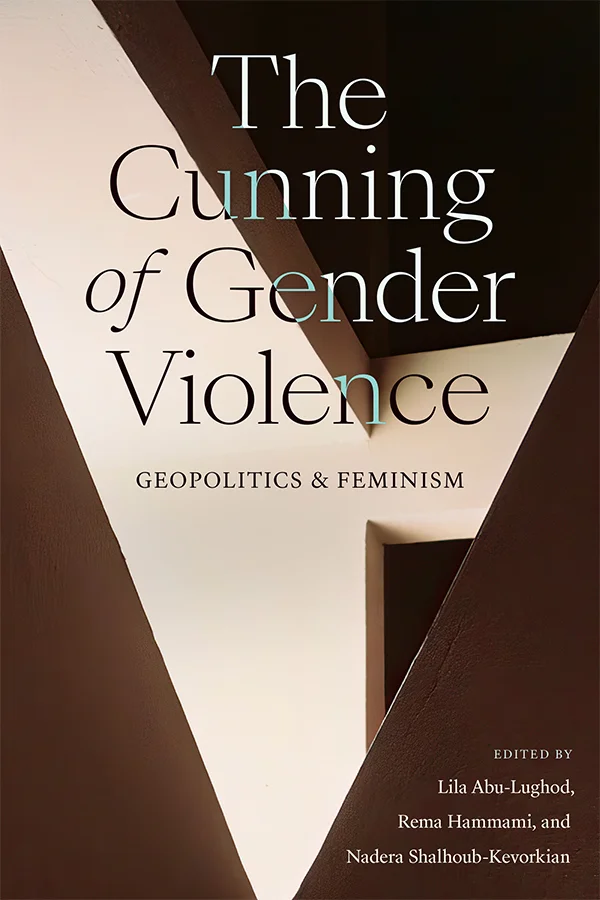
The Cunning of Gender Violence cover image

Next Wave: New Directions in Women's Studies

More about this series

Read the Introduction

Book

Pages: 480

Illustrations: 4 illustrations

Published: August 2023

The Cunning of Gender Violence focuses on how a once visionary feminist project has folded itself into contemporary world affairs. Combating violence against women and gender-based violence constitutes a highly visible and powerful agenda enshrined in international governance and law and embedded in state violence and global securitization. Case studies on Palestine, Bangladesh, Iran, India, Pakistan, Israel, and Turkey as well as on UN and US policies trace the silences and omissions, along with the experiences of those subjected to violence, to question the rhetoric that claims the agenda as a “feminist success story.” Because religion and racialized ethnicity, particularly “the Muslim question,” run so deeply through the institutional structures of the agenda, the contributions explore ways it may be affirming or enabling rationales and systems of power, including civilizational hierarchies, that harm the very people it seeks to protect.

Contributors. Lila Abu-Lughod, Nina Berman, Inderpal Grewal, Rema Hammami, Janet R. Jakobsen, Shenila Khoja-Moolji, Vasuki Nesiah, Samira Shackle, Sima Shakhsari, Nadera Shalhoub-Kevorkian, Dina M Siddiqi, Shahla Talebi, Leti Volpp, Rafia Zakaria

Praise

The Cunning of Gender Violence is a riveting and much-needed interdisciplinary collection that aims both to understand and radically shift the securitized, racialized, and imperial approaches to gender violence that dominate law, policy, and the media. Compellingly calling on feminists to recognize the Faustian bargain they have struck by perpetuating these dominant approaches, the book brings to the fore lives and experiences that have often been relegated to the margins of global feminist attention, even as they are at the center of multiple forms of quotidian global and state violence.” - Karen Engle, author of author of The Grip of Sexual Violence in Conflict: Feminist Interventions in International Law

“Those committed to an anti-Muslim agenda appoint themselves as modern, humanitarian, democratic, and feminist, a status achieved against a Third World constituted as premodern, illiberal, Muslim, and uniquely given to gender-based violence. It is a major contribution of this book to show how global racial governance is achieved through the idea of gender-based violence as a defining feature of Third World cultures and communities.” - Sherene H. Razack, author of Nothing Has to Make Sense: Upholding White Supremacy through Anti-Muslim Racism

"A remarkable piece of work within the realm of geopolitical feminism. ... It stands out for its sharp acumen and the detailed analysis of scholars who have dedicated themselves to researching and confronting gender-based violence against women in various global contexts."

- Yanyan Zhu, Affilia

"In brief, this volume represents a thorough investigation and assessment of the trajectory of the feminist project to combat violence against women in the wider context of global and local circuits of religious and political power. Recommended. Graduate students and faculty." - A. Rassam, Choice

"The Cunning of Gender Violence is part of a growing corpus of critical feminist scholarship dedicated to the politics of gender violence. It is a necessary and long-awaited theoretical intervention. . . . It provides indispensable ethnographic accounts of GBVAW’s operations among non-Western societies." - Zina Sawaf, Journal of Anthropological Research

Buy

Availability: In stock

Price: $32.95

Request a desk or exam copy Spring 2026 Web Sale

Information

Author/Editor Bios

Back to Top
Lila Abu-Lughod is Buttenwieser Professor of Social Science at Columbia University.

Rema Hammami is Associate Professor of Anthropology at the Institute of Women's Studies at Birzeit University.

Nadera Shalhoub-Kevorkian is Professor of Criminology and Social Work at The Hebrew University and Chair in Global Law at Queen Mary University of London.

Table Of Contents

Back to Top
Acknowledgments  vii
Introduction: Circuits of Power in GBVAW Governance / Lila Abu-Lughod, Rema Hammami, and Nadera Shalhoub-Kevorkian  1
I. Securitization
1. Lawfare, CVE, and International Conflict Feminism / Vasuki Nesiah  55
2. Securofeminism: Embracing a Phantom / Lila Abu-Lughod  88
3. The Role of “Honor Killings” in the Muslim Ban / Leti Volpp  122
4. Because Religion: Does Something Called “Religion” Cause Gender-Based Violence? / Janet R. Jakobsen  151
II. States of Violence, Unruly Subjects
5. GBV and Postcolonial India: Transnational Media, Hindutva, and Muslim Racializations / Inderpal Grewal  177
6. The Politics of Legislating “Honor Crime” in Contemporary Pakistan / Shenila Khoja-Moolji  209
7. State Criminality and Gender-Based Violence: Palestinian Schoolgirls between Books and Rifles / Nadera Shalhoub-Kevorkian  233
8. Power, Subjectivity, and Sexuality in Iranian Political Prisons / Shahla Talebi  259
III. Civilizing Interventions: Development and Humanitarianism
9. Child Marriage in the Feminist Imagination / Dina M. Siddiqi  293
10. Catastrophic Aid: GBV Humanitarianism in Gaza / Rema Hammami  324
11. What Counts as Violence? Transgender Refugees, Torture, and Sanctions / Sima Shakhsari  361
IV. Media Frames
12. Weaponized Bodies: Female Genital Mutilation and Immigrant Exclusion / Rafia Zakaria  391
13. Breaking the Frame: The Power of Media Narratives and the Question of Agency / Samira Shackle  405
14. Dressed Up, Stripped Down: Media Depictions of Conflict Rape / Nina Berman  422
Contributors  439
Index  445

Rights

Back to Top

Sales/Territorial Rights: World

Rights and licensing

Awards

Back to Top

Honorable Mention for the 2025 Feminist Theory and Gender Studies section of the International Studies Association Book Prize

Additional Information

Back to Top
Paper ISBN: 978-1-4780-2043-1 / Hardcover ISBN: 978-1-4780-1995-4 / eISBN: 978-1-4780-2454-5 / DOI: https://doi.org/10.1215/9781478024545