
Home / Books / The Invention of Order

The Invention of Order

On the Coloniality of Space
Book

Pages: 160

Published: January 2026

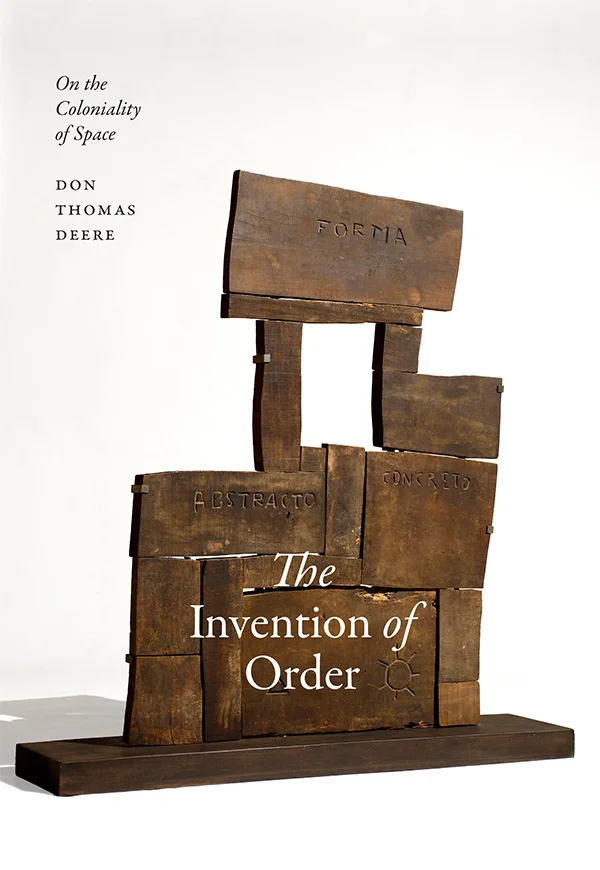
In The Invention of Order, Don Thomas Deere retraces the colonial origins of spatial organization in the Americas and the Caribbean and its lasting impact on modern structures of knowledge, power, race, gender as well as understandings of global modernity. The coloniality of space dispossessed Indigenous, African, and mixed populations as it constructed new systems of control and movement. Deere demonstrates how these developments manifested, among other forms, in urban grid patterns imposed during the development of Spanish colonial cities as well as totalizing trade routes crisscrossing the Atlantic. Drawing on a range of thinkers including Enrique Dussel, Édouard Glissant, and Sylvia Wynter, Deere reveals how movement—who travels, who settles, and who is excluded—becomes an essential component of control under colonial rule. Against the violence of spatial reordering, Deere outlines how novel forms of resistance and insurgency geographies still take hold, particularly in the Caribbean, where landscapes remain excessive, eruptive, and uncaptured by the order of modernity.

Praise

“A critically important book, The Invention of Order offers a spatial reading of the modern/colonial world system, revealing the constitutive relations between the categories of peoples and the organization and representation of space. With lively examples, Deere fills in the large gaps left by Foucault, Harvey, Bachelard and other theorists of spatiality. The idea that a people control the meaning of their land had to be overcome for colonialist and capitalist dispossession, and this fight is far from over.” - Linda Martín Alcoff, author of Visible Identities: Race, Gender and the Self

The Invention of Order presents a novel analysis of modern colonial projects, adding to current scholarship on the temporal and spatial significance of colonial conquest. Don Thomas Deere’s treatment of how this spatiality gives rise to and shapes colonial frames of reason, subject-formation, and the body is vital for any study of both the singularity of modern forms of colonial violence as well as the articulation of the radical nature of decolonial alternatives.” - Kris F. Sealey, author of Creolizing the Nation

Buy

Availability: Loading...

Price: Loading...

Request a desk or exam copy

Information

Author/Editor Bios

Back to Top
Don Thomas Deere is Assistant Professor in the Philosophy Department at Texas A&M University.

Table Of Contents

Back to Top
Foreword / Santiago Castro-Gómez  vii
Acknowledgments  xiii
Introduction  1
Part I. Genealogies of Colonial Space
1. Orders of the Grid  15
2. Orders of Movement: The Traveler and the Settler  33
Part II. Transmodern Cartographies
3. Transmodernity and the Battlefield of Coloniality  57
4. Archipelagos of Resistance: Limits of the Map  81
Notes  103
Bibliography  121
Index  131

Rights

Back to Top

Sales/Territorial Rights: World

Rights and licensing

Additional Information

Back to Top
Related Links Paper ISBN: 978-1-4780-3287-8 / Hardcover ISBN: 978-1-4780-2942-7 / eISBN: 978-1-4780-6162-5 / DOI: https://doi.org/10.1215/9781478061625