
Home / Books / The Lettered Indian

The Lettered Indian

Race, Nation, and Indigenous Education in Twentieth-Century Bolivia
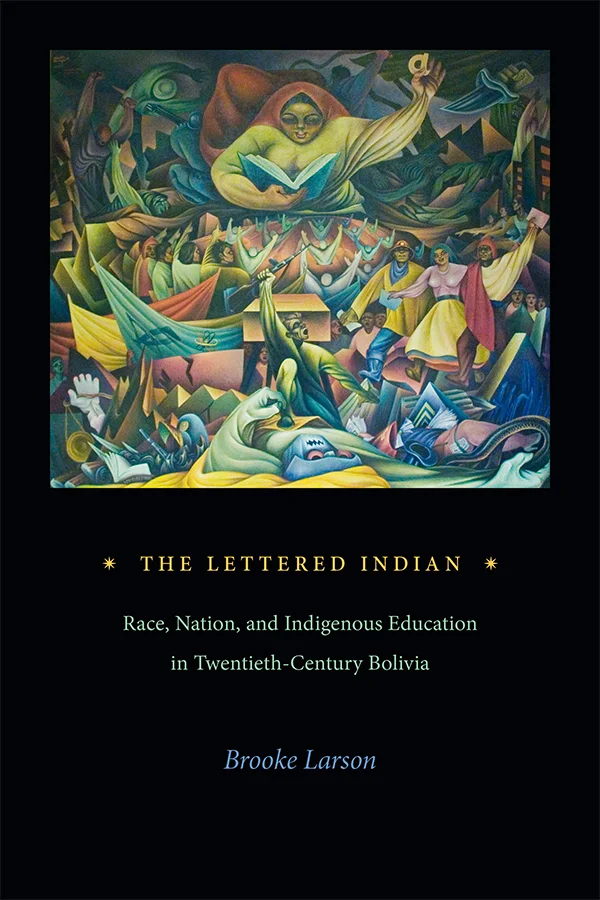
Book

Pages: 496

Illustrations: 38 illustrations

Published: January 2024

Author: Larson, Brooke

Bringing into dialogue the fields of social history, Andean ethnography, and postcolonial theory, The Lettered Indian maps the moral dilemmas and political stakes involved in the protracted struggle over Indian literacy and schooling in the Bolivian Andes. Brooke Larson traces Bolivia’s major state efforts to educate its unruly Indigenous masses at key junctures in the twentieth century. While much scholarship has focused on “the Indian boarding school” and other Western schemes of racial assimilation, Larson interweaves state-centered and imperial episodes of Indigenous education reform with vivid ethnographies of Aymara peasant protagonists and their extraordinary pro-school initiatives. Exploring the field of vernacular literacy practices and peasant political activism, she examines the transformation of the rural “alphabet school” from an instrument of the civilizing state into a tool of Aymara cultural power, collective representation, and rebel activism. From the metaphorical threshold of the rural school, Larson rethinks the politics of race and indigeneity, nation and empire, in postcolonial Bolivia and beyond.

Praise

The Lettered Indian is a beautifully narrated and painstakingly documented history of Indigenous education in twentieth-century Bolivia. Drawing on a prodigious array of archival, print, and oral sources, Brooke Larson weaves a history of Aymara activism, in which schooling and literacy play a primary role, thus putting the lie to the myth of the ‘oral Indian.’ At once historical and ethnographic, this book places Indigenous actors at the center of Bolivian history to tell a powerful and vibrant story of postcolonial nation-building. It is a major contribution to Latin American history, anthropology, and Indigenous studies.” - Joanne Rappaport, author of Cowards Don't Make History: Orlando Fals Borda and the Origins of Participatory Action Research

The Lettered Indian is a monumental work by a masterly historian. Through profound investigation, incisive analysis, and compelling narration, Brooke Larson shows how education is central for decolonization. Moving between Indigenous activism and peasant community initiative, national intellectual debate and state policy, as well as US imperial projects, her book reveals that the struggle over popular education led to the dismantling of neocolonial modernity in Bolivia over the course of the twentieth century.” - Sinclair Thomson, coeditor of The Bolivia Reader: History, Culture, Politics

"Larson’s eloquent study of Indigenous education in Bolivia lays bare with triumphant clarity the inevitable destination—the reclamation of a heritage and identities from the iron grip of tight Euro-American imperial narratives. ... This fascinating study provides a key insight into the discourse and practice of race and indigeneity in the nation-building projects of elites and those they dominate, behind which Indigenous Bolivians themselves sought to wrest the agenda into their own hands."

- Gavin O'Toole, Latin American Review of Books

"The Lettered Indian is a monumental work that should become a key reference point for twentieth-century Latin American history, even beyond the theme of Indigenous education in Bolivia. It is also a model for writing, as it richly paints urban and rural landscapes and colourful figures of all stripes and personalities, and does so paying close attention to the ebbs and flows of political and economic dynamics." - Bret Gustafson, Journal of Latin American Studies

"This book, a long time coming, is a great addition to Bolivian history and to the history of education in Latin America. It is also an excellent and deeply researched political history of twentieth-century Bolivia (and especially the northern Andean highlands), as refracted through education policy. I can highly recommend it for those interested in the history of Bolivia, Latin American education policy, and Indigenous education and social movements." - Erick D. Langer, Hispanic American Historical Review

"Overall, the book explores how rural education, both in discourse and practice, was an intercultural
battleground over broader social issues of race, nation and education in the formation of postcolonial Bolivia. The book’s interpretive approach and multiple perspectives help readers see that efforts to improve education for Indigenous people are not just limited to the eradication of illiteracy, but are also an integral part of a larger effort to build a more just and inclusive society, where every individual has the opportunity to fully participate in the political and economic life of the country."    - Diana Monita, Journal of Latinos and Education

"Larson’s excellent book thoroughly explores the context and perspective of the debates, ideologies, and aspirations surrounding Indigenous education in the Bolivian Andes. . . . Once finished with the book, the reader feels to have accurately traversed a century of history of the Bolivian Andes and, particularly, of the struggles faced by the Aymara communities." - Anna Guiteras Mombiola, American Historical Review

"This book will be a significant addition to both undergraduate courses and graduate seminars on the history of modern Latin America, the history of indigenous peoples, and the history of modern schooling. Scholars studying decolonising discourses and practices will benefit from reading how, why, and when indigenous peoples in Bolivia used education as a means of decolonising their society. Educators of rural education and, in general, educators concerned with the school as a means for social change will find in this book a hint of hope amidst the advancement of neoliberal policies globally." - Sabrina González, Paedagogica Historica

"A masterful piece of historical research and writing that uses the lens of Indigenous education to examine the country’s colonial racist legacy and the struggle of Indigenous people to eliminate it. . . . This exceptional work is essential for understanding Bolivian history and the struggles of Indigenous people in the Americas." - Ann Zulawski, The Americas

"Brooke Larson’s book on the history Indigenous education in Bolivia is a masterpiece. It is deeply researched, beautifully written, a pleasure to read and a gift to historians of Bolivia, education, Indigenous movements and so much more." - Sarah T. Hines, ReVista

"The Lettered Indian is the culmination of a long and productive career that contributes significantly to readers’ understanding of rural schooling and literacy campaigns in the Andes." - M. Becker, Choice

"This study provides essential reading to historically situate contemporary transformations of Indigenous education in Bolivia in relation to social movements and political change." - Berenice Ortega Bayona, H-LatAm, H-Net Reviews

Buy

Availability: In stock

Price: $29.95

Request a desk or exam copy Spring 2026 Web Sale

Information

Author/Editor Bios

Back to Top
Brooke Larson is Professor Emerita of History at Stony Brook University; author of Cochabamba, 1550-1900: Colonialism and Agrarian Transformation in Bolivia, also published by Duke University Press, and Trials of Nation Making: Liberalism, Race, and Ethnicity in the Andes, 1810–1910; and coeditor of Ethnicity, Markets, and Migration in the Andes: At the Crossroads of History and Anthropology.

Table Of Contents

Back to Top
Preface  xi
Introduction  1
1. To Civilize the Indian: Contested Pedagogies of Race and Nation  23
2. Lettered Aymara: The Insurgent Politics of Literacy and Schooling  70
3. Warisata: Forging an Intercultural School Experiment  110
4. Whose Indian School? Revenge of the Oligarchy  160
5. Instigators of New Ideas: Peasant Pedagogies of Praxis  192
6. Enclaves of Acculturation: The North American School Crusade  229
7. The Hour of Vindication: Rural Literacy and Schooling in the Age of Revolution  269
Epilogue. Silences, Remembrances, and Reckonings  315
Acknowledgments  339
Notes  345
Bibliography  423
Index

Rights

Back to Top

Sales/Territorial Rights: World

Rights and licensing

Awards

Back to Top

Winner of the 2025 Arthur P. Whitaker Prize, presented by the Mid-Atlantic Council of Latin American Studies

Co-Winner of the 2025 Bolton-Johnson Prize, presented by the Conference on Latin American History

Additional Information

Back to Top
Related Links Paper ISBN: 978-1-4780-2546-7 / Hardcover ISBN: 978-1-4780-2065-3 / eISBN: 978-1-4780-2756-0 / DOI: https://doi.org/10.1215/9781478027560