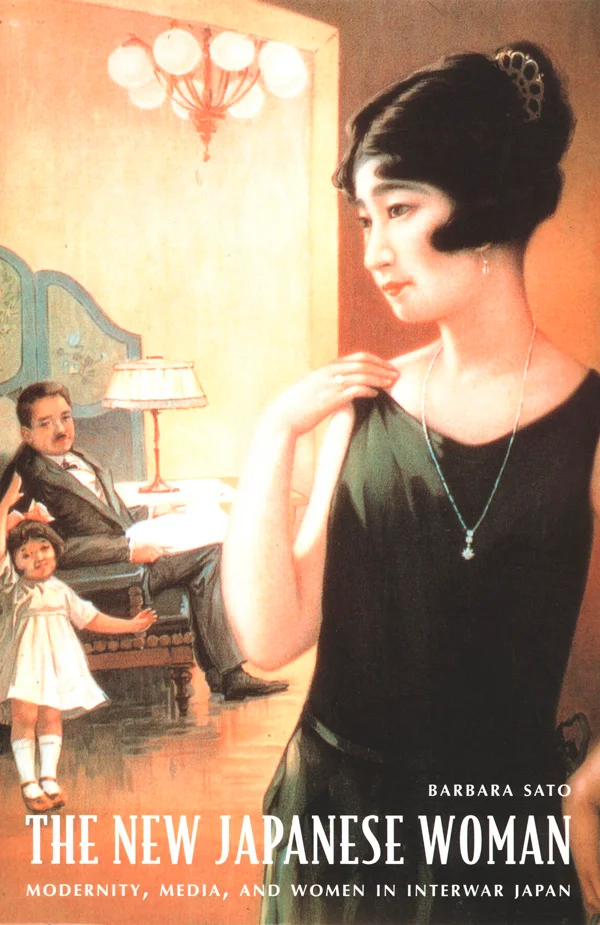
“Sato’s The New Japanese Woman is a delight to read. The attention to detail and historical context is impressive throughout the book. Her arguments are well supported by primary sources, statistics, and visual aids. The selection and number of illustrations provide wonderful corroborating evidence and truly enhance her points.” - Dina Lowy, H-Women, H-Net Reviews
"[An] excellent book that is well-written, solidly researched and beautifully illustrated." - Ronald P. Loftus , Gender Studies
"[B]eautifully illustrated. . . . [Sato's] book . . . adds greatly to understandings of the social and cultural history of Japan in the 1920s and the relationship of women to that history. In particular, it will be difficult for any researcher in the future to focus on mass culture in Japan without a careful examination of the ways in which women shaped mass culture, as well as the ways that popular culture changed the lives of women." - Sandra Wilson , Intersections
"[Sato's] research is thorough, and the extensive bibliography in both English and Japanese is impressive. The book makes a persuasive case for the centrality of popular culture in the creation of vernacular modernity." - Mitsuyo Wada-Marciano , Journal of Asian Studies
"[W]ell written and nicely illustrated. It leaves a strong sense of how women were shaping and were shaped by the media. Moreover, it provides a solid background for understanding the new millennium women in Japanese society. . . ." - Lisbeth Clausen, Copenhagen Journal of Asian Studies
"[W]onderfully illustrated. . . . Anyone working on gender in the interwar period will find a wealth of valuable material in this book; it provides what is probably the best exposition in English of the historical development of women's magazines and their promotion of consumerism in the 1920s. . . . [Sato's] book is a valuable contribution to the ongoing discussion of all these issues, and more, in interwar Japan. It is well worth reading." - Sharon Sievers , American Historical Review
"Essential reading for historians and other scholars of modern Japan, this book should also be of considerable interest . . . to others as well. The language is crisp and precise; translations are excellent; repeatedly, the general background to events is sketched skillfully; the presence of so many beautifully reproduced, relevant illustrations is a rare treat. Barbara Sato's careful attention given to the pre-1920s origins of her subjects and to related developments in later periods provides a clear historical context for the study. It was a pleasure to read it." - E. Patricia Tsurumi , Canadian Journal of History
"Sato has not only shed new light on middle-class women's agency; she has posed an important set of problems regarding gender, class, and mass in an era of dizzying technological transformation and dramatic social change." - David R. Ambaras , Monumenta Nipponica
"Sato succeeds in adding significantly to our understanding of gender in interwar culture." - Sally A. Hastings, Journal of Japanese Studies
"Sato's book is an interesting examination of consumerism and mass media's effect on the creation of the figure of the modern woman in Japan." - Merryon Ryall, M/C Reviews
"The great accomplishment of this book is not only the vivid presentation of the new woman, but the exploration of her femininity and the understanding that the modern girl, the housewife, and the working woman are the key to comprehending the roles and lives of women in Japan throughout the twentieth century. This book gives us both the perspectives and the methodology to unravel the tangled lives of Japanese women, even today." - Kazumi Ishi , Asian Studies Review
"This carefully researched monograph should become a heavily marked volume in the library of every English-reading scholar of Japanese women. . . . Sato has given us a treasure-trove of references to and beautifully translated quotations from the myriad mass women's magazines that were read by literate urban and rural women. . . . [E]xciting." - Helen Hopper , Journal of Social History
“Barbara Sato has produced a superb book on the construction of a new women's culture in Japan in the interwar period. In captivating detail, she documents the creation of a new subjectivity—'women'—through the interactions of middle-class women with consumer capitalism and the mass media. By showing us the myriad ways that women wrote themselves into the narratives of modernity, Sato's book opens up new ways of thinking about the relationship between women and the modern.” - Louise Young, author of Japan’s Total Empire
“In no other study of Japanese women are issues of gender and social history so magnificently intertwined. No other work in the English language provides such a detailed view of the multiple configurations of mass culture (film, radio, popular magazines, department stores, fashions, etc.) in the 1920s and 1930s. This is a remarkable accomplishment.” - Don Roden, author of Schooldays in Japan
“Now the 'new women’ of interwar Japan join their subversive sisters around the globe in this vivid presentation of the social imaginaries of the modern girl, the housewife, and the professional working woman of middle-class Tokyo. Self-consciously modern, they were also evoked by their critics to redefine modernity, though not necessarily in directions they themselves might have wished. A new story, an old story, well told and nicely illustrated.” - Carol Gluck, Columbia University