
Home / Books / To Make Negro Literature

To Make Negro Literature

Writing, Literary Practice, and African American Authorship
Book

Pages: 312

Illustrations: 26 illustrations

Published: October 2021

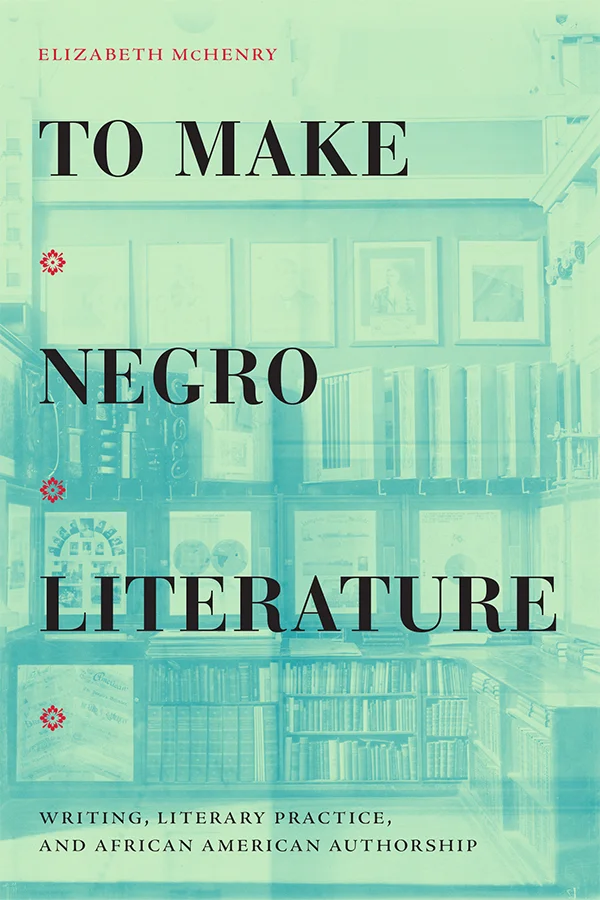
In To Make Negro Literature Elizabeth McHenry traces African American authorship in the decade following the 1896 legalization of segregation. She shifts critical focus from the published texts of acclaimed writers to unfamiliar practitioners whose works reflect the unsettledness of African American letters in this period. Analyzing literary projects that were unpublished, unsuccessful, or only partially achieved, McHenry recovers a hidden genealogy of Black literature as having emerged tentatively, laboriously, and unevenly. She locates this history in books sold by subscription, in lists and bibliographies of African American authors and books assembled at the turn of the century, in the act of ghostwriting, and in manuscripts submitted to publishers for consideration and the letters of introduction that accompanied them. By attending to these sites and prioritizing overlooked archives, McHenry reveals a radically different literary landscape, revising concepts of Black authorship and offering a fresh account of the development of “Negro literature” focused on the never published, the barely read, and the unconventional.

Praise

“From the title to the final words of her coda, Elizabeth McHenry provokes, persuades, and prods readers to apply thought to the knowledge presented in this book. It is a nuanced and wise offering of immaculate research and righteous rumination to anyone—whether the casual browser who never once thought about the topic or the most sophisticated scholar of Black culture generally and print culture particularly.” - Frances Smith Foster, author of ’Til Death or Distance Do Us Part: Love and Marriage in African America

“In this revelatory study, Elizabeth McHenry argues that the turn of the twentieth century, so often lamented as a nadir of race relations, was in fact the pivotal era when the infrastructure for the African American literary tradition was built. Looking behind the scenes to efforts that at first glance might seem perfunctory or crassly commercial (subscription bookselling services, printing presses, reading rooms, bibliographies), she unearths the enormous labor—albeit sometimes aborted or thwarted or unfinished—undertaken by writers and intellectuals in the period to create the very concept of ‘Negro literature’ as a viable publishing category as much as an ideological project linked to uplift and civil rights.” - Brent Hayes Edwards, author of Epistrophies: Jazz and the Literary Imagination

"This reviewer found especially engaging the author's assessment of Mary Church Terrell’s efforts to publish short stories and the records she kept (for posterity) of publishers’ rejections. Other chapters are equally engaging, revealing surprising information about the interstices of the African American literary tradition. In sum, this is a riveting, much needed account of the spaces between recognized African American literary success and the scaffolding that enables it. Essential. Lower-division undergraduates through faculty and professionals; general readers." - A. S. Newson-Horst, Choice

"McHenry teaches how to read the past in order to glean the lessons to be learned from defeat. If we study failure, we can learn about process, creativity, and the makings of literary culture in the US alongside the country’s history of racialized and gendered violence. . . .  By reading in this way, McHenry invites failure to speak and us to admit how it has made and shaped this literary history. Such reading reveals how Black authors have wrestled with and against 'what is.'" - Tara A. Bynum, Public Books

"McHenry thus challenges scholars to rethink what types of work receive critical attention. Instead of prizing only texts that are original, creative, and public, what if we attended more closely to pedagogical, utilitarian, and unpublished works? What would a bibliography of African American literature’s queer failure look like?" - Laura E. Helton, Bibliographical Society of America

"To Make Negro Literature does not brashly proclaim the renewal of African American, and, in fact, of American literary history, but instead proposes to subtly challenge the accepted narrative, by encompassing objects and individuals heretofore excluded from 'literature' and literary culture. . . . By suggesting that we turn to the 'underground' structures of literature, and consider failure as a form of resistance, Elizabeth McHenry invites us to think about the potentiality of literature, and of literariness." - Cécile Cottenet, Revue électronique d’études sur le monde anglophone

"A richly innovative archive of under-researched, though vital textual practices alongside defamiliarizing and thus generative readings of better-known ones. . . . The timely analytical and methodological interventions in To Make Negro Literature emerge from McHenry homing in on failed, unrefined, and workaday black texts." - Douglas A. Jones, Jr., American Literary History

"McHenry’s detailing of African American genres and authors that are commonly overlooked offers readers a more comprehensive view of African American literature during the late nineteenth and early twentieth centuries. Readers of McHenry’s book are called to appreciate noncanonical African American literature through her clear explanations. . . . This book will interest scholars of African American literature, especially those who wish to learn more about unfamiliar writers and works." - Courtney Walton, European Journal of American Studies

"A luminous venture into a little-known corner of African American literary history." - Sara Rutkowski, Journal of Southern History

"To Make Negro Literature is an archivally rich, lucidly written, substantial, and award-winning contribution to our ever-deepening understanding of African American literary history. . . . . It is no overstatement to conclude that if literature scholars in all fields apply McHenry’s generous example to other authors, works, and times, we stand to gain an immeasurably more inclusive understanding of literary history and theory, with the potential to do much greater justice to people and literatures of the past, present, and future." - Marcy J. Dinius, MLQ

"This volume mines unexamined archives and neglected fields of thought to sketch out why failed publications, bankrupt publishing ventures and disdained modes of textual distribution fundamentally constructed a world in which Black writing and the powerful ideas about social and cultural values could emerge as we see them today." - Susanna Ashton, Criticism

"By reorienting archival research . . . and instead focusing on instances of what she calls literary 'failure'—unpublished stories, unfinished encyclopedias, frustrated careers—McHenry’s latest makes an invaluable contribution to the theory and practice of Black archival and print culture studies." - Marc Blanc, Journal of the Midwest Modern Language Association

Buy

Availability: Loading...

Price: Loading...

Open Access

Read OA Edition

Funding information for the OA format is found at the bottom of the page.

Request a desk or exam copy

Information

Author/Editor Bios

Back to Top
Elizabeth McHenry is Professor of English at New York University and author of Forgotten Readers: Recovering the Lost History of African American Literary Societies, also published by Duke University Press.

Table Of Contents

Back to Top
Acknowledgments  ix
Introduction. To Make Negro Literature  1
1. "The Information Contained in This Book Will Never Appear in School Histories": Progress of a Race and Subscription Bookselling at the End of the Nineteenth Century  23
2. Thinking Bibliographically  78
3. Washington's Good Fortune: Writing and Authorship in Practice  129
4. The Case of Mary Church Terrell  188
Coda. Underground Railroads of Meaning  235
Notes  239
Bibliography  269
Index  285

Rights

Back to Top

Sales/Territorial Rights: World

Rights and licensing

Awards

Back to Top

Winner of the 2022 DeLong Book History Prize, presented by the Society for the History of Authorship, Reading, and Publishing (SHARP)

Honorable Mention, 2022 William Sanders Scarborough Prize, presented by the Modern Language Association

Co-Winner of the 2023 St. Louis Mercantile Library Prize, awarded by the Bibliographical Society of America

Additional Information

Back to Top
Related Links Paper ISBN: 978-1-4780-1451-5 / Hardcover ISBN: 978-1-4780-1359-4 / eISBN: 978-1-4780-2181-0 / DOI: https://doi.org/10.1215/9781478021810

Funding Information

Back to Top
This book is freely available in an open access edition thanks to TOME (Toward an Open Monograph Ecosystem)—a collaboration of the Association of American Universities, the Association of University Presses, and the Association of Research Libraries—and the generous support of New York University. Learn more at the TOME website.