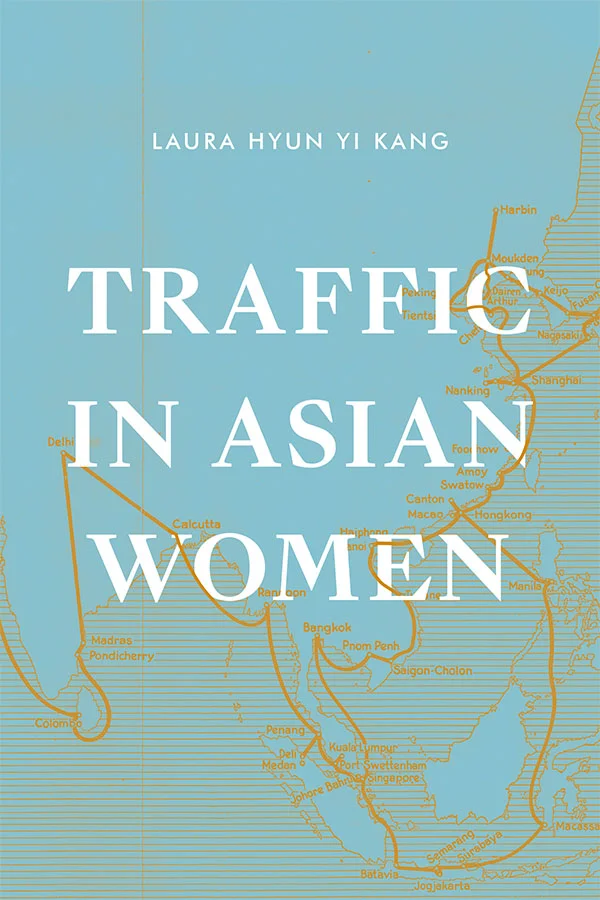
“Deeply thought-provoking and powerfully written, Traffic in Asian Women is an eminently illuminating examination of the contradictory figuration of ‘Asian Women.’ Laura Hyun Yi Kang offers a singular model of critically erudite, deeply engaged scholarship.” - Lisa Yoneyama, author of Cold War Ruins: Transpacific Critique of American Justice and Japanese War Crimes
“Traffic in Asian Women is a meticulously researched, thoroughly compelling, and persistently incisive study. It is a book full of brilliance, one that shows us how to conduct outward facing, politically engaged research in ways that enact intersectional thinking, not only in research but as a way of relating to the world.” - Kandice Chuh, author of The Difference Aesthetics Makes: On the Humanities “After Man”
“This is a mode of feminist writing that rejects faith in the twinned powers of exposure and expertise…. Kang’s deft history skips a stone across regimes of visibility and governance, alighting on their connective systems instead of laying claim to the subjects inside.” - Zoë Hu, Baffler
“Through its detailed historiography, [Traffic in Asian Women] documents how multiple political, legal, and ethical frameworks have ultimately proved inadequate to fully acknowledge violence against Asian women throughout the twentieth century and beyond.” - Kodai Abe, Journal of Asian American Studies
“Traffic in Asian Women is a generative text for scholars of the comfort system and its legacies, Asian Studies, transnational American and Asian American Studies, and Gender and Sexuality Studies, among others.... Kang demonstrates the value of continuously learning from those possessing intimate knowledge about experiences of racial and gendered violence and living their effects.” - Nicolyn Woodcock, American Studies
“While written for practitioners of U.S. women’s, gender, and sexuality studies, American studies, and Asian American studies, [Traffic in Asian Women] is likely to appeal to social work scholars and policymakers interested in questions of intersectionality, critical race and ethnic studies, cultural production, human rights, transnational feminism, and social movement.” - Alexa Ploss, Affilia
“Although Traffic in Asian Women is ostensibly a reconsideration of history, . . . Kang's main interest is in the present and future—in shifting the efforts of those who claim to be feminists and/or human rights activists toward a wider sphere of current injustices. . . . Kang's is a powerful polemic.” - Margaret D. Stetz, History Teacher
"Traffic in Asian Women challenges both scholars and activists who have been engaged with the problematics of the comfort women. With erudition and sharp criticism, Kang persuasively explains how institutionalized discourses of feminism and US interests in global governance have both informed and constrained the movements to bring justice to the women forced to serve in the Japanese military’s sex slavery." - Yumi Moon, Journal of Korean Studies
"Challenging readers’ impulse to seek a neat narrative, Kang’s book successfully fulfills her goal to “have ‘Asian women’ mean less intensely and matter more broadly."" - Juwon Lee, International Feminist Journal of Politics