
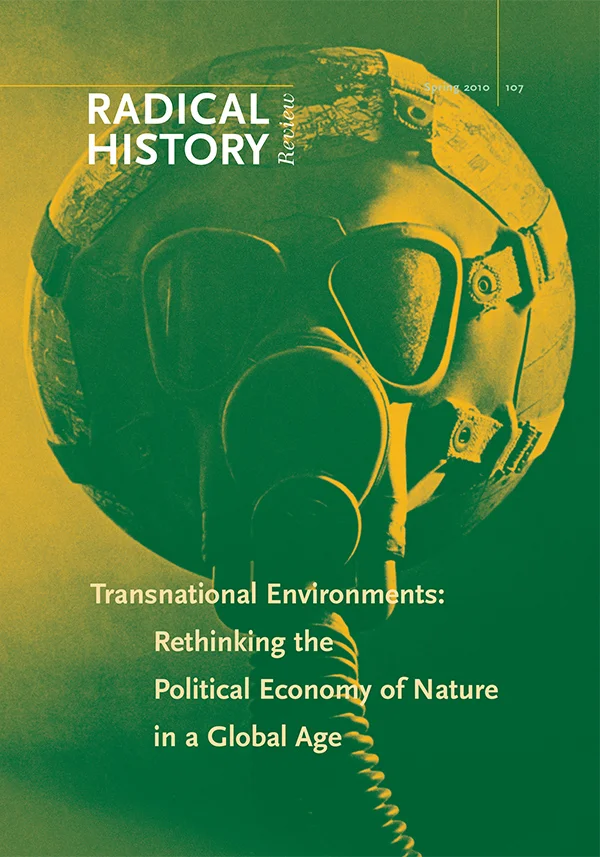
Transnational Environments
Rethinking Nature and Politics in a Global Age
An issue of: Radical History Review
Special Issue Editors: David Kinkela and Neil M. Maher
Buy
For more information or to access this journal, visit the Radical History Review page.
Price: Loading...
Information
Table Of Contents
Back to Top1. Editors' Introduction–David Kinkela and Neil M. Maher
INTERVENTIONS
2. Can Capitalism Save the Planet?: On the Origins of Green Liberalism–Ted Steinberg
3. Swapping Air, Trading Places: Carbon Exchange, Climate Change Policy, and Naturalizing Markets–Mart A. Stewart
FEATURES
4. Latex and Blood: Science, Markets, and American Empire–Gregg Mitman and Paul Erickson
5. Flexible Fishing: Gender and the New Spatial Division of Labor in Eastern Indonesia's Rural Littoral–Jennifer L. Gaynor
INTERVIEWS Back
6. Revisiting a "World without Borders": An Interview with Donald Worster–David Kinkela and Neil M. Maher
REFLECTIONS
7. Mercury's Web: Some Reflections on Following Nature across Time and Place–Michael Egan
8. Rural Electrification as a "Bioterritorial" Technology: Redefining Space, Citizenship, and Power during the New Deal–Samer Alatout and Chelsea Schelly
TEACHING RADICAL HISTORY Back
9. Contemplating Animal Histories: Pedagogy and Politics across Borders–Thomas G. Andrews
CURATED SPACES
10. Urban Images from "World View of Global Warming"–Gary Braasch
11. Vicissitudes of Urban Nature: Transitions and Transformations at a Global Scale–Matthew Gandy
(RE)VIEWS Back
12. Commodities, Colonial Science, and Environmental Change in Latin American History–Mark Carey
13. Recent Developments in Transnational Environmental History: Labor, Settler Communities, and Comparative Histories–Sterling Evans
14. World Environmental History: Nature, Modernity, and Power–Robert B. Marks