
Home / Journals / Radical History Review / Walkers, Voyeurs and the Politics of Urban Space

Walkers, Voyeurs and the Politics of Urban Space

An issue of: Radical History Review
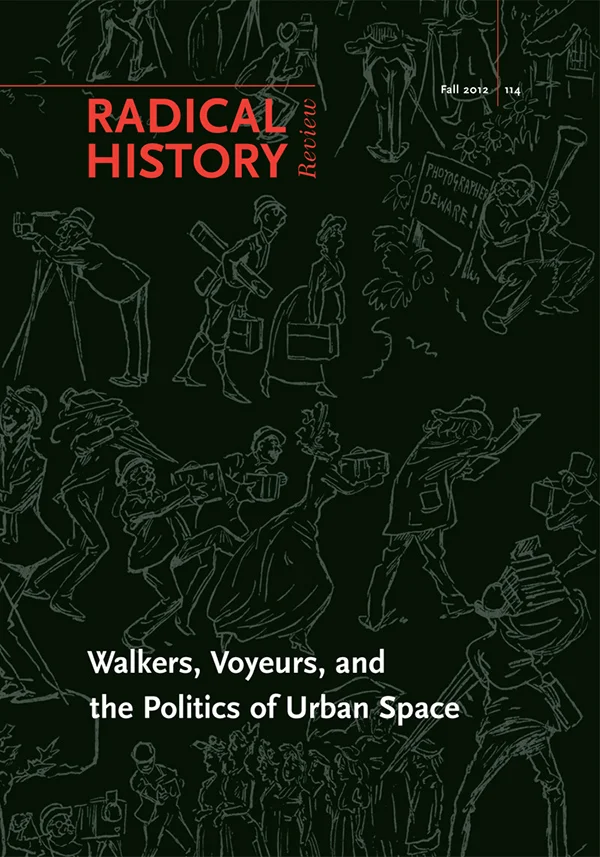
RHR 12:3 (114) cover image

Journal Issue

Pages: 224

Volume 12, Number 3

Published: Fall 2012

An issue of: Radical History Review

Special Issue Editors: Robyn Autry, Daniel J. Walkowitz

Urban engagement and experience of city spaces takes many forms, but walking-and how we do it-has always been central to the urban experience.  Indeed, urbanites defined the parameters of the "walking city" historically by the time it took them to traverse space between home and work.  But the practice of walking city streets was and is fraught with social meaning.  The imagined urban walker occupies a commanding position in the way city officials and planners seek idealized settings for social, cultural, and economic exchanges.  Their visions shape the practice of walking through the use of street signs, traffic lights, trails, historical markers, and other visual cues and technologies designed to control the production and experience of street life.  Even in ostensibly progressive initiatives, such as the greening and re-pedestrianizing of cities, assumptions about active mobility and visible publics shape official narratives of urban life. The postwar growth of the walking tour industry and the reimagining of old industrial cities as sites for memorializing versions of the past has arisen alongside increasing post 9/11 concerns – indeed, near obsessions -- with the surveillance of dangerous bodies.   The historical – what is to remembered and animates how people walk the city, and in tours, are instructed as to its meaning.  However, as residents and visitors themselves navigate these streets, they produce their own meanings and strategies of maneuver, illuminating how the politics and social construction of walking from one street to another are contested, unstable and may differ in any given time period.  This volume take us across time and space to historicize and reconsider the flaneur as the iconic bystander to the spectacle of urban life and change.

Buy

For more information or to access this journal, visit the Radical History Review page.

Availability: Loading...

Price: Loading...

Request a desk or exam copy

Information

Additional Information

Back to Top
Paper ISBN: 978-0-8223-6779-6 /